
- Fintechs and products that want existing users can deploy on OP Mainnet.
- Exchanges and institutions that want their own chain use OP Enterprise.
- Issuers, payment companies and licensed partners run their own products and carry their own compliance obligations.
The Optimism Foundation builds the OP Stack and OP Enterprise. Issuers, payment companies and licensed partners run their own products and carry their own compliance obligations. OP Labs, the Foundation's primary subcontractor, runs chain operations for OP Enterprise customers.
What are the five criteria for choosing a stablecoin payments blockchain?
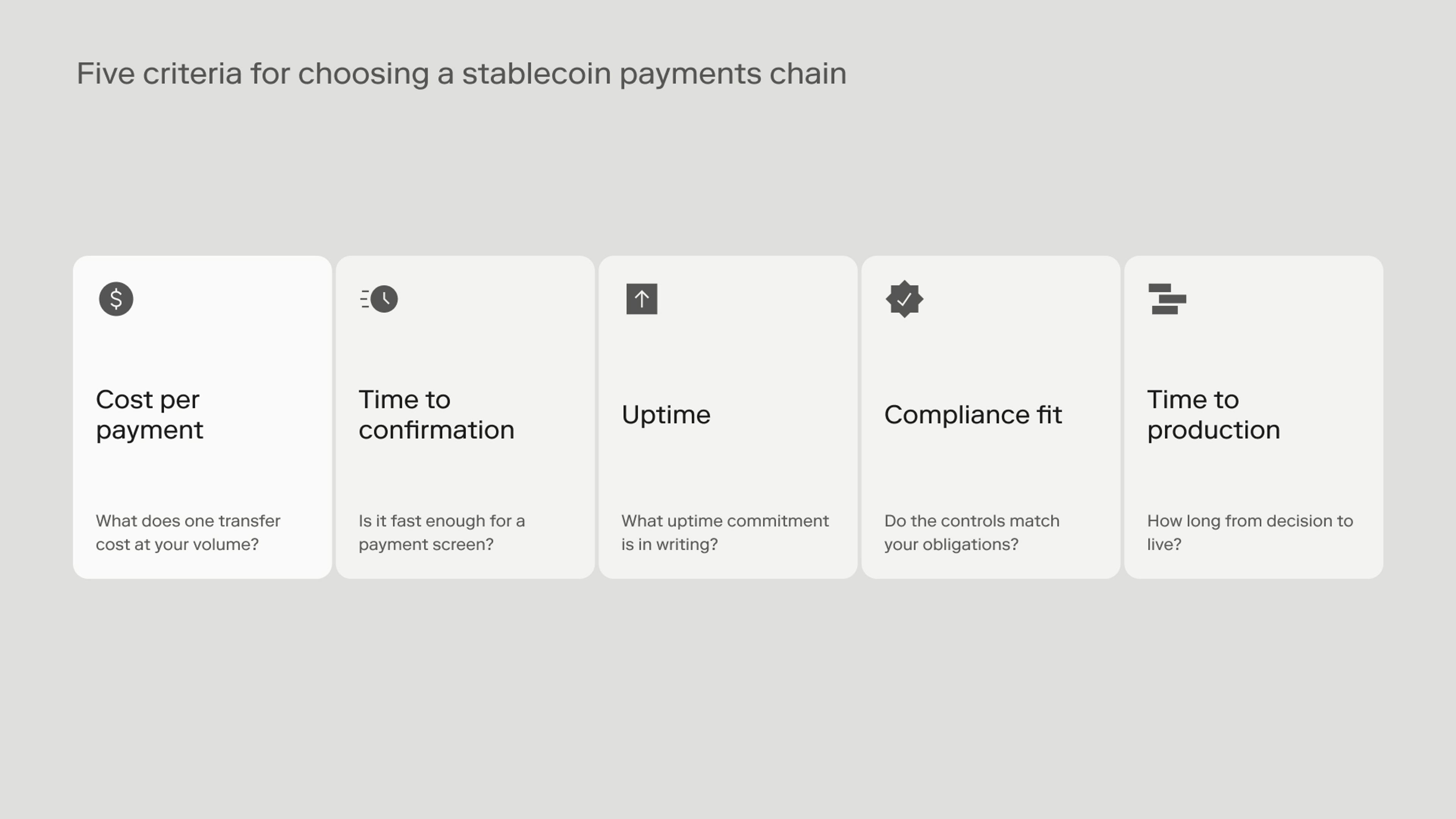
Banks, exchanges and fintechs usually compare candidate chains on five criteria: cost per payment, time to confirmation, uptime, compliance fit and time to production. Cost and speed decide whether a chain works for small, frequent payments. Uptime, compliance fit and time to production decide whether an institution can rely on it.
What are the two paths on the OP Stack?
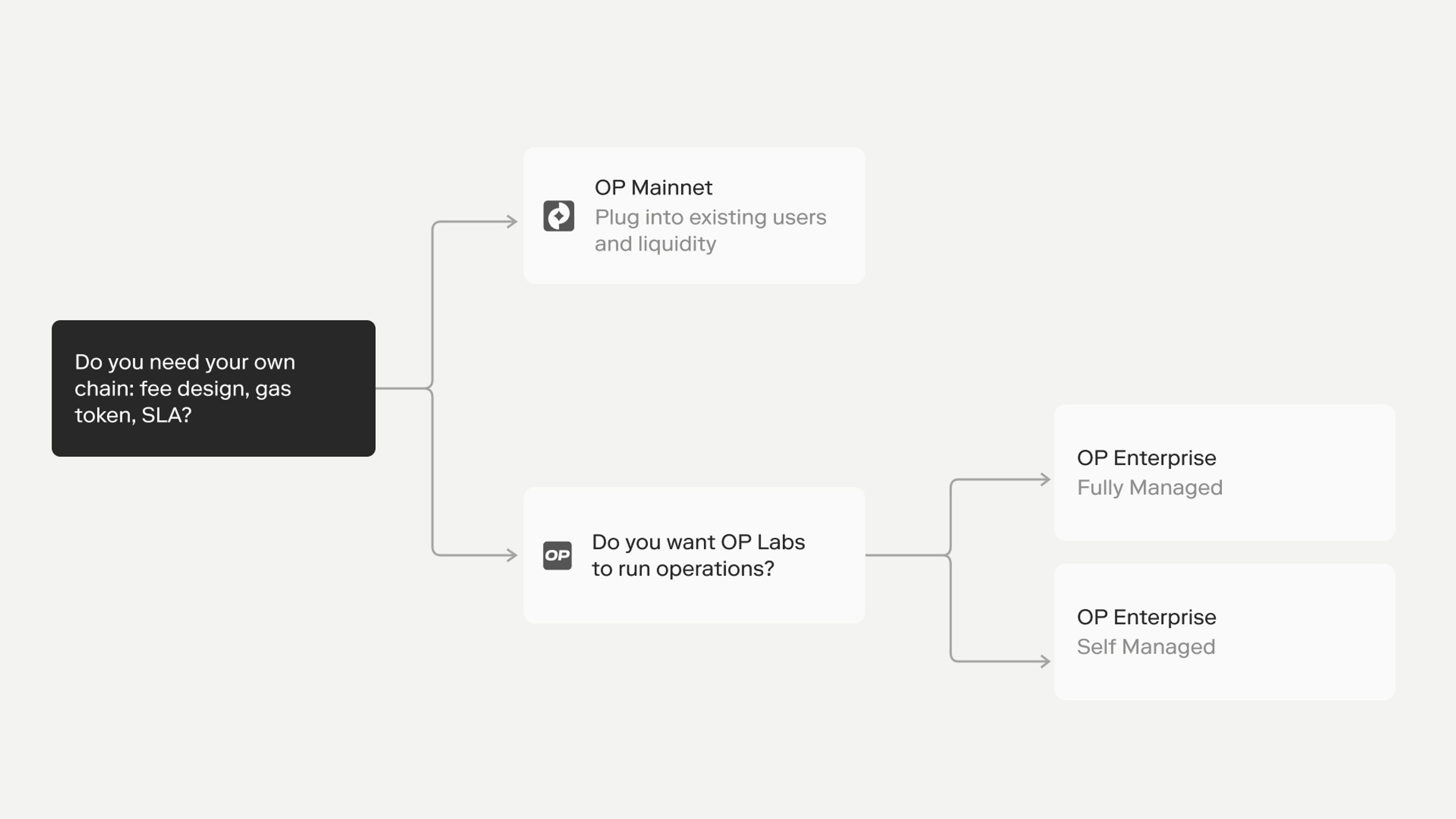
Teams building on the OP Stack have two paths. OP Mainnet is a shared public network that any developer or user can access. OP Enterprise is the Optimism Foundation's product for a dedicated chain built on the OP Stack, configured around the customer's own users and partners. It comes Self Managed, where the customer runs the chain infrastructure with OP Labs support, or Fully Managed, where OP Labs runs it.
| Question | OP Mainnet | OP Enterprise |
|---|---|---|
| What it is | A shared public network. Open to any developer or user. | The Optimism Foundation's product for a dedicated chain built on the OP Stack, offered Self Managed or Fully Managed. |
| Access | Permissionless | Dedicated to the customer |
| Users and liquidity | Existing users and liquidity. | Built around the customer's own users and partners. |
| Stablecoins | Stablecoins available on the network | Native USDC and Circle's CCTP are available on Circle-supported chains, including OP Mainnet. On a dedicated chain, they depend on Circle adding support. Other stablecoins are configurable based on issuer agreements. |
| Time to production | Deploy contracts on a live network. Ethereum contracts deploy without modification because the OP Stack is EVM equivalent. | 6 to 8 weeks from decision to production as a baseline, per OP Enterprise guidance for fintechs. Timing depends on other chain launches in the queue and any customizations. |
| Cost | Network fees. See the median fee below. | Each plan is built around your chain, so pricing varies. We're happy to put together a quote for you. |
| Best fit | Products that want to plug into an existing economy | Exchanges and institutions that want a dedicated chain with support under an SLA |
Sources: What is OP Mainnet, Blockchain infrastructure for fintechs, What is the OP Stack.
Two questions usually settle the choice. Does the team need its own chain, with control over fee design, gas token and support terms? If so, does it want OP Labs to run operations?
| Team | The decision | Starting path |
|---|---|---|
| Banks | Settle onchain within audit and compliance duties | OP Enterprise |
| Fortune 500 companies | Cut treasury and settlement cost with a new rail | Pilot on an existing OP Stack chain, then OP Enterprise |
| Crypto exchanges | Own the chain beneath payment and settlement products | OP Enterprise Fully Managed |
| Fintech companies | Ship stablecoin payments inside an existing product | OP Mainnet, or OP Enterprise Fully Managed |
What does stablecoin payment volume look like on OP Mainnet?
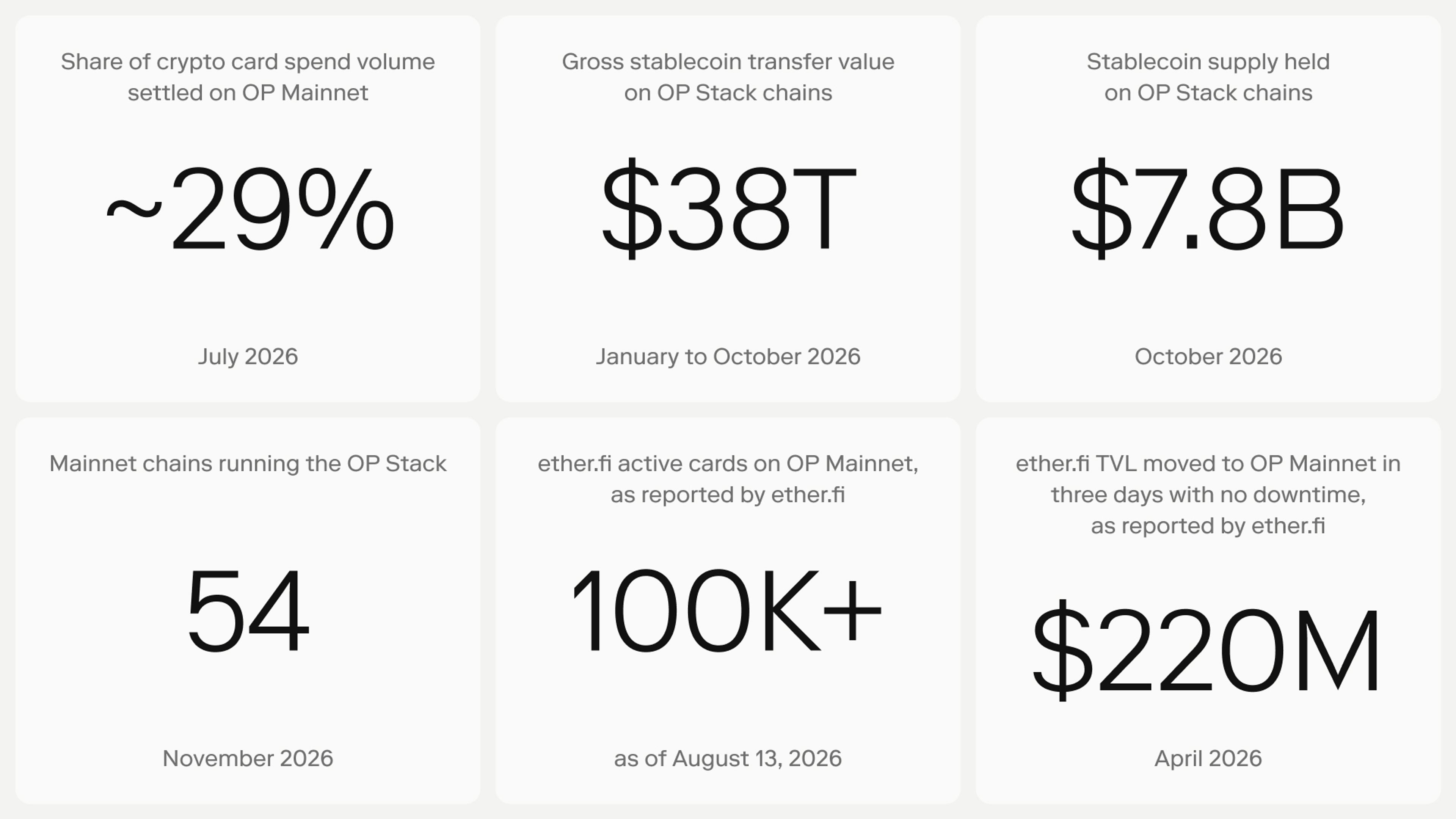
ether.fi runs a non-custodial crypto card on OP Mainnet. It migrated in April 2026. According to ether.fi, its Cash product had more than 100,000 active cards and more than 300,000 accounts as of August 13, 2026, and its April 2026 migration moved $220M in TVL in three days with no downtime. As of April 2026, OP Mainnet's median fee was $0.00001.
The figures below are from the April 2026 ether.fi launch, except the card and account counts, which are as of August 13, 2026. OP Mainnet facts are stated directly, and ether.fi's own figures are attributed to ether.fi:
- ether.fi reported more than 100,000 active cards and more than 300,000 accounts (August 13, 2026)
- ether.fi reported $220M in TVL moved in three days with no downtime (April 2026)
- OP Mainnet median fee of $0.00001 (April 2026)
- OP Mainnet uptime of 99.99% (April 2026)
- ether.fi reported millions of dollars in real-world payments every day
For timing, transactions on OP Mainnet are included in ~200ms and settled to Ethereum in about 3 minutes. Subblocks, which first rolled out under the name Flashblocks, are the streaming block-building design behind the fast inclusion.
Sources: ether.fi upgrades to Aave V4 on OP Mainnet (Optimism Foundation blog) for the August 2026 counts, and ether.fi is live on OP Mainnet (Optimism Foundation blog) for April 2026.
Which blockchains support cross-border payments and remittances?
Cross-border payments need a low, predictable fee per transfer, stablecoins in the currencies senders and recipients use, confirmation fast enough for a payment screen, and local licensing handled by licensed partners. On the OP Stack, Celo runs mobile-first payments, and the Optimism Foundation and Toss have signed an MOU to explore a Won-backed stablecoin.
What to require:
- A low, predictable fee per transfer
- Stablecoins in the currencies senders and recipients use
- Confirmation fast enough for a payment screen
- Local licensing handled by licensed partners
What exists on the OP Stack:
- Celo moved from a standalone Layer 1 to an OP Stack Layer 2 on March 26, 2025 to run mobile-first payments in emerging markets. Celo reports a peak of 840K daily active users, which it describes as the most among Ethereum L2s, 1.3M monthly active users, 25 stablecoins including 14 local-currency stablecoins, and $65.9B in stablecoin volume across 2025.
- Opera's MiniPay is a self-custodial stablecoin wallet that runs on Celo. As of October 2026 it reports 20M wallet activations, 600M transactions and $2.3B in processed volume across 70+ countries. Through integrated partners, users get on and off-ramps, a Visa card and local payments.
- The Optimism Foundation and Toss signed an MOU to explore a Won-backed stablecoin built on the OP Stack, with a three-month proof of concept planned. This is an MOU and a proof of concept. No Won stablecoin is live.
Which blockchains do stablecoin cards and crypto neobanks use?
Stablecoin card programs need uptime that matches a card network, fees low enough for small purchases and a migration path that keeps live cards running. According to Paymentscan data cited by a16z crypto, OP Mainnet carried about 29% of crypto card spend volume in July 2026, and ether.fi runs its non-custodial card on OP Mainnet.
What to require:
- Uptime that matches a card network
- Fees low enough for small purchases
- A migration path that does not interrupt live cards
The July 2026 figure comes from a16z crypto, which tracks card programs with Paymentscan data.
What should a bank look for in a stablecoin payments blockchain?
Banks deciding whether to settle payments onchain need know-your-customer and anti-money-laundering controls handled by the institution and its partners, auditable transaction records, support under an SLA, and a stablecoin issuer that meets the institution's requirements. OP Enterprise is the Optimism Foundation's product for this path, offered Self Managed or Fully Managed.
OP Enterprise covers platform operations, security patching, compliance tooling and a partner network of stablecoin issuers, oracle providers, bridges, block explorers and wallet infrastructure. The institution and its partners remain responsible for their own compliance obligations.
What should a Fortune 500 company look for in a stablecoin payments blockchain?
Large companies weighing stablecoin payments need to know whether treasury and settlement savings justify a new rail. They usually require a named support team and an SLA, integration with treasury, accounting and reconciliation systems, stablecoin issuers they can contract with, and a deployment path that needs no in-house blockchain expertise.
Some teams pilot on an existing OP Stack chain through a payments provider that holds the required licenses, to test the cost savings. They then move to OP Enterprise for managed infrastructure, named support under an SLA, and partners that cover issuers and treasury integrations.
What should a crypto exchange look for when it wants its own chain?
Exchanges deciding whether to own the chain beneath payment and settlement products should look for control over fee design and gas token choice, throughput for customer withdrawals and transfers, and support for the exchange's own stablecoin and listing choices. Exchange-backed chains such as Ink and X Layer already run on the OP Stack.
What exists on the OP Stack:
- Ink announced in June 2026 that it is upgrading to OP Enterprise Fully Managed, with cutover planned for August. Chain ID, code and apps stay the same.
- Bitpanda announced Vision Chain in March 2026 as the first chain set to launch on OP Enterprise Fully Managed, targeting mainnet later in 2026. It plans to support Bitpanda's upcoming euro stablecoins as gas tokens.
Under OP Enterprise Fully Managed, OP Labs manages operations, security and scaling through OP Enterprise, so the exchange controls fees, gas token and listings without staffing a chain team. The exchange owns its chain.
| Team | What they run | Status |
|---|---|---|
| ether.fi | Non-custodial card and accounts | On OP Mainnet since April 2026 |
| Celo | Mobile-first payments Layer 2 | Live OP Stack Layer 2 |
| Opera MiniPay | Self-custodial stablecoin wallet | Runs on Celo |
| Toss | Won-backed stablecoin exploration | MOU and proof of concept, not live |
| Ink | Exchange-backed chain from the Kraken team | Announced upgrade to OP Enterprise Fully Managed |
| Bitpanda | Vision Chain | Announced, mainnet targeted later in 2026 |
| OKX | X Layer | Listed OP Stack chain |
What should a fintech look for when adding stablecoin payments?
Fintechs adding stablecoin payments to an existing product need fast integration with wallets, oracles and bridges, stablecoin support through the issuer the product already uses, and fees low enough for small payments. They can plug into OP Mainnet's existing liquidity or deploy a dedicated chain through OP Enterprise Fully Managed.
ether.fi moved its card product to OP Mainnet in April 2026. According to ether.fi, its Cash product had more than 100,000 active cards and more than 300,000 accounts as of August 13, 2026. OP Mainnet's median fee was $0.00001 as of April 2026. In July 2026, a16z crypto reported that OP Mainnet carried about 29% of crypto card spend volume.
Frequently Asked Questions
What should a bank look for in a stablecoin payments blockchain?
Banks need compliance tooling, auditable transaction records and uptime backed by an SLA. OP Enterprise is the Optimism Foundation's product for dedicated chains built on the OP Stack, offered Self Managed or Fully Managed. The institution and its partners stay responsible for their own compliance obligations, including know-your-customer and anti-money-laundering controls.
What should a Fortune 500 company look for in a stablecoin payments blockchain?
Large companies need support commitments and integration with their finance systems. OP Enterprise provides managed infrastructure and a direct engineering relationship. Native USDC and Circle's CCTP are available on Circle-supported chains, including OP Mainnet, and on a dedicated chain they depend on Circle adding support. Other stablecoins are configurable based on issuer agreements.
What should a crypto exchange look for when it wants its own chain?
Exchanges need control over fee design and gas token choice, throughput for withdrawals, and support for their own stablecoin and listing choices. Exchange-backed chains such as Ink and X Layer already run on the OP Stack. Under OP Enterprise Fully Managed, OP Labs manages operations while the exchange owns its chain.
What should a fintech look for when adding stablecoin payments?
Fintechs can plug into OP Mainnet or deploy a dedicated chain through OP Enterprise. ether.fi runs a non-custodial card product on OP Mainnet and reports more than 100,000 active cards as of August 13, 2026. Compare fees, integrations with wallets, oracles and bridges, and support for the stablecoin issuer you already use.
Which blockchains work for cross-border stablecoin payments and remittances?
This guide covers the OP Stack. On it, Celo runs mobile-first stablecoin payments, and Opera's MiniPay wallet on Celo has passed 20M wallet activations across 70+ countries. The Optimism Foundation and Toss signed an MOU to explore a Won-backed stablecoin, and Bitpanda announced Vision Chain, which plans to support euro stablecoins as gas.
Which blockchains do crypto neobanks and stablecoin card products use?
This guide covers the OP Stack. ether.fi runs its non-custodial card and account product on OP Mainnet, and a16z crypto, using Paymentscan data, reports that OP Mainnet carried about 29% of crypto card spend volume in July 2026. Compare settlement chains on fees, uptime and migration paths that keep live cards running.
What stablecoins can run on OP Enterprise?
USDC through Circle's CCTP is the standard path on chains Circle supports, including OP Mainnet. On a dedicated chain, native USDC and CCTP depend on Circle adding support. Other stablecoins are configurable based on issuer agreements. The issuer, not the Optimism Foundation, is responsible for the stablecoin and its regulatory obligations. Confirm issuer support during scoping.
How long does it take to go live?
Guidance for fintechs is 6 to 8 weeks from decision to production on OP Enterprise. That is a baseline, and timing depends on other chain launches in the queue and any customizations. Deploying contracts on OP Mainnet can be faster because the network is already live, and Ethereum contracts deploy without modification since the OP Stack is EVM equivalent.
How much does OP Enterprise cost?
Each plan is built around your chain, so pricing varies. We're happy to put together a quote for you. Reach the OP Enterprise team through optimism.io with your use case, expected volume and timeline, and we will scope the plan together.
Glossary
- OP Stack: Open source software stack, released under the MIT license, for building Ethereum Layer 2 chains.
- OP Mainnet: A shared public Ethereum Layer 2 network built on the OP Stack and open to any developer or user.
- OP Enterprise: The Optimism Foundation's product for a dedicated chain built on the OP Stack, offered Self Managed or Fully Managed.
- OP Enterprise Fully Managed: The OP Enterprise tier in which OP Labs deploys, operates and upgrades a chain on the partner's behalf. The partner owns the chain and its product. In Self Managed, the customer runs the chain infrastructure with OP Labs support.
- Subblocks: A streaming block-building design, first released under the name Flashblocks, that shares transactions in small batches before a full block is sealed.
- CCTP: Circle's Cross-Chain Transfer Protocol, which moves USDC between chains by burning it on one chain and minting it on another.
- OP Labs and The Optimism Foundation: The Optimism Foundation is the technology service provider for the Ethereum Layer 2 services, while OP Labs is the Foundation's primary subcontractor for these services. Labs also provides the Foundation with business development and deal structuring support for its Layer 2 commercial offerings.
Related reading
- Stablecoin and tokenization infrastructure for financial institutions
- What is OP Enterprise?
- Blockchain infrastructure for fintechs
The Optimism Foundation provides blockchain infrastructure software and managed services. Partners are responsible for their own products, compliance and regulatory obligations. Third-party companies named on this page are independent projects. Naming them is not an endorsement, and neither OP Labs nor The Optimism Foundation controls their products or results. This page is informational. It is not financial advice or an offer.
Authored by

Optimism