
ether.fi outgrew its own lending engine, so it upgraded to Aave V4 on OP Mainnet

ether.fi Cash, one of the largest crypto cards in the world, has moved its credit backend to a dedicated Aave V4 instance on OP Mainnet. It's one of Aave V4's first Layer 2 deployments, with ether.fi targeting $500 million in lending capacity by 2027.
The scale
More than 100,000 people carry an active ether.fi Cash card. Over 300,000 accounts use it. Cardholders spend against their crypto at the point of sale. It's one of the largest crypto cards in the world, part of a platform with more than $6B in TVL across Cash, Stake, and Liquid, and it's been running in production on OP Mainnet the whole time.
“Consumers are looking for more ways to put their digital assets to work. ether.fi Cash is helping bridge onchain capital with everyday spending, and we're excited to support its continued growth.”

What launched
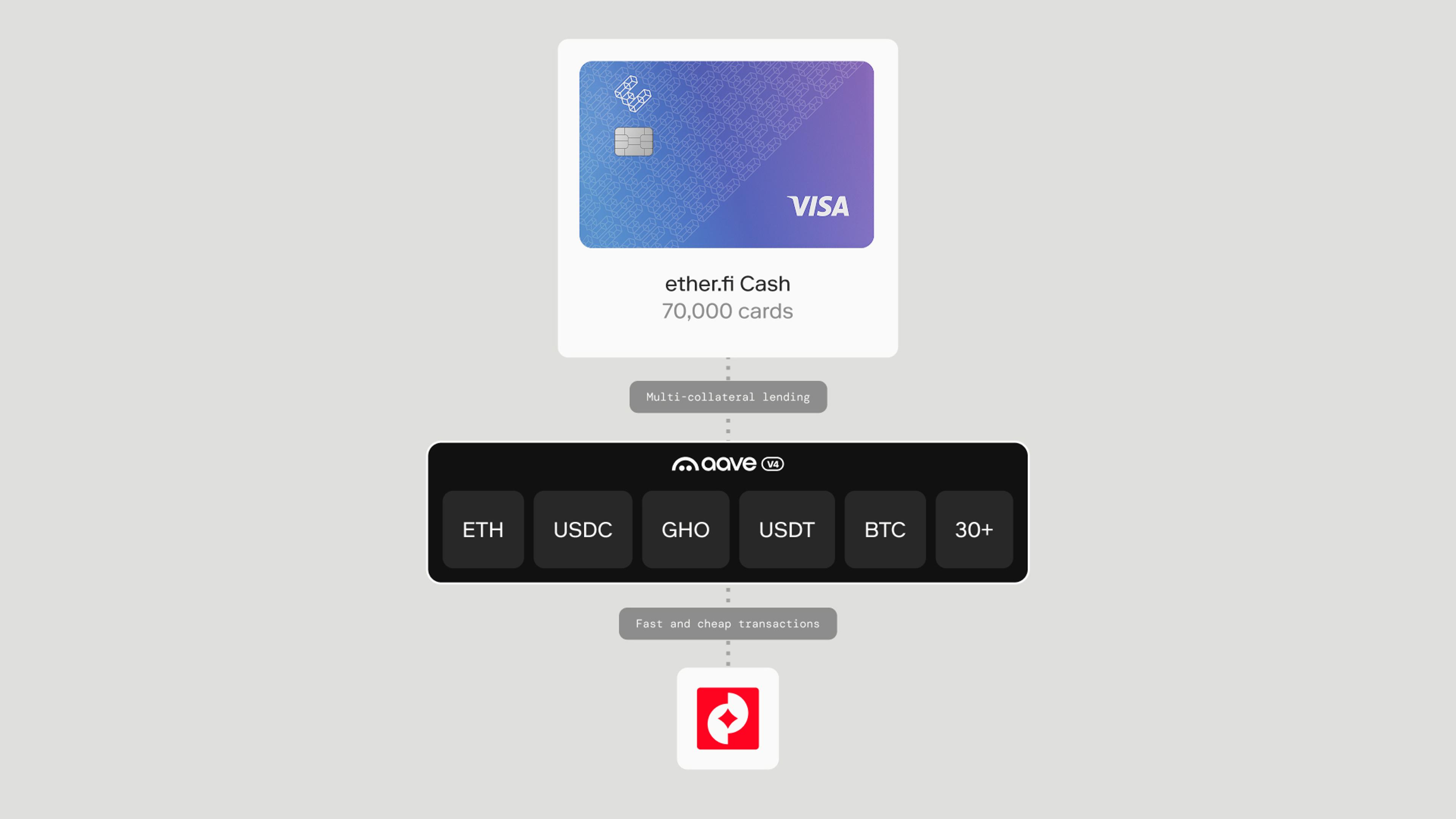
A dedicated, ether.fi-operated Aave V4 instance is now live on OP Mainnet, powering Cash's credit backend. It replaces the Debt Manager, the in-house lending system that took Cash from zero to its current scale, and it cleared the full Aave DAO governance process: TEMP CHECK, ARFC, and AIP. It's one of Aave V4's first Layer 2 deployments.
“ether.fi Cash was built to prove that crypto and everyday spending aren't separate worlds. Aave and Optimism are the right partners to help us scale from tens of millions to half a billion dollars in lending capacity. Aave's V4 architecture gives us the flexibility to underwrite against the diverse collateral our users actually hold, and Optimism's infrastructure gives us the speed and cost profile consumers expect. This partnership is about making it possible for anyone holding digital assets to use them like real financial capital, without ever having to sell.”
The problem
Cardholders hold a wide range of assets at once: Ethereum derivatives, wrapped Bitcoin, stablecoins, platform tokens, vault receipts, and more. Each one needs to work as collateral in the same market, with its own risk parameters set correctly. Building and running that infrastructure in-house got harder as Cash grew. Success outgrew the software.
Why Aave V4
So ether.fi upgraded. It chose Aave V4. V4's hub-and-spoke architecture lets one capital hub serve multiple borrow markets, comes with a published audit history, an established liquidation system, and existing price feeds already in place. The deployment also brings GHO, an Aave stablecoin, to OP Mainnet as a natively issued stablecoin, backed by an Aave-deployed GHO Stability Module.
“Aave V4 provides foundational lending infrastructure tailored for ether.fi's product and user base. V4 enables ether.fi Cash to support a broad range of digital assets within a single lending market, giving users access to deep liquidity while allowing ether.fi to retain full control over market configuration and risk management.”

Why OP Mainnet
Cash already ran in production on OP Mainnet before this move, so the upgrade expands a live product instead of standing one up from nothing. Real-time borrowing at the point of sale needs execution that's fast and cheap enough to clear at checkout. OP Mainnet does that at consumer scale, with the DeFi liquidity nearby to fund the borrowing.
“I've frequently heard that 'normal' people will never use crypto in their daily lives, but ether.fi Cash has provided 100,000 reasons to believe otherwise. This new partnership happened because ether.fi Cash had a great problem to solve: how to meet overwhelming demand from retail consumers using their cards.”

For cardholders
For a cardholder, nothing about the app changes. Turn on Borrow Mode, and a purchase gets funded by collateralizing crypto you already hold and borrowing a stablecoin (USDC or GHO) that settles the transaction in real time. Repayment terms, collateral requirements, and liquidation conditions are set by ether.fi.
For depositors
Stablecoins can be supplied permissionlessly to the instance on OP Mainnet, and that supply funds cardholder borrowing and gets repaid with interest as balances come down. Supply is open on OP Mainnet, and operates according to the parameters and mechanics of the Aave V4 instance; users may also be subject to the terms of the interface used to access it. Borrowing remains permissioned and is limited to ether.fi's KYC'd cardholders spending in Borrow Mode.
The numbers
Cardholders are currently borrowing roughly $22 million against their digital assets. ether.fi is aiming to grow that to $500 million in lending capacity by 2027. The Optimism Foundation is supporting the launch with treasury liquidity and a joint incentive package alongside ether.fi.
Part of a pattern
This lands alongside a run of financial institutions choosing OP Mainnet and the OP Stack for real infrastructure: Toss piloting a Won-backed stablecoin in Korea, Bitpanda's Vision Chain in Europe, Mitsui bringing tokenized metals onchain in Japan. Now a live consumer credit product, used by tens of thousands of people at the point of sale, has scaled its credit engine here.
Both are live on OP Mainnet today: ether.fi Cash and Aave V4.
About the partners
About ether.fi. ether.fi is a leading onchain neobank for digital asset management. With $6B+ in TVL across Cash (crypto credit card), Stake, and Liquid, ether.fi has established category dominance in crypto neobanking. It's the rare institutional-grade product built for consumer adoption.
About Aave Protocol. The Aave Protocol is the world's largest and most trusted decentralized finance (DeFi) lending and credit market. It operates as a global lending, borrowing, and savings network, where users can deposit crypto or stablecoins to earn and borrow instantly using their assets as collateral. Powered by transparent blockchain smart contracts, with no banks, no paperwork, and available 24/7, the Aave Protocol brings open, onchain finance to a global audience. For more information, visit aave.com.
About Optimism. Optimism builds programmable financial infrastructure for the onchain economy. Its open-source technology, the OP Stack, is the MIT-licensed, Ethereum-aligned foundation used by more than 30 chains, including Coinbase's Base, World, Kraken's Ink, Bitpanda's Vision Chain, and Sony's Soneium. OP Enterprise, its commercial offering, delivers managed infrastructure for institutions and exchanges, with programmable block building and operational reliability.
About OP Mainnet. The chain that settles the world. OP Mainnet is the original chain built on the OP Stack, with a production track record measured in years. It's the venue where a global asset's full lifecycle - custody, credit, and spend - already works, backed by real partners today, not a roadmap. For an asset issuer or trading desk asking where to go onchain, OP Mainnet is increasingly the first name that comes up.
ether.fi Cash and Aave are third-party applications that are not owned or controlled by the Optimism Foundation. As noted above, the Optimism Foundation has supported the launch with liquidity and a joint incentive package, and therefore has a financial interest in its success. This announcement is for informational purposes only and is not an endorsement or a solicitation to invest your own capital. Participation in digital asset protocols is risky; please conduct your own due diligence before use.
Authored by

Optimism