
What Is the OP Stack? The Most Widely Deployed Framework for Ethereum L2 Chains
The OP Stack is an open-source, MIT-licensed framework for building Ethereum Layer 2 chains. It processes transactions away from Ethereum mainnet, posts transaction data and state commitments to Ethereum in the standard L2 configuration, and uses fault proofs to enforce correct state transitions. Teams choose it for dedicated block space, sequencer economics, EVM equivalence, production-tested infrastructure, and managed deployment options.
OP Stack key features and deployment offerings
| Feature or offering | What it gives a chain operator |
|---|---|
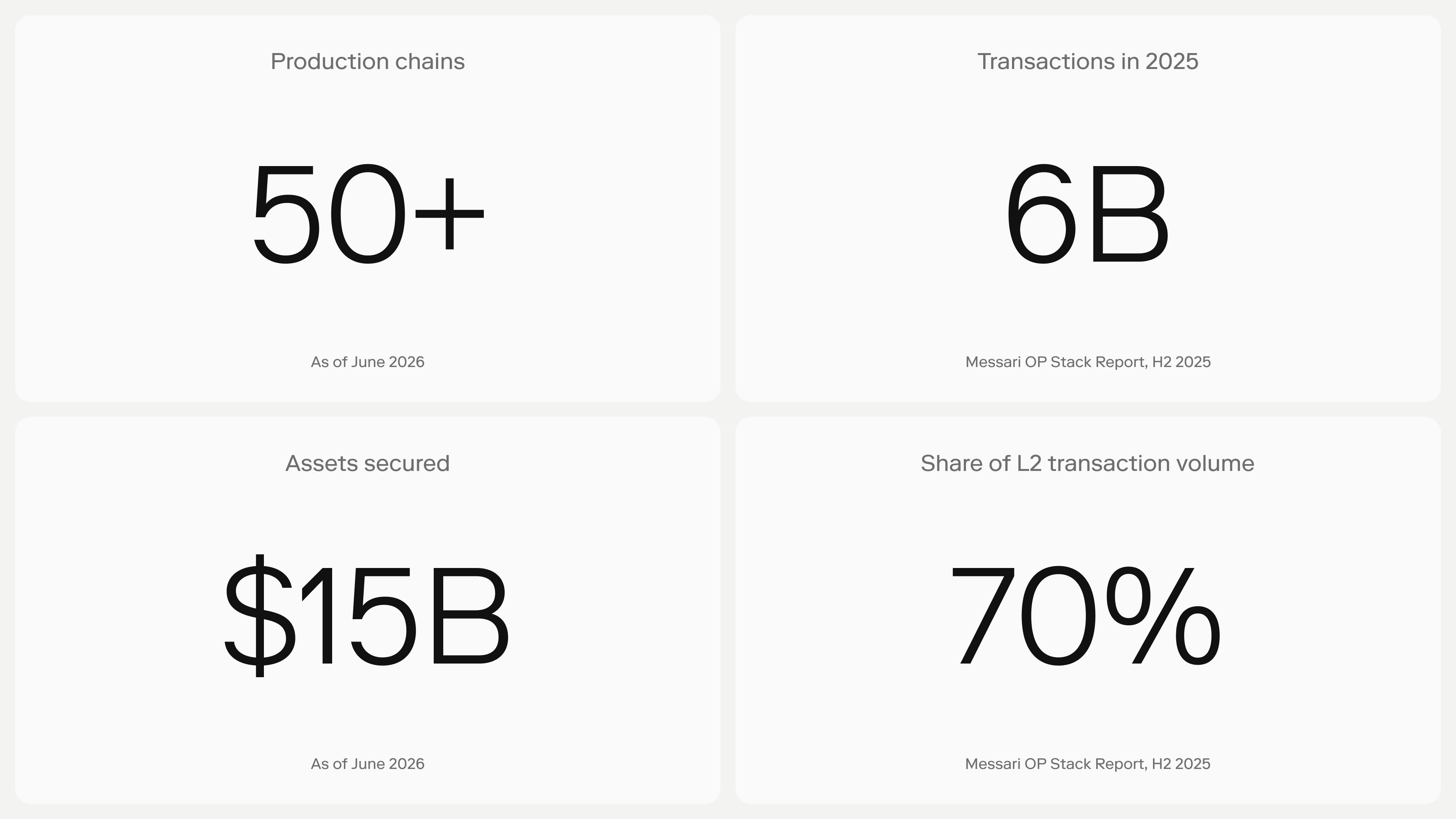
| Production adoption | 50+ chains in production; more than 50% of all L2 transaction volume |
| Assets secured | $16B+ in assets secured across the ecosystem |
| Licensing and economics | MIT-licensed, no fees to Optimism; sequencer revenue belongs entirely to the operator |
| Ethereum compatibility | Full EVM equivalence - Ethereum contracts deploy without modification |
| Deployment models | Self-operated deployment, managed deployment through OP Enterprise, or direct deployment on OP Mainnet |
| Standard L2 security model | Transaction data and state commitments are posted to Ethereum, with correctness enforced through fault proofs |
What is the OP Stack?
The OP Stack is the software framework used to build Ethereum Layer 2 chains. It defines every layer of the stack: how transactions are ordered and batched, how data is posted to Ethereum, and how the chain's state is committed and verified.
The code is MIT-licensed, and production chains deployed with the standard configuration share the same core architecture and security model. The codebase is available in the official OP Stack repository.
The framework is modular and configurable. Teams can change components such as the gas token, sequencer policies, and data availability configuration. Choosing an alternative data availability layer changes the security assumptions described for the standard Ethereum L2 configuration.
How do OP Stack chains work?
An OP Stack chain is an optimistic rollup. It processes transactions off Ethereum, compresses them into batches, and posts those batches back to Ethereum at regular intervals. Ethereum stores the transaction data and serves as the settlement layer in the standard configuration. The computation happens on the rollup. The security guarantee comes from Ethereum and the rollup's fault proof system.
The name "optimistic" describes the security model. Submitted state commitments are assumed valid by default. Anyone who believes a submitted state contains an invalid transition can challenge it using the fault proof system, which runs on Ethereum. If a challenge succeeds, the invalid claim is rejected. If no valid challenge is submitted within the defined window, the state can be used to complete withdrawals through the canonical bridge.
This model gives OP Stack chains full EVM equivalence. Smart contracts written for Ethereum deploy without modification. Any application that works on Ethereum works on an OP Stack chain with no contract code changes required.
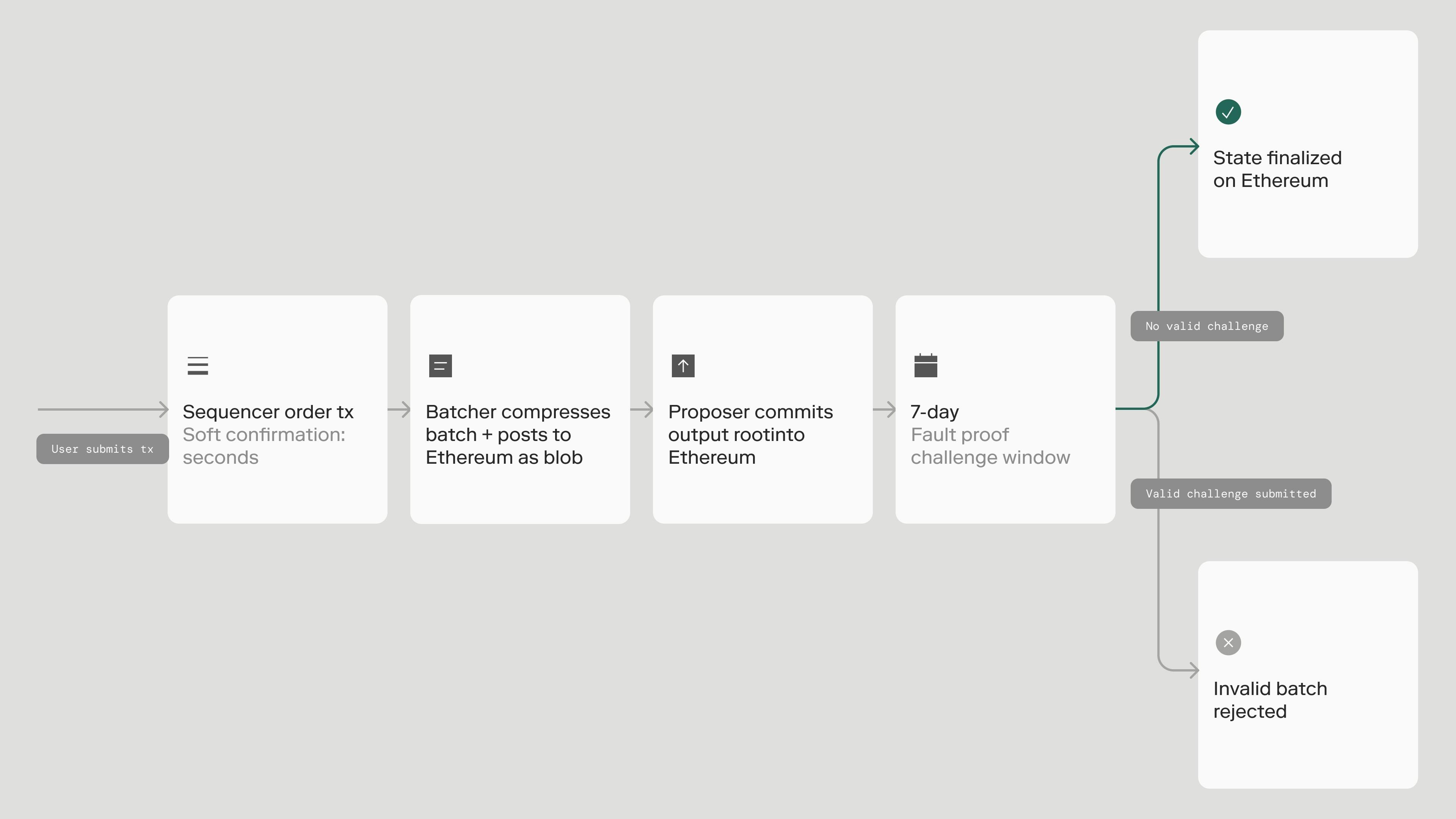
The standard challenge period is 7 days. If a valid challenge is submitted within that period, the invalid claim is rejected. If no valid challenge arrives, withdrawals based on the submitted state can be finalized on Ethereum.
How an OP Stack transaction works in five steps
- The sequencer receives the transaction, orders it, and gives the user a soft confirmation.
- The batcher compresses the transaction data and posts it to Ethereum.
- The proposer submits a cryptographic commitment to the chain's state.
- The fault proof system allows an invalid state claim to be challenged on Ethereum.
- After the challenge period, withdrawals based on an unchallenged valid state can be finalized on Ethereum.
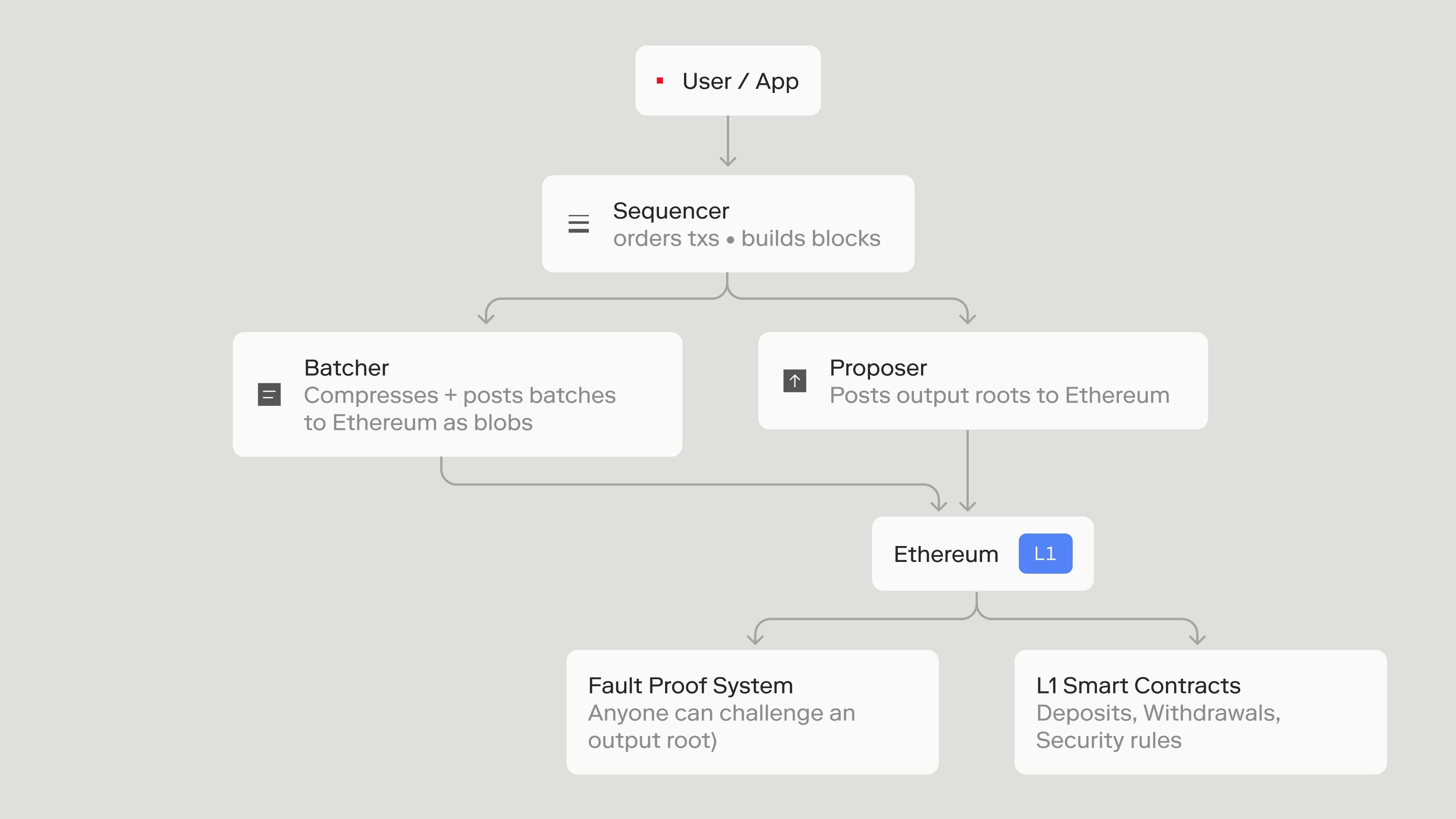
OP Stack architecture
Five core components connect to Ethereum: the sequencer handles transaction ordering, the batcher posts compressed data to L1, the proposer commits state roots, the fault proof system enforces correctness, and L1 smart contracts define security rules and handle withdrawals.
Sequencer
The node responsible for ordering incoming transactions, building blocks, and batching them for submission to Ethereum. The sequencer is where the chain's economics live: transaction fees come in, data posting costs go out, and the difference is sequencer revenue. The sequencer is also the liveness-critical component.
Batcher
The component that compresses transaction batches and posts them to Ethereum. Since EIP-4844, introduced with Ethereum's Dencun upgrade in March 2024, batches can be posted as blobs, a dedicated data format that cut rollup posting costs by more than 90% compared to earlier calldata methods. Batcher costs are the primary ongoing operating expense for any chain and scale with transaction volume.
Proposer
Posts output roots to Ethereum at regular intervals. An output root is a cryptographic commitment to the chain's current state. It is what the fault proof system references when detecting invalid state transitions.
Fault proof system
OP Stack's security layer. Anyone can challenge a state claim they believe is incorrect. The challenge runs on Ethereum without requiring permission from Optimism or any other party. The permissionless fault proof system was rebuilt from scratch and shipped in 2024.
Permissionless fault proofs remove the need for a designated party to initiate a challenge. Protocol upgrade authority, emergency controls, and other governance assumptions depend on the configuration and maturity of each deployed chain. Those controls should be evaluated for the specific chain rather than inferred from the framework alone.
L1 contracts
The set of smart contracts deployed to Ethereum mainnet that define the chain's security rules, handle deposits and withdrawals, and anchor the chain's state to Ethereum. These contracts are audited, production-tested across 50+ chains, and used without modification by most OP Stack deployments.
Who builds on the OP Stack?
More than 50 chains are live in production on the OP Stack. Together they secured more than $16 billion in assets and processed 6 billion transactions in 2025, representing 29 times growth in 12 months. OP Stack chains handle more than 50% of all L2 transaction volume.
These are ecosystem figures reported through June 2026. Chain activity, assets, and transaction share change continuously.
| Company | Chain | Use case | Reported metric and date |
|---|---|---|---|
| Coinbase | Base | General-purpose consumer L2 | 6.1M active addresses, 218M monthly transactions (April 2026) |
| Uniswap | Unichain | DeFi trading | 21.4M monthly transactions, $27.3M TVL (May 2026) |
| Sony | Soneium | Media and entertainment | 197K active addresses, 29M monthly transactions (May 2026) |
| Kraken | Ink | Exchange infrastructure | 80K active addresses, $286M TVL, 10.9M monthly transactions (June 2026) |
| OKX | X Layer | Exchange infrastructure | $1.52B stablecoin market cap, $70M TVL |
| World | World Chain | Identity network | $49M TVL, 33M monthly transactions (May 2026) |
| Celo | Celo | Stablecoin payments | 1.9M active addresses, 47M monthly transactions (April 2026) |
Why do teams choose the OP Stack over deploying on an existing chain?
The decision typically comes down to two things: control over block space and economics.
| Requirement | Why a team may choose the OP Stack |
|---|---|
| Dedicated block space | The operator controls transaction ordering, capacity, and chain-level configuration |
| Chain economics | Transaction fees belong to the operator after data posting and infrastructure costs |
| Ethereum compatibility | Ethereum contracts, development tools, and wallet integrations carry over |
| Production record | The framework has processed billions of transactions across 50+ production chains |
| Configurability | Teams can configure gas tokens, compliance screening, data availability, and other chain behavior |
| Operating support | OP Enterprise provides fully managed and supported deployment models |
Teams that generate significant transaction volume reach a point where sequencer revenue makes dedicated infrastructure worthwhile. A top-3 US exchange generated $75 million in sequencer revenue in H2 2025 by running on the OP Stack. That revenue belongs entirely to the chain operator.
Full EVM equivalence removes the migration friction that other frameworks introduce. Every contract, dev tool, and wallet integration carries over.
The production record matters too. That operating history runs across exchange infrastructure, consumer payments, and DeFi protocols at scale. Architecture decisions for blob posting, fault challenges, and sequencer uptime have been tested against billions of real transactions, not simulated ones.
A dedicated chain also introduces responsibilities that do not exist when deploying contracts on an existing L2. The operator must account for sequencer uptime, Ethereum data posting costs, monitoring, security patching, partner integrations, and upgrade coordination. OP Enterprise exists for teams that want dedicated infrastructure without owning all of those operations.
How does the shared codebase benefit every chain operator?
Every OP Stack chain gets improvements made by any team working on the codebase. When OP Labs ships a performance fix, it's available to every operator. When Ink or another chain resolves an issue, the fix propagates across the framework. No individual chain has to maintain the shared infrastructure on its own.
The fault proof system is maintained and improved by OP Labs. Security patches are made available across production deployments. Operators using OP Enterprise receive patches within hours of identification.
OP Stack deployment options: self-operated, OP Enterprise, or OP Mainnet
Teams can self-operate an OP Stack chain, use OP Enterprise for managed infrastructure or operational support, or deploy directly on OP Mainnet.
OP Enterprise is Optimism's managed chain service for organizations that want to run on the OP Stack without owning the full infrastructure operations. Three tiers cover a range of operating models, from fully managed SaaS to self-operated with OP Labs support.
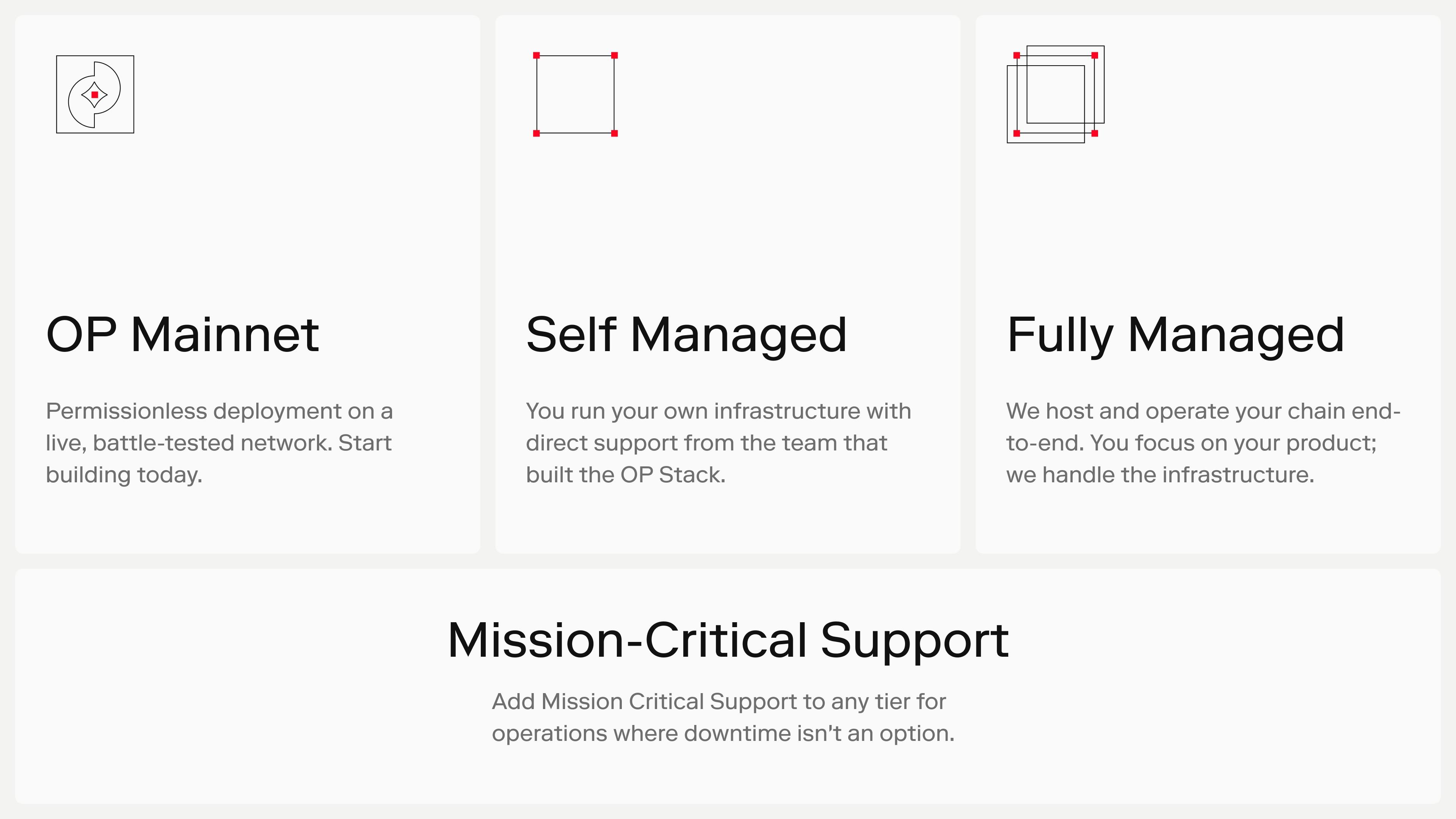
| Tier | Operating model | Best for |
|---|---|---|
| Fully Managed | OP Labs operates everything on OP infrastructure | Teams that want a dedicated chain without running the underlying stack |
| Self Managed | Customer runs own infrastructure; OP Labs provides support and monitoring | Teams with strong internal infra capacity that want OP Labs coverage |
| OP Mainnet | Deploy on the existing chain | Teams that want L2 scale and liquidity without running a chain |
Fully Managed
OP Labs operates the sequencer, batcher, proposer, and all chain infrastructure as a SaaS service on Optimism's servers. Customers receive a production mainnet and testnet with no infrastructure to manage. Designed for teams that want to run a dedicated chain without building or operating the underlying stack.
Self Managed
For organizations that run their own chain on their own infrastructure and want OP Labs expertise behind them. The customer controls the sequencer and all node infrastructure. OP Labs provides support, security and bridge monitoring with runbooks, custom engineering hours, and security and performance assessments. Designed for teams with strong internal infrastructure capacity that want OP Labs coverage without giving up operational control.
OP Mainnet
Deploy directly on OP Mainnet and access the scale and liquidity of one of the largest L2s - no chain infrastructure to operate. Free to deploy.
Mission Critical Add-On
Available as an add-on to Fully Managed and Self Managed. Upgrades to a 99.95% uptime SLA, 15-minute P1 initial response with 30-minute status updates, a dedicated Technical Account Manager, quarterly business reviews, and OP engineer presence in your war room for critical incidents or major launch events.
| Capability | Self-Operated | Fully Managed | Self Managed | OP Mainnet |
|---|---|---|---|---|
| Launch timeline | 8–12 weeks | 6–8 weeks | 6–8 weeks | Days |
| Sequencer ops | You own it | SLA-backed, 24/7 managed | You own it | Shared |
| Security patching | You schedule and apply | Handled by OP Labs | You schedule and apply | Handled by OP Labs |
| Compliance tooling | Custom build | Included | Customer-managed | N/A |
| Custom engineering hours | None | Included in year 1 | Included in year 1 | N/A |
| Engineering access | OP Labs docs | Direct line to OP Labs | Ticket portal | OP Labs docs |
OP Enterprise also includes access to Optimism's partner network, covering stablecoin issuers, oracle providers, bridges, wallet teams, and block explorers. Partner integrations that typically take months of individual negotiation compress to weeks through the existing network.
What's next for the OP Stack?
Interoperability is the current development focus. Each OP Stack chain today operates independently, and moving assets between two of them requires a bridge. The planned interoperability upgrade is designed to let participating OP Stack chains exchange assets and messages natively. The initial target is OP Mainnet and Unichain.
Deployment timing and the current list of participating chains are tracked in the OP Stack documentation.
Frequently Asked Questions
What is the OP Stack?
The OP Stack is an open-source, MIT-licensed software framework for building Ethereum Layer 2 chains. It defines how transactions are ordered, batched, posted to Ethereum, committed, and verified.
How does the OP Stack work?
An OP Stack chain processes transactions away from Ethereum mainnet. The sequencer orders transactions, the batcher posts compressed transaction data to Ethereum, the proposer commits the resulting state, and the fault proof system allows invalid state claims to be challenged on Ethereum.
Why would a team build an Ethereum L2 on the OP Stack?
Teams choose the OP Stack for dedicated block space, control over chain economics, full EVM equivalence, configurable chain behavior, a shared open-source codebase, and infrastructure tested across more than 50 production chains. Teams can self-operate the chain or use OP Enterprise for managed deployment and support.
What is the difference between the OP Stack and OP Mainnet?
OP Mainnet is a specific chain built on the OP Stack framework. The OP Stack is the underlying software framework used to build OP Mainnet and other chains that share its architecture. "OP Stack" refers to the codebase and framework. "OP Mainnet" refers to the specific production chain that Optimism operates.
Is the OP Stack free to use?
Yes. The OP Stack code is MIT-licensed, and Optimism does not charge a framework fee. A chain operator still pays for infrastructure, Ethereum data posting, security, monitoring, integrations, and other operating costs. Managed services have separate commercial terms.
What smart contract languages does the OP Stack support?
Any language that compiles to EVM bytecode, including Solidity and Vyper. Full EVM equivalence means Ethereum contracts deploy on an OP Stack chain without modification.
How long does it take to launch an OP Stack chain?
Self-operated deployment typically runs 8 to 12 weeks from start to mainnet, assuming technical resources are in place and key configuration decisions have been made in advance. Managed deployment through OP Enterprise typically runs 6 to 8 weeks.
What is the OP Stack's relationship to Ethereum?
OP Stack chains configured as Ethereum L2s settle to Ethereum. Transaction data is posted to Ethereum, and the chain's state is anchored through cryptographic commitments. Ethereum provides data availability and settlement in the standard configuration. The OP Stack provides the execution layer that makes high-throughput, low-cost transactions possible while keeping Ethereum as the trust anchor.
Alternative data availability configurations are supported, but they introduce different security assumptions.
Can I configure an OP Stack chain for my use case?
Yes, the OP Stack is modular and configurable. Teams can set a custom gas token, configure compliance screening at the sequencer level, choose alternative data availability layers, and modify other default behaviors. Configuration decisions made before deployment are hard to change after launch. Custom modifications to core contracts require a security audit before production deployment.
Glossary
Optimistic rollup - A Layer 2 approach that processes transactions off Ethereum, posts compressed batch data to Ethereum for storage, and assumes submitted state transitions are valid unless challenged within a set window.
Sequencer - The node that orders incoming transactions, builds blocks, and batches them for submission to Ethereum. The sequencer is where chain economics concentrate: fees in, data-posting costs out, the difference is operator revenue.
Batcher - The component that compresses transaction batches and posts them to Ethereum as blobs. The batcher's data-posting costs are the primary ongoing operating expense for any OP Stack chain.
Proposer - Posts cryptographic output roots to Ethereum at regular intervals. Output roots are the commitments the fault proof system uses to detect invalid state transitions.
Fault proof - The onchain dispute mechanism that lets anyone challenge an invalid state claim on Ethereum without permission from Optimism. Rebuilt from scratch and shipped in 2024.
EVM equivalence - Full compatibility with the Ethereum Virtual Machine. Smart contracts written for Ethereum deploy on an OP Stack chain without modification.
EIP-4844 / blobs - An Ethereum upgrade introduced in March 2024 that created a dedicated low-cost data format for rollups. Blob posting cut OP Stack data submission costs by more than 90% compared with the prior calldata method.
Output root - A cryptographic commitment to an OP Stack chain's state, posted to Ethereum by the proposer. The reference point for fault challenges.
Fully Managed - OP Enterprise's fully managed tier: OP Labs operates the sequencer and all chain infrastructure as a SaaS service. Customers get a production mainnet and testnet with no infrastructure to manage.
Self Managed - OP Enterprise's self-operated tier. The customer runs the sequencer and all nodes; OP Labs provides support, monitoring, security advisories, and custom engineering hours.
OP Mainnet - Optimism's flagship L2, free to deploy on. For teams that want Ethereum L2 scale and liquidity without running their own chain.
Mission Critical Add-On - A premium support tier available with Fully Managed and Self Managed. Adds a 99.95% uptime SLA, 15-minute P1 response, a dedicated Technical Account Manager, quarterly business reviews, and war-room support for critical incidents.
Authored by

Optimism