
Ink doubles down on Optimism's programmable financial infrastructure as a strategic design partner for the next generation of institutional onchain finance.
Testnet is now live.
Ink, an L2 built on the OP Stack, is upgrading to OP Enterprise Fully Managed, run by the team that built the protocol. Cutover lands in August. Chain ID, code, and the Ink application surface, including Tydro and Nado, all stay the same.
The deal extends Optimism's programmable financial infrastructure to one of the largest exchange-backed blockchain networks in the industry.
This upgrade is the next move in a focused mission. The Ink Foundation and Optimism are aligned on what institutional capital actually needs from a chain.
Why institutional, why now
The shift onchain is no longer hypothetical. Stablecoin transaction volume surpassed $33 trillion in 2025, outpacing Visa and Mastercard combined, as regulatory clarity continued to drive institutional adoption. Major exchanges are building their own blockchain networks to own the infrastructure layer beneath their financial products. As organizations move financial activity onchain, operating that infrastructure requires the same reliability and support expected of traditional financial systems.
“Running a blockchain in production is a unique operational challenge. That's why we picked Optimism , the team behind the stack Ink is built on, to operate the network. The next phase of onchain finance demands a chain operated by those with the technical depth to prioritize reliability and security in everything they do.”
Institutional capital moving onchain doesn't need the same things retail flow needs. It needs predictable execution, reliable settlement, and operators that institutional risk teams already trust. It needs a chain whose security posture matches the standards of qualified custody, regulated exchange operations, and serious asset issuance.
Since launching in December 2024, Ink has grown into one of the most active networks on the OP Stack, processing more than one million transactions in the first 24 hours of mainnet launch. Native applications on Ink now generate close to $40 million in annual revenue.
“Programmable financial infrastructure is becoming the foundation of how institutions build onchain, but operating that infrastructure requires a different set of expertise. By working together, the Ink Foundation can focus on growing the ecosystem while Optimism focuses on operating and improving the network.”

Ink was unleashed by the team that brought you Kraken, with the security culture and operational discipline that define the exchange. The OP Enterprise upgrade extends that combination into the operations layer of the chain itself. The protocol team and the operations team are now one, working alongside the Ink Foundation.
For the teams building real-world asset products, tokenized financial instruments, and institutional yield strategies onchain, that combination matters. It's what makes a chain worth depositing into for the long term, not just farming for the short term.
What ships with this upgrade
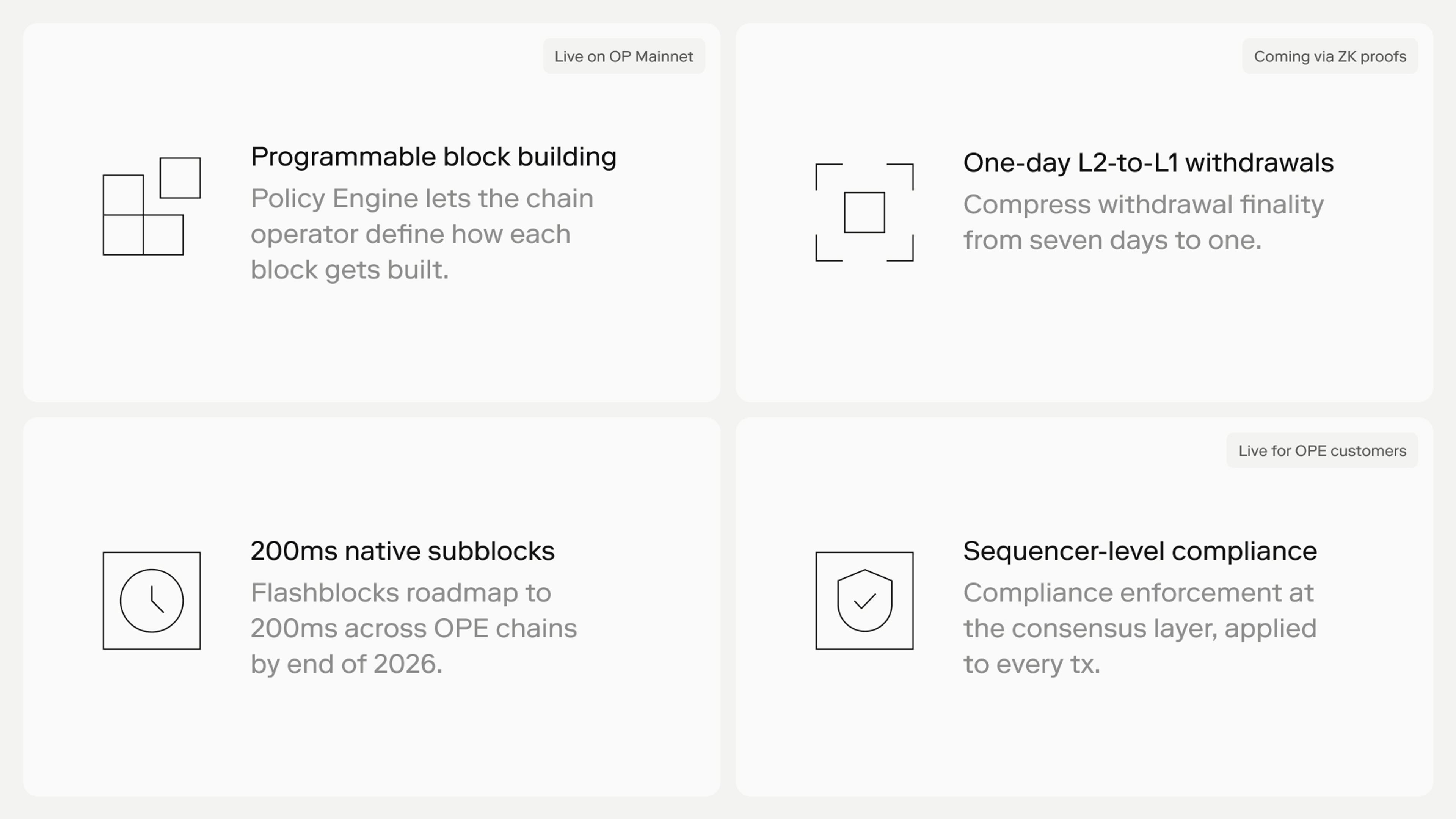
Ink is the launch partner for a set of OP Enterprise premium features, which are available to every OPE customer.
How each feature works
Programmable block building
The Policy Engine, live on OP Mainnet today, lets the chain operator define the rules for how each block gets constructed. Whose transactions land first. What gets reserved space. Which addresses get priority. For an institutional chain, that's the difference between predictable execution and best-effort execution.
One-day L2-to-L1 withdrawals
Standard optimistic withdrawal windows are seven days. For chains running real institutional volume, that's a week of capital that can't move. OPE is bringing the proof system online to compress that to a single day combining ZK proofs and fault proofs. Capital efficiency stops being a binding constraint on what gets built on the chain.
200ms native subblocks
OPE’s flashblocks runs at 250ms today, we will be upgrading to a native subblock architecture and shaving off 50ms.
Sequencer-level compliance
OFAC and sanctions screening usually live at the application layer, where they're easy to circumvent. OPE customers run compliance enforcement at the sequencer, which means the rules apply to every transaction the chain processes.
These capabilities roll out across OP Enterprise alongside performance improvements targeting throughput of 200 megagas per second and block times as low as 200 milliseconds by the end of 2026.
The reliability spine
The institutional-grade thesis depends on the team running the stack. Ink is now operated by an alignment of two groups, each carrying its own track record on reliability: the Ink Foundation and Optimism.
- The Ink Foundation provides the strategic perspective of a team building the chain for the long term.
- Optimism handles protocol authorship and the daily production operations work.
Together, the two teams are what gives institutional capital comfort that the chain underneath their products will be running tomorrow.
What's on the horizon
The work doesn't stop with the upgrade. The Ink Foundation and Optimism are jointly developing the next layer of capabilities institutional capital needs onchain. That includes new approaches to operational safety and security response. The premium features rolling out across OPE customers in the second half of 2026 are the visible piece. More is coming.
We'll have more to share as the work matures. The direction is clear: a chain that institutional partners can build into with the same confidence they have in their existing operational systems.
What stays the same for users
For the people using Ink today, nothing material changes. The chain ID and the applications all stay the same. Tydro and Nado keep running. From the user side, the chain you know stays the chain you know.
From the operator side, Optimism takes over the production stack: high-availability sequencers across mainnet and testnet, monitoring, incident response, RPC, block explorer, and direct engineering hours from the team that ships the protocol code.
What's next
Ink keeps shipping, with Tydro and Nado continuing to run on the chain. Optimism runs the chain. The cutover lands in August.
This upgrade follows the launch of Bitpanda's Vision Chain, the first chain set to be deployed on OP Enterprise Fully Managed. Built for European institutional finance, Vision Chain provides infrastructure for tokenized assets and other onchain financial products. With the addition of Ink, the Fully Managed tier now supports exchange-serviced blockchain networks across two major global markets.
For institutional teams building toward serious onchain financial products, including asset issuers, fund managers, regulated venues, and real-world asset platforms, we're talking with teams.
Authored by

Jing Wang