
- Liquidity and control usually decide between OP Mainnet and a dedicated chain.
- OP Mainnet can reach production in days. A managed dedicated chain can take 6 to 8 weeks.
- Transactions are confirmed in roughly 200–250 milliseconds, at which point they are considered guaranteed. On OP Mainnet, batches of transactions are posted to Ethereum approximately every three minutes.
- The institution issues, holds, and controls its assets. The OP Stack is infrastructure, not an issuer.
MDC (Mitsui & Co. Digital Commodities), a wholly owned subsidiary of Mitsui & Co., launched Zipangcoin on OP Mainnet in April 2026. Zipangcoin is a cryptoasset backed by gold, silver, and platinum. Since then, KB Securities (September 23) and Meritz Securities (October 21) have each signed an MOU with The Optimism Foundation to explore tokenized products on OP Stack networks, including OP Mainnet.
Tokenization turns assets that trade intermittently into instruments that can settle and move around the clock. That takes a programmable venue and institutional controls. The institution keeps control of issuance and holds the assets, and the OP Stack is infrastructure, not an issuer.
What are the deployment options for tokenized assets?
The OP Stack gives institutions two deployment models: OP Mainnet, a shared public Ethereum Layer 2 with no chain to operate, and a dedicated OP Enterprise chain with its own capacity, configuration, and economics. The right model depends on requirements, so decide the model before comparing individual platforms.
OP Mainnet provides access to an established ecosystem of stablecoins, applications, and onchain financial activity. A dedicated chain adds controls at the chain level and runs either Self Managed, where the customer operates it, or Fully Managed, where OP Labs, a subcontractor of the Optimism Foundation, deploys, operates, and upgrades it as a managed service, through the Optimism Foundation's OP Enterprise offering.
| Question | OP Mainnet | Dedicated OP Enterprise chain |
|---|---|---|
| Chain operations | None for the application team | Customer (Self Managed) or OP Labs (Fully Managed) |
| Liquidity access | Connected to public stablecoin liquidity | Dedicated environment, liquidity strategy set by the product |
| Transaction controls | Generally at the application level | Chain-level options, such as permissioned access |
| Economics | Shared network economics | Dedicated chain economics |
| Time to production | Days | 6 to 8 weeks managed |
| Best fit | Fast path to production on existing liquidity | Products that justify dedicated control, capacity, or economics |
In short, OP Mainnet can reach production in days with no chain to run, while a managed dedicated chain can take 6 to 8 weeks and adds dedicated capacity, controls, and economics.
What should an institution evaluate before choosing infrastructure?
Six questions decide the choice: where liquidity sits, where transaction controls are enforced, how settlement works, who operates the chain, who issues and controls the assets, and how much vendor lock-in the choice creates. Liquidity and control usually split institutions between OP Mainnet and a dedicated chain.
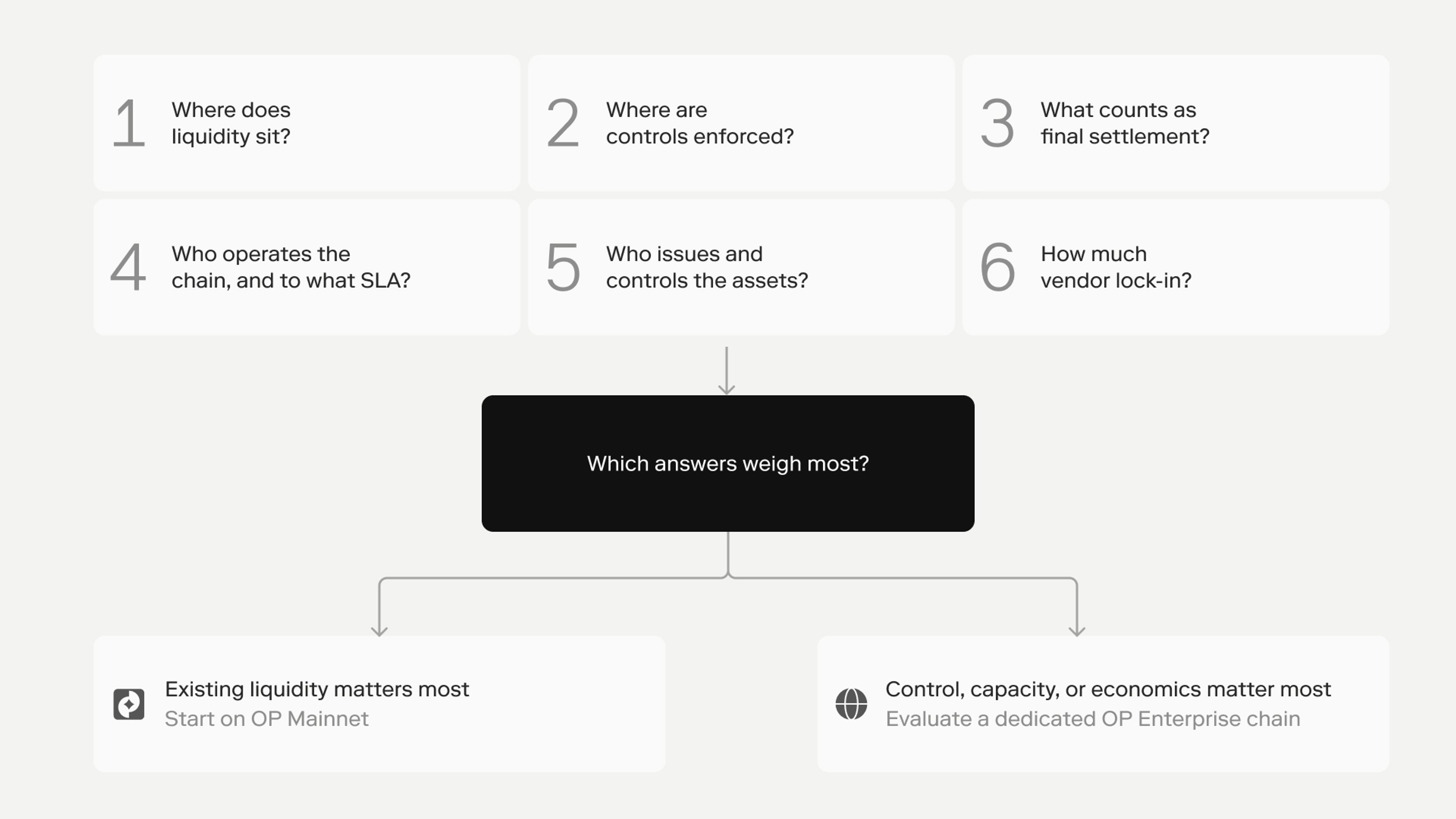
Institutions that prioritize existing liquidity start on OP Mainnet, while those that need greater control, capacity, or different economics evaluate a dedicated chain.
Where does liquidity sit?
Stablecoin volume concentrates in dollar-backed tokens. In July 2026, USDC was about 58% and USDT about 26% of crypto card spend, according to a16z crypto using Paymentscan data.
As of November 2026, OP Mainnet has approximately $425 million in DeFi total value locked (TVL), giving products access to an established ecosystem of liquidity pools and lending markets (DefiLlama). A dedicated chain becomes more attractive when control over capacity or economics matters more than shared liquidity.
Where are transaction controls enforced?
No base network makes a financial product compliant by itself. The institution keeps responsibility for its own policies, customer controls, and approvals.
On OP Mainnet, institution-specific controls generally sit in the application. A dedicated chain can add chain-level screening and permissioned access, and none of these options is an approval on its own.
How fast is settlement, and what counts as final?
OP Mainnet confirms transactions in roughly 200 to 250 milliseconds.
Transaction batches are posted to Ethereum approximately every three minutes, with transactions becoming irrevocable once finalized on Ethereum.
Who operates the chain, and what are the service levels?
Dedicated infrastructure creates an operating obligation. OP Enterprise separates that obligation from the decision to use it.
| Self Managed | Fully Managed | Mission-Critical add-on | |
|---|---|---|---|
| Operations owner | Customer runs the chain, with OP Stack support | OP Labs deploys, operates, and upgrades the chain through OP Enterprise | Added to Self Managed or Fully Managed |
| Uptime SLA | No uptime SLA published | 99.9% | 99.95% |
| SEV 1 response | 1-hour SLA for critical issues | 30 minutes | 15 minutes |
| Added support | 24/7 incident response | Managed operations and upgrades | Multi-region deployment, dedicated technical account manager |
Fully Managed carries a 99.9% uptime SLA with 30-minute SEV 1 response, and the Mission-Critical add-on raises that to 99.95% and 15 minutes.
Who issues and controls tokenized assets?
The institution does. It issues, holds, and controls the assets. The OP Stack provides the technology, and under OP Enterprise's Fully Managed, OP Labs operates the chain through OP Enterprise.
How much vendor lock-in does the choice create?
The OP Stack has an MIT-licensed open-source core. Open source does not make migration free, because a production system still has integrations, procedures, and counterparties around it.
Which institutions are building on OP Mainnet?
MDC launched Zipangcoin in April 2026, and KB Securities and Meritz Securities signed MOUs in September and October 2026. ether.fi Cash shows a card and credit product running in production on the same shared network.
| Institution | What | Status | Public source |
|---|---|---|---|
| MDC (Mitsui & Co. Digital Commodities) | Zipangcoin, a cryptoasset backed by gold, silver, and platinum | Launched April 2026 | Optimism blog, April 17, 2026 |
| KB Securities with Securitize | Tokenized money market fund and a fund built on a KB Asset Management strategy, for Korean institutional investors | MOU signed September 23, 2026, exploratory | Optimism blog, September 23, 2026 |
| Meritz Securities | Issuance, settlement, and distribution of tokenized financial assets on OP Stack networks, including OP Mainnet | MOU signed October 21, 2026, exploratory | Optimism blog, October 21, 2026 |
| ether.fi Cash | Card and credit product | In production | Optimism blog, August 13, 2026 |
Zipangcoin and ether.fi Cash are live on OP Mainnet. The KB Securities and Meritz Securities MOUs are exploratory and do not mean a product has launched.
ether.fi Cash has more than 100,000 active cards and more than 300,000 accounts as of August 13, 2026, and its credit backend runs on a dedicated Aave V4 instance on OP Mainnet. Cardholders had roughly $30M in active borrowing as of September 2026. ether.fi card spend passed $1B in cumulative volume on October 17, 2026, according to ether.fi.
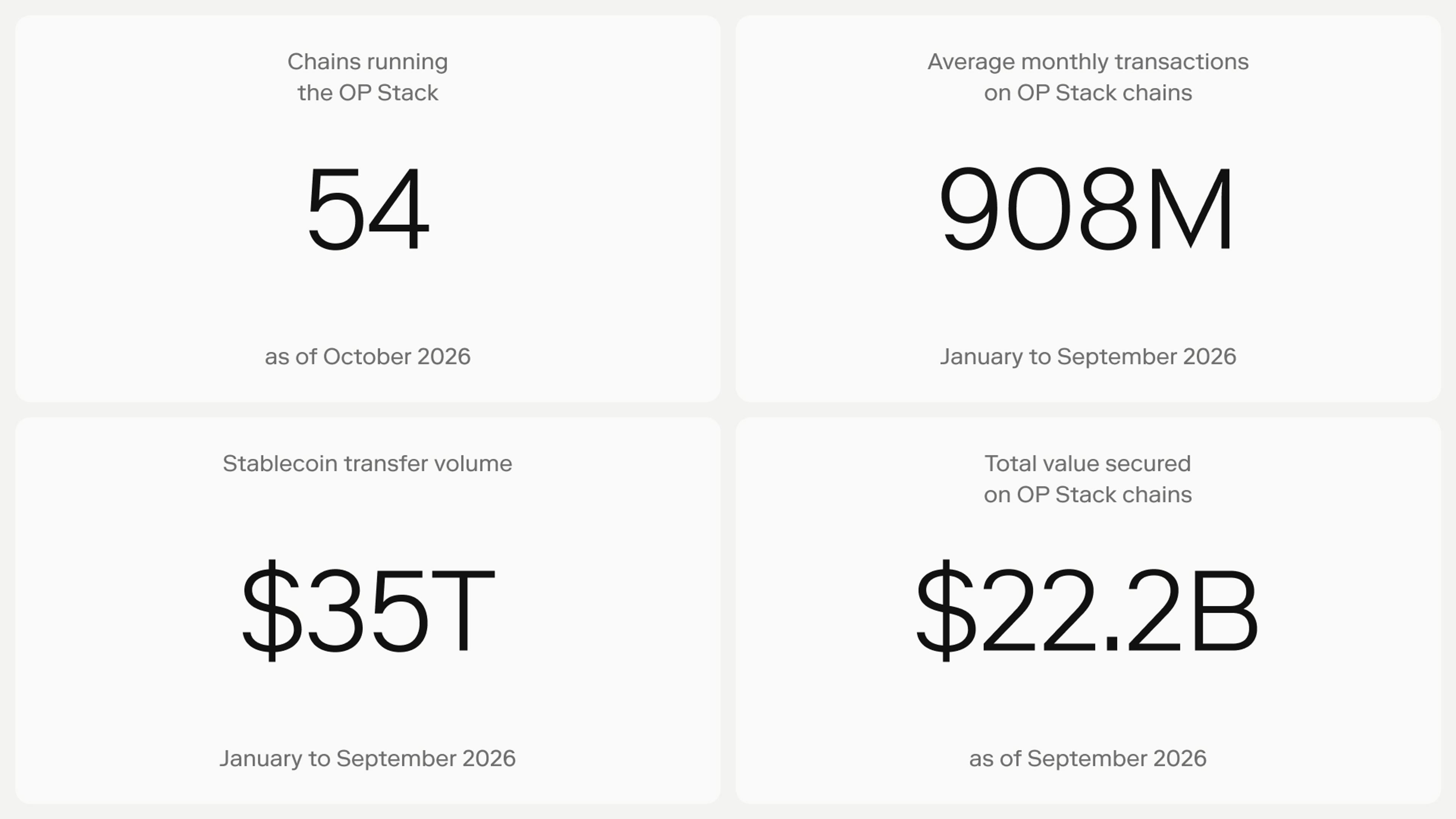
OP Stack chains settled an average of 908M transactions a month from January to September 2026, and 54 mainnet chains were deployed on the OP Stack as of October 2026, according to optimism.io/stats.
What comes next?
- KB Securities and Securitize intend to start with a tokenized money market fund and a fund built on a KB Asset Management flagship strategy on the OP Stack, and to expand over time as Korea's regulatory framework develops.
- Meritz Securities plans to review the detailed scope of cooperation, taking into account the development of Korea's security token regulatory framework.
Resources
Frequently Asked Questions
What is the difference between OP Mainnet and a dedicated OP Enterprise chain?
OP Mainnet is a shared public Ethereum Layer 2 with no chain for the application team to operate, and it launches in days. A dedicated OP Enterprise chain gives an institution its own capacity, configuration, and economics, run Self Managed or Fully Managed, and a managed chain takes 6 to 8 weeks to reach production.
How long does it take to launch a tokenized product?
OP Mainnet can launch in days because there is no chain to operate. A managed dedicated chain through OP Enterprise can take 6 to 8 weeks from decision to production. Partner integrations usually set the pace more than engineering does.
Does the infrastructure issue or hold tokenized assets?
No. The institution issues, holds, and controls its assets, and the OP Stack is a platform, not an issuer. MDC issues Zipangcoin, for example. Under Fully Managed, OP Labs operates the chain through OP Enterprise, and the customer keeps control of its chain's configuration, economics, and roadmap.
Is fast confirmation the same as final settlement?
No. OP Mainnet confirms transactions in roughly 200 to 250 milliseconds, which is fast confirmation. Final settlement comes when the transaction batches reach finality on Ethereum.
Can an institution start on OP Mainnet and move later?
Yes. An institution can start on OP Mainnet when a shared public network fits the product, then evaluate a dedicated OP Enterprise chain if it needs more control over capacity, operations, or economics. Open-source software lowers licensing lock-in, but a production system still has integrations and counterparties to move.
Which institutions have announced tokenization work on OP Mainnet?
MDC launched Zipangcoin, a cryptoasset backed by gold, silver, and platinum, in April 2026. KB Securities, with Securitize, signed an MOU on September 23, 2026, and Meritz Securities signed an MOU on October 21, 2026. Both MOUs are exploratory and do not mean a product has launched.
What service levels does OP Enterprise offer?
Fully Managed chains carry a 99.9% uptime SLA and 30-minute SEV 1 response. The Mission-Critical add-on raises that to a 99.95% uptime SLA and 15-minute SEV 1 response, with multi-region deployment and a dedicated technical account manager. Self Managed includes 24/7 incident response with a 1-hour SLA on critical issues.
Glossary
- Tokenization: Representing an asset, such as a commodity, a fund, or a financial asset, as a token that can be issued, held, and transferred onchain.
- MOU: A memorandum of understanding. It records an intention to collaborate and does not commit either party to launch a product.
- OP Mainnet: A shared public Ethereum Layer 2 built on the OP Stack. Application teams deploy contracts without running a chain.
- OP Stack: The open-source, MIT-licensed technology for deploying scalable blockchains, stewarded by The Optimism Foundation.
- OP Enterprise: Optimism's managed chain service for organizations that want a dedicated chain, with Self Managed and Fully Managed tiers and an optional Mission-Critical add-on.
- OP Labs and The Optimism Foundation: The Optimism Foundation is the technology service provider for the Ethereum Layer 2 services, while OP Labs is the Foundation's primary subcontractor for these services. Labs also provides the Foundation with business development and deal structuring support for its Layer 2 commercial offerings.
- Finality: The point at which a transaction can no longer be reversed. On OP Mainnet, final settlement comes when the transaction reaches finality on Ethereum.
- Sequencer: The component that orders and processes transactions on an OP Stack chain.
Zipangcoin, ether.fi Cash, and the other products named in this post are third-party products not owned or controlled by the Optimism Foundation. This post is for informational purposes only and is not an endorsement or a solicitation. Digital asset products carry risk, please conduct your own due diligence.
Authored by

Optimism