
- Controls: capacity planning, fee settings and supported access policies, depending on the deployed software and governance arrangements.
- Operating decisions: who runs the infrastructure, how stablecoins arrive and leave, and which event counts as payment completion.
- Examples: Ink and X Layer are live networks, and Vision Chain is announced.
- Evaluation: set a baseline, confirm each route, then run a scoped pilot with an outage and recovery exercise.
Legal and regulatory requirements vary by jurisdiction and structure. This guide is informational and does not state what any exchange must do. Consult your own legal and regulatory advisors.
What can an exchange control on its own chain?
On a shared network, an exchange uses capacity alongside other applications and follows the network's fee rules. A dedicated chain gives it more control over capacity planning, fee settings and supported access policies. The available controls depend on the deployed software and governance arrangements.
| Area | Shared network | Dedicated chain | Still a dependency |
|---|---|---|---|
| Capacity | Shared with other applications | The exchange plans capacity | Protocol limits |
| Fee settings | Follows the network's fee rules | The exchange configures fee settings | Ethereum data publication costs vary with Ethereum conditions |
| Access policies | Set by the network | Supported access policies, per the deployed software and governance arrangements | Governance arrangements |
| Stablecoin support | Depends on the stablecoin's issuer and the transfer route | Depends on the stablecoin's issuer and the transfer route | Native issuance and issuer-supported transfer protocols |
| Offchain payments | Depends on payment services | Depends on payment services | Fiat redemption and bank-account credit |
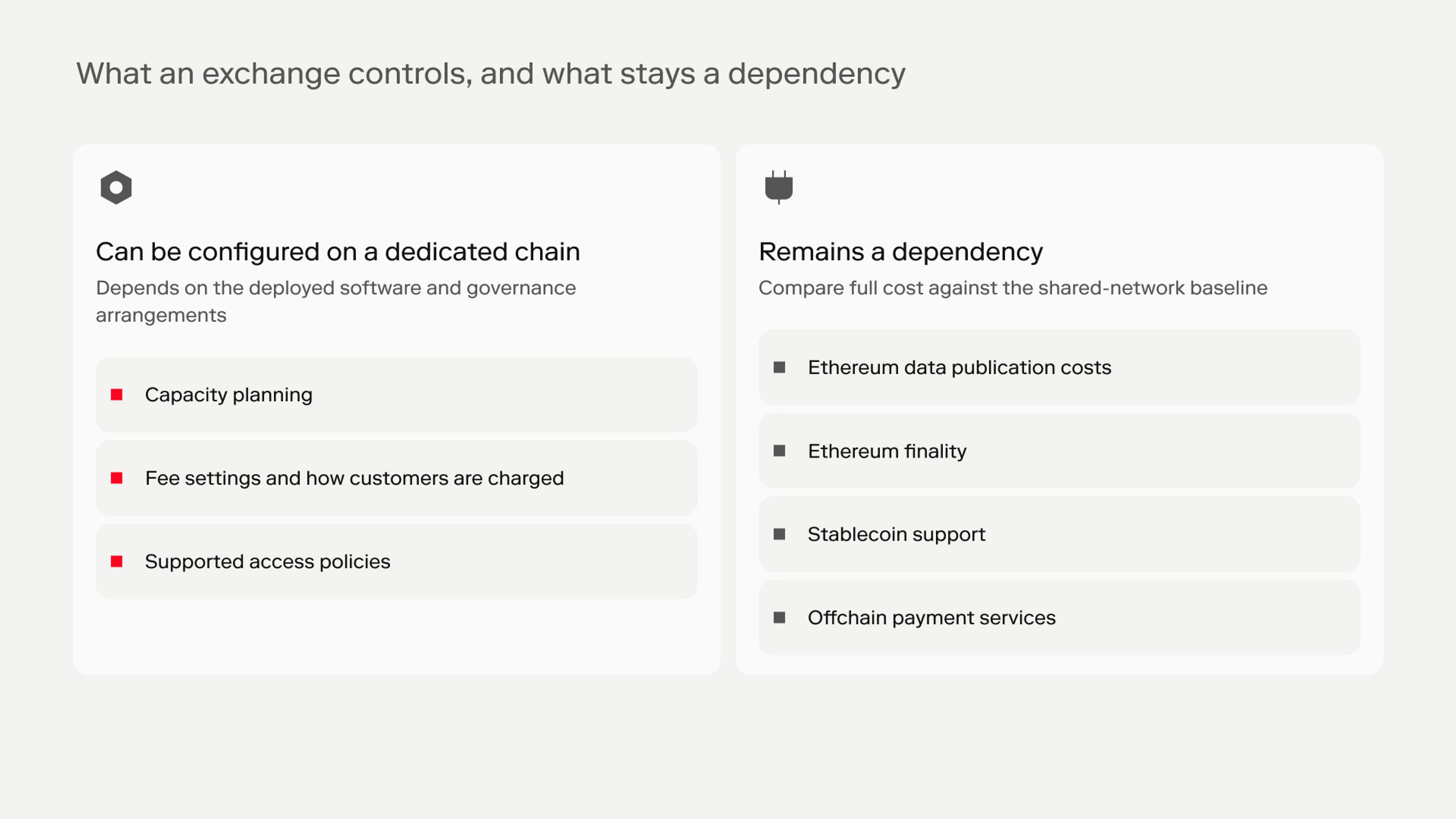
For a rollup that posts data to Ethereum, the cost of publishing that data still varies with Ethereum conditions. An exchange can choose how to charge customers, but a fixed customer fee may require it to absorb variable costs. Compare the full cost of operation, including infrastructure, data publication, support and liquidity, with the shared-network baseline. See the OP Stack fee documentation.
What operating decisions come with a dedicated chain?
Three decisions come first: who runs the infrastructure, how stablecoins arrive and leave, and which event counts as payment completion.
Who runs the infrastructure?
This guide covers OP Enterprise, the Optimism Foundation's infrastructure offering for the OP Stack. Its options include OP Mainnet deployment, Self Managed support and Fully Managed dedicated chains. Other OP Stack providers and self-operated deployments are available.
| Question | Self Managed | Fully Managed |
|---|---|---|
| Who operates the infrastructure? | The customer | Technical support provided by OP Labs, the Optimism Foundation's primary subcontractor, on the customer's behalf |
| What does OP Labs do? | Provides support | Deploys, operates and upgrades the infrastructure. The customer owns its chain. |
See the OP Enterprise overview.
How do stablecoins arrive and leave?
Identify the token contract, issuer, bridge or transfer protocol, and supported redemption route. A bridge-backed representation and a stablecoin issued natively on the destination chain have different dependencies.
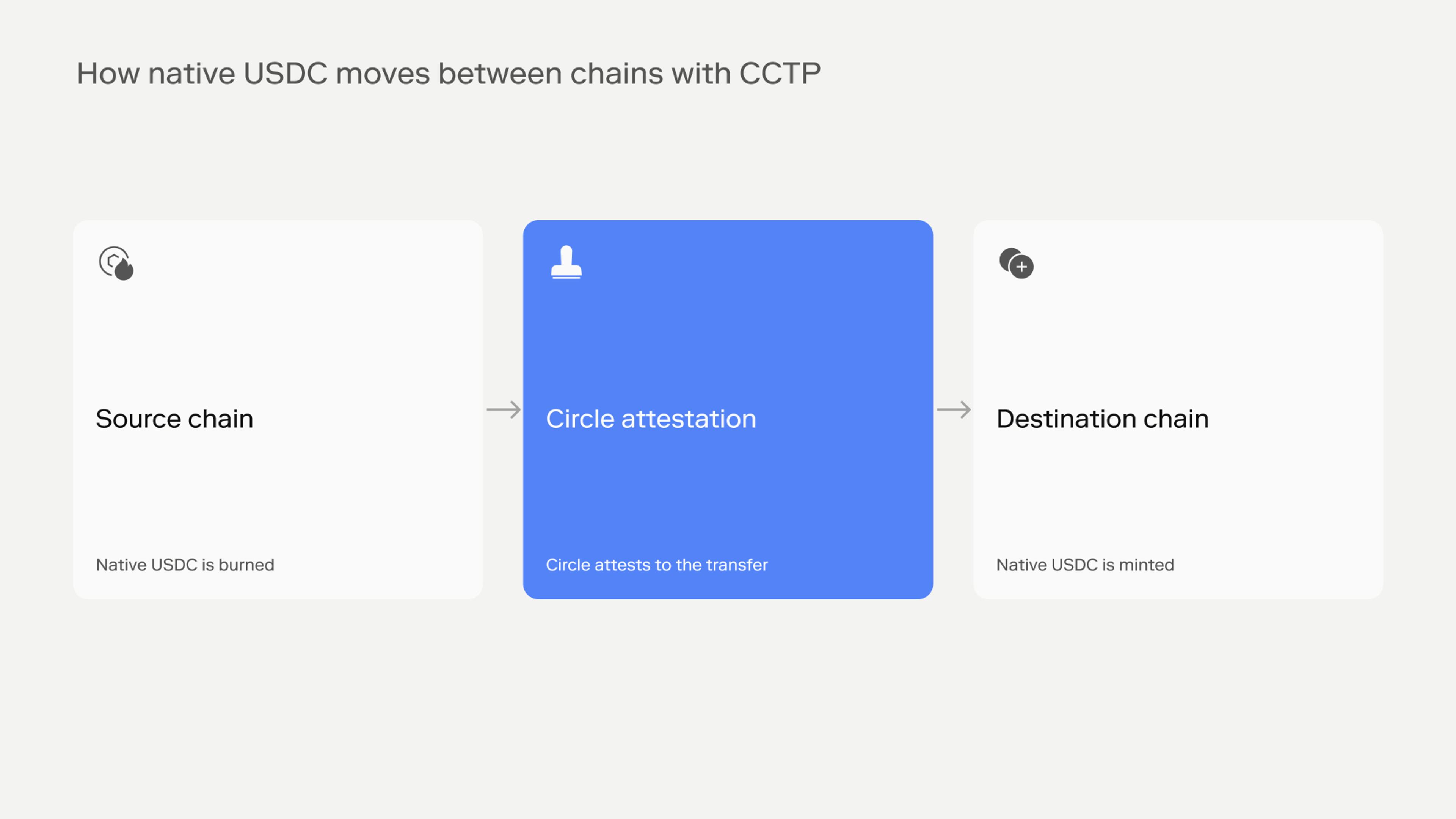
Some stablecoin issuers support their own cross-chain transfer protocols, and each covers only the stablecoins that issuer supports. For example, for USDC, Circle's Cross-Chain Transfer Protocol, or CCTP, burns native USDC on the source chain and mints native USDC on the destination after Circle attests to the transfer. Native issuance and transfer protocol support are separate checks, and deploying an OP Stack chain does not automatically provide either.
As of November 23, 2026, Circle lists OP Mainnet, Ink and X Layer among its supported CCTP chains. Check the available transfer mode, fees and finality requirements for each intended route.
Which events may be relevant to payment completion?
Measure these steps separately as you consider requirements for payment completion:
- Transaction inclusion on the source chain.
- The confirmation or finality threshold required by the exchange or transfer service.
- Completion of any transfer between chains.
- Credit to the recipient's exchange account.
- Fiat redemption and bank-account credit, where relevant.
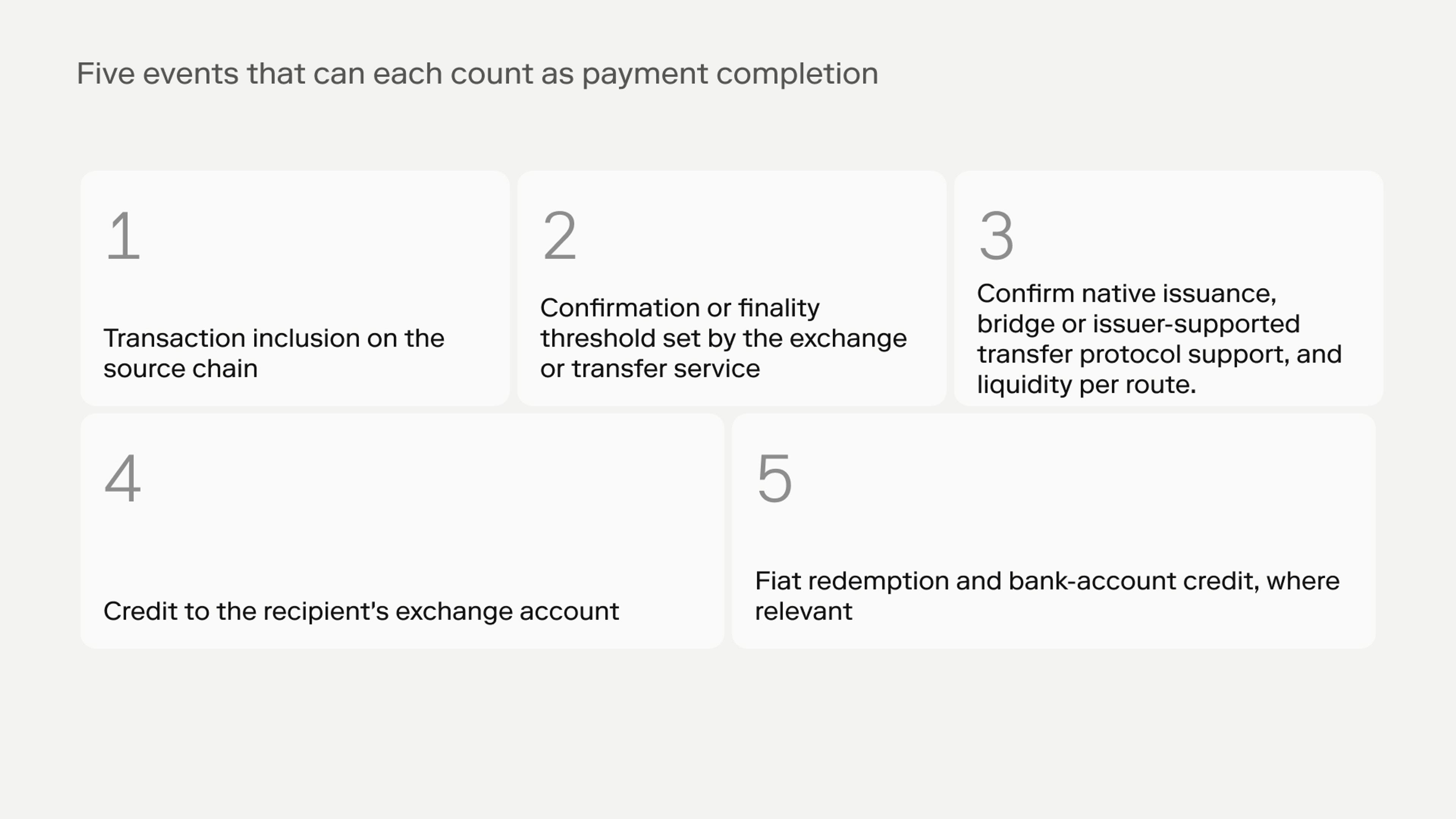
An onchain transfer does not establish when an exchange credits an account or a bank makes redeemed funds available. Define the endpoint for each payment flow, then measure it under normal and disrupted conditions. For foreign-exchange flows, include conversion and funding of both currencies.
On OP Mainnet, initial L2 confirmation, posting data to Ethereum and Ethereum finality are distinct stages. A standard bridge withdrawal has a separate waiting period. Use the same definition when comparing timing figures. See the OP Stack finality documentation.
Which examples are live, and which were announced?
Status review: November 17, 2026.
| Example | Status supported by the reviewed sources | What the example establishes |
|---|---|---|
| OP Mainnet | Live public Ethereum L2 | A shared network for deploying applications; see the OP Mainnet overview |
| Kraken's Ink | Live OP Stack network | An exchange-founded chain; see Ink's documentation |
| OKX's X Layer | Live network using an enhanced OP Stack | An exchange-founded chain; see OKX's documentation |
| Vision Chain | OP Enterprise deployment announced; current public-mainnet launch not verified in this review | A planned institutional deployment, rather than evidence of measured production performance |
On March 25, 2026, Bitpanda and the Vision Web3 Foundation announced Vision Chain, and the Optimism Foundation published its own announcement. A later foundation update still described the public explorer and sequencer launch prospectively. Confirm current launch status and available production data before using Vision Chain as a live comparison.
An operating chain does not establish that a particular exchange payment flow is in production. Check the asset, application and route being cited.
Companies named in this guide: Circle (USDC and CCTP), Kraken (Ink), OKX (X Layer) and Bitpanda (Vision Chain).
How can an exchange evaluate a dedicated chain?
An evaluation can follow five steps, from choosing flows to test to a scoped pilot measured against today's baseline.
- Select the stablecoin flows, assets, counterparties and transfer routes to test.
- Record today's full cost and time to the intended endpoint, including account credit or fiat redemption.
- Confirm native issuance, bridge or issuer-supported transfer protocol support, and liquidity for each route.
- Assign infrastructure duties and document provider service commitments.
- Run a scoped pilot, including an outage and recovery exercise, and compare the results with the baseline.
Frequently Asked Questions
What can an exchange control on its own chain?
An exchange with a dedicated chain can configure its capacity, fee policy and supported access policies within the protocol's limits. The available controls depend on the deployed software and governance arrangements. Ethereum data costs and finality, stablecoin support and offchain payment services remain dependencies.
Does running its own chain change what stablecoin settlement costs an exchange?
A rollup that posts data to Ethereum still pays a data publication cost that varies with Ethereum conditions. An exchange can choose how to charge customers, but a fixed customer fee may require it to absorb variable costs. Compare the full cost of operation, including infrastructure, data publication, support and liquidity, with the shared-network baseline.
Who operates the infrastructure for an exchange's dedicated chain?
Under OP Enterprise Self Managed, the customer operates the infrastructure with technical support from the Optimism Foundation's subcontractor, OP Labs. Under Fully Managed, OP Labs supports deployment, operations and upgrades to the infrastructure while the customer owns its chain. Other OP Stack providers and self-operated deployments are also available.
How do stablecoins reach an exchange's own chain?
An exchange identifies the token contract, issuer, bridge or transfer protocol, and supported redemption route. Some stablecoin issuers support their own cross-chain transfer protocols, and each covers only the stablecoins that issuer supports. For example, for USDC, Circle's Cross-Chain Transfer Protocol (CCTP) burns native USDC on the source chain and mints native USDC on the destination after Circle attests to the transfer. Native issuance and transfer protocol support are separate questions, and deploying an OP Stack chain does not automatically provide either.
When is a stablecoin payment complete?
It depends on the endpoint the exchange defines. Transaction inclusion, a confirmation or finality threshold, completion of any transfer between chains, credit to the recipient's exchange account, and fiat redemption with bank-account credit are separate events. An onchain transfer does not establish when an exchange credits an account or a bank makes redeemed funds available.
Which exchange-founded chains are live, and which were announced?
As of November 17, 2026, the reviewed public sources support Ink as a live OP Stack network and OKX's X Layer as a live network using an enhanced OP Stack. Bitpanda and the Vision Web3 Foundation announced Vision Chain on March 25, 2026.
How can an exchange evaluate a dedicated chain?
An exchange can select the flows and routes to test, record today's full cost and time to the endpoint, confirm native issuance, bridge or issuer-supported transfer protocol support and liquidity for each route, assign infrastructure duties, and run a scoped pilot with an outage and recovery exercise. Legal and regulatory requirements vary by jurisdiction and structure, so consult your own legal and regulatory advisors.
Glossary
- OP Stack: The open source software stack for building Ethereum Layer 2 chains.
- OP Mainnet: OP Mainnet is a shared, permissionless public Ethereum Layer 2 network built on the OP Stack and open to any developer or user.
- OP Enterprise: The Optimism Foundation's infrastructure offering for the OP Stack, offered Self Managed or Fully Managed with technical support from OP Labs.
- Self Managed and Fully Managed: OP Enterprise Fully Managed is the tier in which OP Labs supports deployment, operations and upgrades a chain on the partner's behalf. The partner owns the chain and its product. In Self Managed, the customer runs the chain infrastructure with OP Labs support.
- Dedicated chain: A chain that a single exchange or institution uses for its own applications, instead of sharing capacity and fee rules with other applications on a shared network.
- CCTP: Circle's Cross-Chain Transfer Protocol. For USDC, it burns native USDC on the source chain and mints native USDC on the destination chain after Circle attests to the transfer.
- Issuer-supported transfer protocol: A cross-chain transfer protocol supported by a stablecoin's issuer that covers only the stablecoins that issuer supports. Circle's CCTP for USDC is one example.
- Native issuance: A stablecoin issued directly on the destination chain by its issuer, as distinct from a bridge-backed representation of a token issued elsewhere.
- Bridge-backed representation: A token on one chain that represents a stablecoin issued on another chain and depends on the bridge that backs it.
- Payment completion: The event an exchange defines as the end of a payment flow, such as source-chain inclusion, a finality threshold, account credit or fiat redemption and bank-account credit.
- OP Labs and the Optimism Foundation: The Optimism Foundation is the technology service provider for the Ethereum Layer 2 services, while OP Labs is the Foundation's primary subcontractor for these services. Labs also provides the Foundation with business development and deal structuring support for its Layer 2 commercial offerings.
Related reading
- What is OP Enterprise?
- What is OP Mainnet?
- OP Stack fee documentation
- OP Stack finality documentation
- Circle CCTP overview
- Circle supported CCTP chains
Legal and regulatory requirements vary by jurisdiction and structure, so consult your own legal and regulatory advisors. Third-party products and companies named in this article, including Circle's USDC and CCTP, Kraken's Ink, OKX's X Layer and Bitpanda's Vision Chain, belong to their respective owners, and naming them does not imply endorsement. This article is informational. It does not offer or promote any financial product and is not legal, regulatory or financial advice.
Authored by

Optimism