
TL;DR: The first generation of enterprise blockchain platforms mostly shut down: Azure Blockchain Service (2021), TradeLens (2022), we.trade (2022), and a Hyperledger Fabric ecosystem that's been shrinking since its 2019–2021 peak. Even R3 is hedging away from its own permissioned model, partnering with Solana to bring Corda-based products onto public rails.
The generation that replaced them (Canton, ZKsync's Prividium, Hyperledger Besu) fixed some of that first generation's problems but kept its core limitation: privacy by access control. Approved participants see the ledger; everyone outside it doesn't. The problem that gets less attention is what happens inside the access list: on most of these platforms, every approved participant sees every other participant's transactions.
The OP Stack, the open source framework behind Optimism and 50+ other chains, takes a different approach at every layer: MIT licensed, fully EVM-compatible, and, as of Privacy Boost, backed by a privacy model that's cryptographic rather than access-controlled. Competitors on the same chain can't see each other's transactions, not because they're not invited, but because the math doesn't allow it.
- Hyperledger Fabric: closed environment, no outside liquidity access, enterprise momentum declining since 2021.
- AWS Managed Blockchain: managed nodes, not a network; inherits AWS's own outage risk.
- Azure Blockchain Service: retired by Microsoft in September 2021.
- R3 Corda: bilateral privacy model disconnected from public liquidity; R3 itself is now building on Solana.
- Canton: the strongest permissioned platform to date (DTCC, Goldman Sachs, JPMorgan, and Euroclear all building on it), but privacy is still trust-based and domains stay isolated from each other.
- ZKsync Prividium: validium architecture with real cryptographic guarantees, but every participant has to be on Prividium or the privacy breaks.
- Hyperledger Besu: EVM-compatible like the OP Stack, but still a bespoke permissioned network with no default liquidity access.
- OP Stack + Privacy Boost: MIT licensed, EVM-compatible, 50+ organizations in production, cryptographic transaction privacy live today.
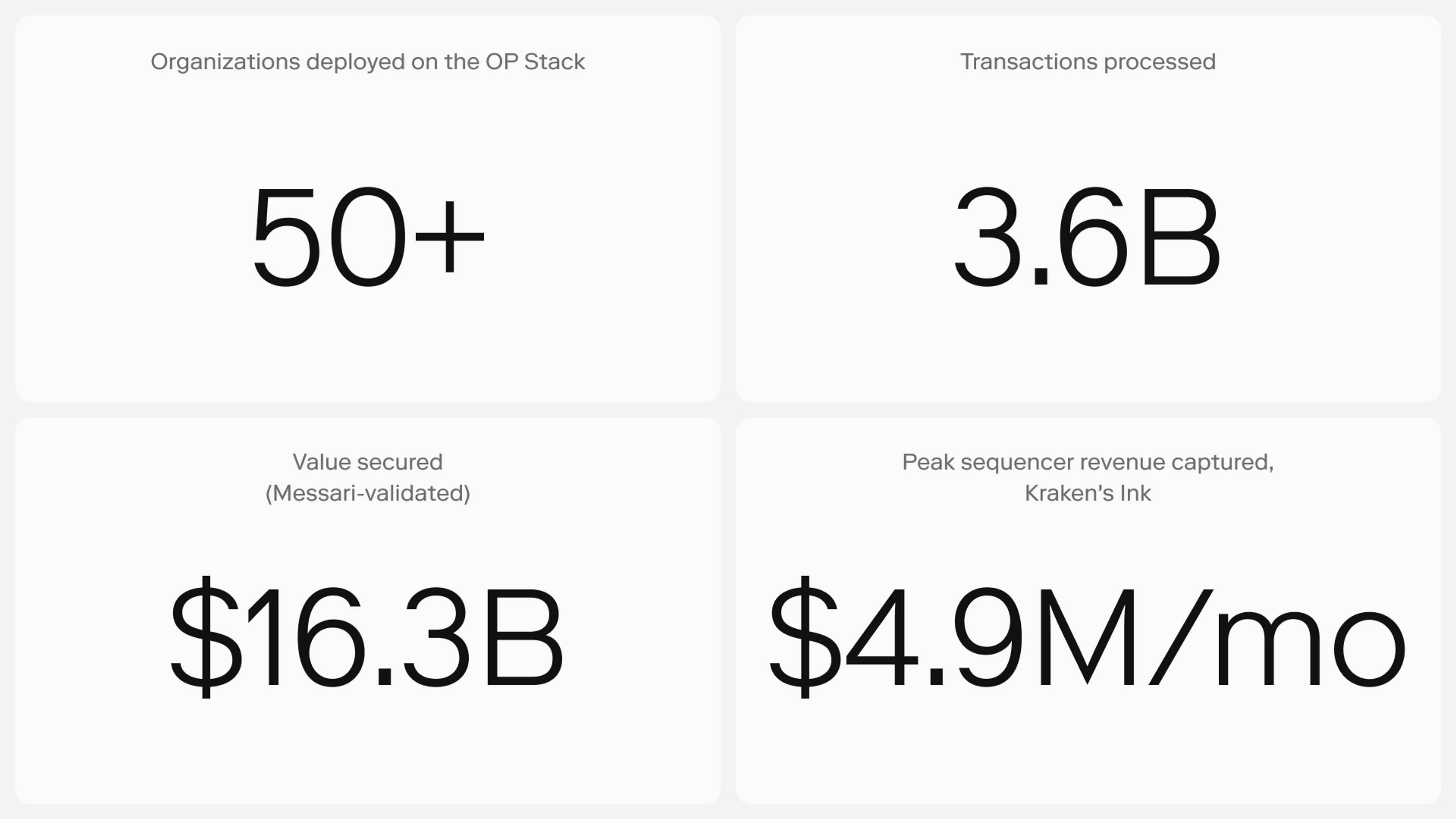
OP Stack by the numbers, as of H2 2025:
| Metric | Value |
|---|---|
| Organizations deployed on the OP Stack | 50+ |
| Transactions processed | 3.6B |
| Value secured | $16.3B (Messari-validated) |
| Peak sequencer revenue captured, Kraken's Ink | $4.9M/month |
| Privacy Boost proof generation | Sub-500ms |
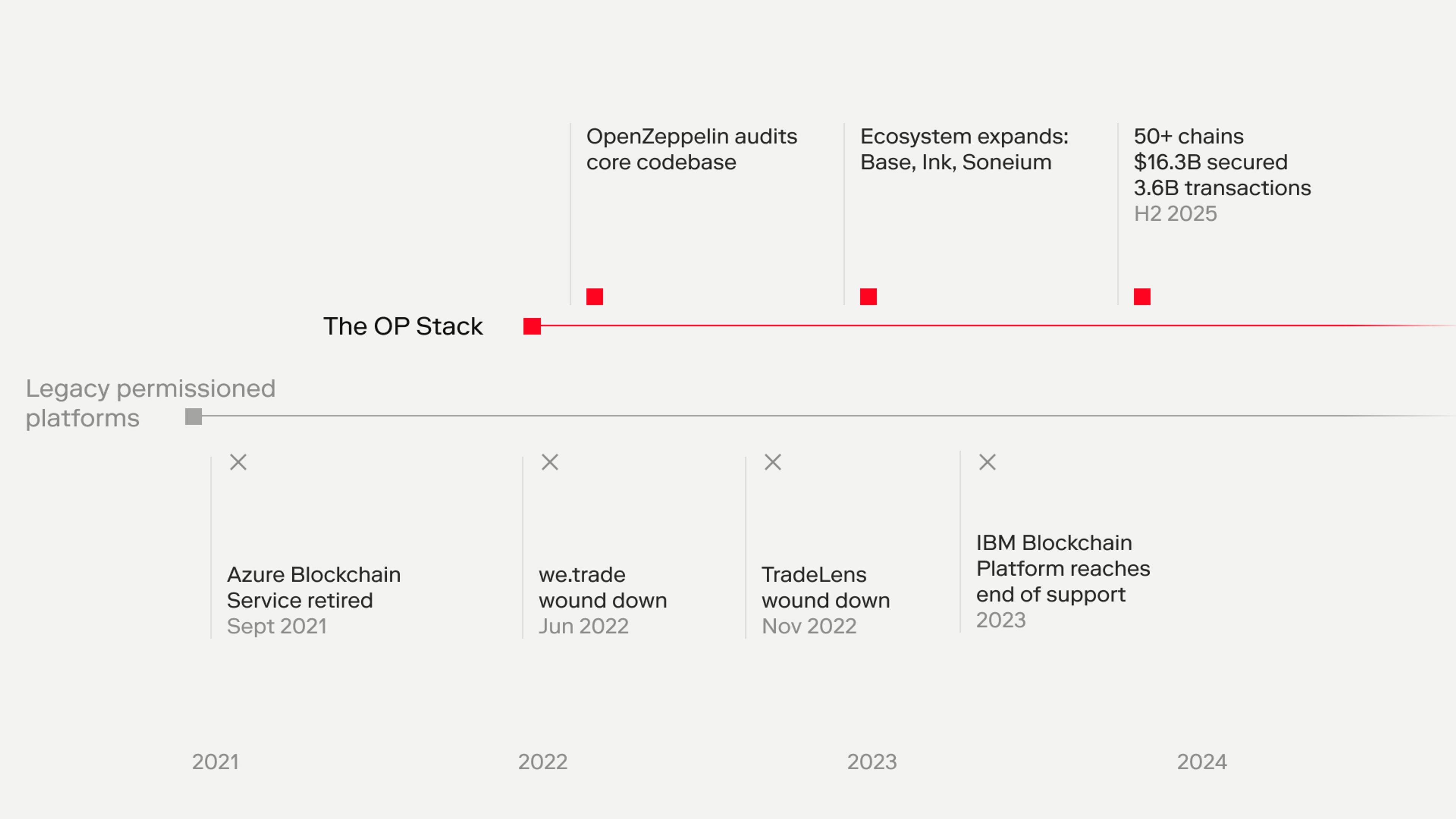
Here's how the platforms enterprises were told to trust compare to what's actually still standing, and to what's actually competing with the OP Stack right now.
Is Hyperledger Fabric still a good enterprise blockchain choice?
Hyperledger Fabric is still supported, but its enterprise momentum has declined sharply since its 2019–2021 peak. It requires a dedicated infrastructure team, runs smart contracts in a closed environment with no access to outside liquidity, and doesn't answer OFAC, MiCA, or AML questions on its own.
Every Fabric deployment needs a dedicated infrastructure team to manage certificate authorities, ordering services, peer nodes, and chaincode lifecycle. There's little standard tooling to lean on. Smart contracts run in a closed environment with no access to outside liquidity or applications, so every integration is custom-built. Permissioned access isn't the same thing as regulatory compliance: enterprises that assumed otherwise found Fabric's architecture wasn't built to answer OFAC, MiCA, or AML questions on its own.
IBM Blockchain Platform software reached end of support in April 2023, with customers directed to Hyperledger Fabric support directly. TradeLens and we.trade, two of Fabric's highest-profile deployments, wound down within months of each other in 2022.
IBM Research hasn't abandoned the underlying technology. It's a lead contributor to Fabric-X, a new architecture aimed at the throughput CBDC and tokenized-deposit use cases need, a research bet on where digital-asset infrastructure goes next. It doesn't reverse the broader enterprise pullback from the permissioned model Fabric popularized.
What are the drawbacks of AWS Managed Blockchain for enterprises?
AWS Managed Blockchain provides managed nodes, not a network. Enterprises still need counterparties, still need to negotiate data-sharing agreements, and still need to build the application layer themselves. Ethereum support covers node access only, not full Layer 2 deployment. It also inherits AWS's own availability risk, since a cloud-wide outage takes the blockchain down with it.
AWS Managed Blockchain went from preview to general availability in 2019, supporting Fabric and Ethereum. The pitch was operational simplicity: AWS runs the infrastructure, your team builds the application. AWS's infrastructure has had major, widely reported outages that took large parts of the internet down. When a blockchain's availability depends on one cloud provider's data centers, that risk transfers directly to whoever built on it.
Why did Microsoft retire Azure Blockchain Service?
Microsoft retired Azure Blockchain Service on September 10, 2021, after halting new deployments that May. The official reason was "evolving technology." The more accurate read: managed permissioned blockchain as a standalone cloud offering didn't find enough demand to justify a major cloud provider's continued investment.
Azure Blockchain Service supported Quorum and integrated with Azure Active Directory, an easy sell to IT teams already running Microsoft infrastructure. Microsoft pointed existing customers toward Azure Confidential Ledger, a narrower audit-log product, and ConsenSys's Quorum Blockchain Service.
Is R3 Corda a good fit for enterprise blockchain deployments?
R3 Corda works for narrow use cases that need bilateral transaction privacy: trade finance, syndicated lending, derivatives settlement. That same privacy model disconnects it from broader public liquidity and DeFi markets, and enterprise deployments typically require R3 consulting engagement plus ongoing licensing on top of a CorDapp developer pool that's much smaller than the Solidity ecosystem most EVM chains draw from.
Corda took a different approach than Fabric: bilateral transaction visibility, where only the parties to a transaction see it, rather than full network transparency or domain-level sharing. It's a real distinction, but the direction R3 itself is moving in tells its own story. R3 has launched Corda Protocol on Solana and stood up R3 Labs specifically to bring institutional assets from its permissioned platforms onto public-chain rails. When the vendor behind a permissioned platform starts building its next chapter on public infrastructure, that's a signal worth reading alongside the sales deck.
How does the OP Stack compare to Canton?
The OP Stack and Canton take different approaches to enterprise blockchain infrastructure. The OP Stack is fully EVM-compatible, where Canton runs on the DAML and Scala programming language. It settles to Ethereum L1, so a chain's state doesn't depend on a consortium staying operational, and Privacy Boost enforces privacy cryptographically rather than through consortium access control. Canton's advantage runs the other way on finality: its two-phase commit protocol gives synchronized, atomic finality across domains in a single step, something the OP Stack doesn't yet replicate natively across separate chains.
Canton deserves a real comparison, not a straw man. It's the most credible permissioned platform on the market, and institutions are using it at scale: DTCC and Euroclear co-chair its governance, Goldman Sachs' GS DAP runs live delivery-versus-payment settlements on it, JPMorgan is bringing JPM Coin natively onto it, and Broadridge routes over $8T/month in repo transactions through it, as of early 2026.
That scale doesn't close Canton's structural gaps. Its privacy model is trust-based: DAML's sub-transaction privacy lets each participant see only their relevant slice of a transaction, but domain membership and consortium governance enforce that, not mathematics. Each Canton domain is effectively its own silo, cut off from Ethereum DeFi and public stablecoins unless a trusted bridge reintroduces the counterparty risk permissioned chains exist to remove.
DAML is not EVM-compatible, and it remains a relatively new language with limited production hardening. It presents a steep learning curve, is supported by a comparatively small developer community, and poses significant upgrade challenges, as modifications frequently require halting the network or risk breaking compatibility with existing applications. Consequently, a chain built on Canton can draw only from a developer pool that is a small fraction of the Solidity ecosystem available to the OP Stack.
Privacy Boost addresses the remaining limitation. Rather than scoping visibility according to domain membership, it renders transaction data cryptographically unreadable to any party lacking the viewing key, including other participants on the same chain. The resulting guarantee derives from the underlying cryptographic proof rather than from the sustained alignment of a consortium.
How does the OP Stack compare to ZKsync's Prividium?
Privacy Boost on the OP Stack scopes privacy to the transaction; Prividium scopes it to the network. That difference means Privacy Boost doesn't get harder to maintain as an enterprise adds counterparties, while Prividium's privacy guarantee breaks the moment one connected participant isn't running Prividium too.
Prividium, ZKsync's validium architecture, is a real product from a real team: off-chain data with on-chain proofs, sub-second finality, KYC/SSO built in, and Deutsche Bank's Project DAMA running on it as of 2025.
Its constraint is structural, though. Every participant on the network has to run Prividium, or the guarantee breaks for whatever connects to the participant that isn't. That's manageable with a handful of known counterparties, but it gets harder every time the network adds one, the same scaling problem permissioned consortiums have run into for a decade under a different name.
Privacy Boost avoids that entirely. It's a drop-in SDK on an existing OP Stack chain, not a separate network every counterparty has to join first. Privacy is scoped to the transaction, not to network membership, so it doesn't get harder to maintain as the counterparty list grows.
How does the OP Stack compare to Hyperledger Besu?
An OP Stack chain settles to Ethereum L1 by default and inherits its liquidity, wallets, and DeFi ecosystem automatically. A Besu-based permissioned network shares the OP Stack's EVM compatibility but has to build custom bridges to reach that same liquidity, because confidentiality on Besu comes from network-level access control, not cryptography.
Hyperledger Besu is the closest technical cousin to the OP Stack on this list and has real institutional traction: it powers roughly 16% of Ethereum mainnet nodes as of early 2026, and banks including Citi and DTCC use it for tokenized deposits and collateral, alongside public-sector deployments like Nigeria's eNaira and the mBridge project.
That traction runs on a different model, though. Besu is a client an enterprise assembles into its own permissioned network, and confidentiality there comes from private transaction groups, the same privacy-by-isolation category as Fabric or Corda. Privacy Boost adds cryptographic transaction privacy on top of Ethereum settlement, without asking an enterprise to give up the liquidity access Besu-style isolation costs.
What makes the OP Stack different from every alternative above?
The OP Stack is the open source, MIT-licensed framework behind Optimism and 50+ other chains, including Base, Kraken's Ink, and Sony's Soneium. It's fully EVM-compatible, has been through public, independent security review, and, with Privacy Boost, has a cryptographic privacy layer that none of the platforms above can match without giving up liquidity access, EVM compatibility, or both.
Five dimensions where that difference shows up concretely:
- License: MIT, no licensing fee, no proprietary runtime, no single infrastructure provider to get locked into.
- Compatibility: fully EVM-compatible, so any existing Solidity smart contract deploys without modification.
- Compliance: enterprises can integrate third-party KYC and AML providers at the application layer, and a guardian role lets operators pause chain activity if something goes wrong. Compliance tooling is configured by the enterprise running the chain, not baked into the protocol as a default.
- Security: OpenZeppelin publicly audited the core OP Stack codebase over seven weeks in 2021, with the full audit history published at docs.optimism.io.
- Privacy: Privacy Boost, a ZK+TEE hybrid SDK built by Sunnyside Labs, an Optimism core developer, plugs into any OP Stack chain. Zero-knowledge proofs handle the confidentiality guarantee; a trusted execution environment handles throughput and the compliance layer: sub-500ms proof generation, viewing keys and selective disclosure for regulators and auditors, OpenZeppelin audited. Worth knowing before deployment: a user's first deposit of public funds into Privacy Boost is visible onchain; everything after that, inside the protocol, is private.
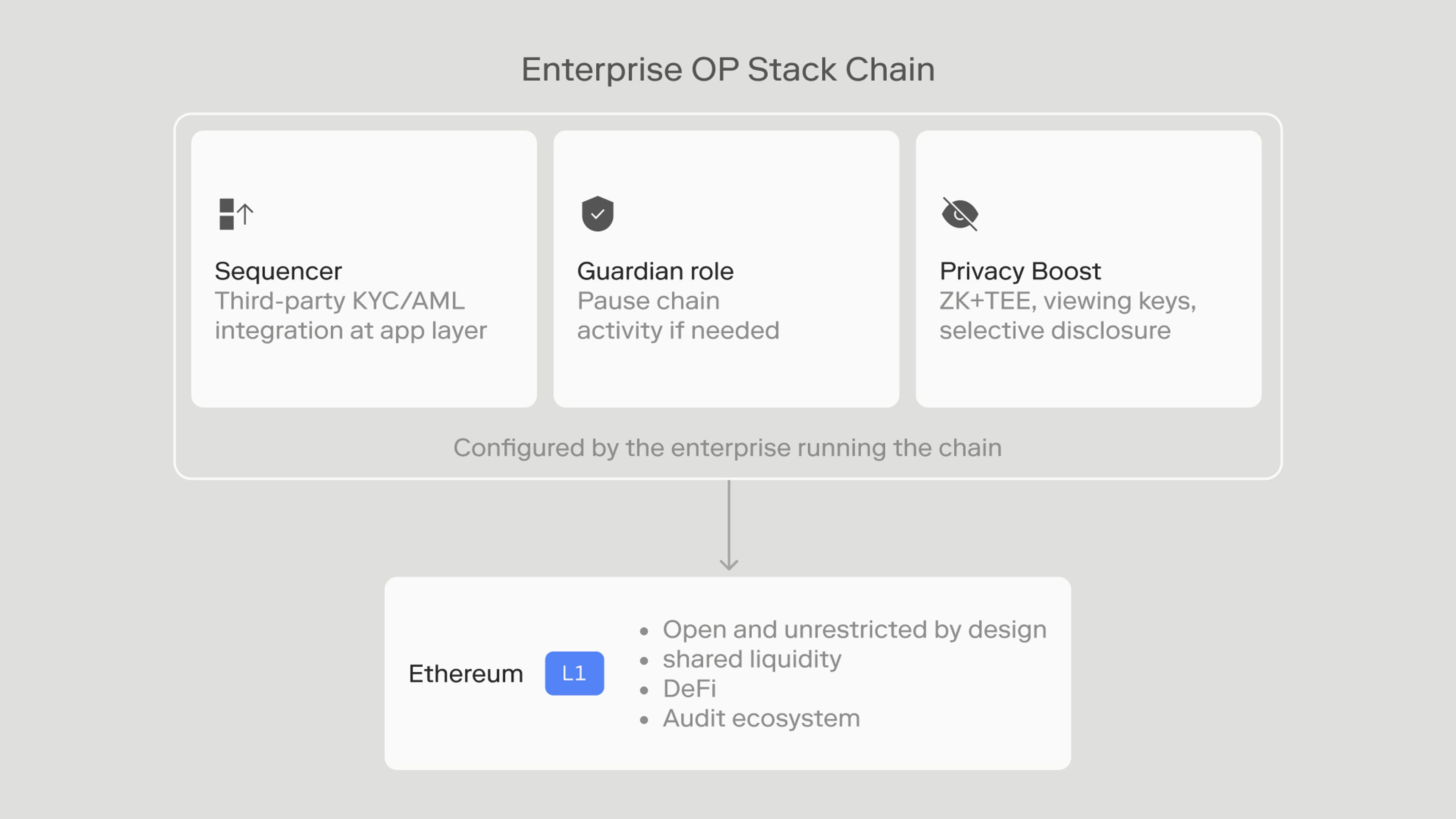
As of H2 2025, 50+ organizations across exchanges, fintechs, gaming, and DeFi have deployed on the OP Stack, processing 3.6B transactions and securing $16.3B in value (Messari-validated). Kraken's Ink chain shows what the economics look like in production: instead of paying transaction fees to a shared chain, Kraken captured that revenue directly, peaking near $4.9M a month. Fabric, Azure Blockchain, and TradeLens ran one experiment for most of a decade. Canton, Prividium, and Besu are running the current one. The OP Stack is the only platform in either generation that pairs an open, EVM-compatible foundation with cryptographic privacy that doesn't ask enterprises to trade away liquidity to get it.
How does the OP Stack compare across every platform in this piece?
| Dimension | OP Stack | Hyperledger Fabric | AWS Managed Blockchain | Azure Blockchain Service | R3 Corda | Canton | ZKsync Prividium | Hyperledger Besu |
|---|---|---|---|---|---|---|---|---|
| EVM compatible | Full | No | Partial (node access only) | No (Quorum) | No | No (DAML) | Yes | Yes |
| License and cost model | MIT, no license fee; pay only network gas costs | Apache 2.0, but requires a dedicated infrastructure team to operate | Proprietary AWS service, usage-based cloud fees | N/A, retired | Partial open source; consulting plus licensing, historically low six figures to $500K+/yr | Partial open source; consortium membership costs and DAML tooling lock-in | Proprietary managed service; commercial licensing | Apache 2.0, but enterprise deployments typically require managed support contracts |
| Privacy model | Cryptographic by default (Privacy Boost), no network dependency | Access control (private data collections) | None native | N/A, retired | Bilateral visibility (access control) | Trust-based, access-controlled (DAML sub-transaction scoping) | Cryptographic, but requires every participant on the network to run Prividium | Access control (private transaction groups) |
| Composability with public liquidity / DeFi | Direct (settles to Ethereum L1) | None | None | None | None | None (isolated domains) | Limited (validium) | None by default |
| Cross-domain atomic finality | No (single-chain finality via Ethereum L1; cross-chain atomicity not native) | No | No | N/A, retired | No | Yes (two-phase commit across domains) | No | No |
| Developer ecosystem | Solidity/EVM, shared with the broader Ethereum developer ecosystem (thousands of monthly active devs) | Chaincode (Go/Java/Node), enterprise-only pool | Depends on underlying chain | N/A, retired | CorDapp (Kotlin/Java), niche pool | DAML, roughly 200 contributors (Electric Capital) | Solidity/EVM, shared with public ZKsync | Solidity/EVM, shared with public Ethereum |
| Vendor / network lock-in | None | Low, but limited ecosystem | High | N/A, retired | High | High (DAML, consortium) | High (every counterparty must join) | Low, but bespoke network |
| State survives if the chain operator disappears | Yes (settles to Ethereum L1) | No | No | N/A, retired | No | No (depends on Super Validators) | Partial (proofs on L1, data availability depends on operator) | No, for permissioned deployments |
| Active development | Active | Declining | Limited | Retired | Limited; pivoting to Solana | Active | Active | Active |
| Enterprise track record | Base, Kraken's Ink, Sony's Soneium: 50+ chains, $16.3B secured | TradeLens, we.trade discontinued | N/A | Retired 2021 | Trade finance, lending | DTCC, Goldman, JPMorgan, Broadridge | Deutsche Bank Project DAMA | Citi, DTCC (tokenized deposits) |
So which enterprise blockchain platform should you choose?
Every platform in this comparison asks an enterprise to accept a tradeoff, and the OP Stack is no exception. Corda asks for narrow scope and now carries R3's own migration risk as the company builds its next chapter on Solana. Canton asks for DAML instead of the Solidity ecosystem the rest of the industry draws from, plus permanent dependence on a consortium's Global Synchronizer, in exchange for deterministic cross-domain finality the OP Stack doesn't yet match. Besu asks for a bespoke permissioned network with no default path to public liquidity. The OP Stack asks enterprises to rely on Privacy Boost, which Sunnyside Labs builds and operates independently rather than OP Labs itself, and, like most rollups today, to accept a single sequencer that OP Labs is still in the process of decentralizing. Each of those tradeoffs is a reason to keep evaluating, not a reason to stop.
| Every alternative in this comparison | OP Stack | |
|---|---|---|
| License & cost | Fees, licensing, or lock-in on every alternative | MIT license. No license fee. |
| Composability | None, or limited, with public liquidity and DeFi on every alternative | Full access to Ethereum liquidity and DeFi |
| Exit test | State does not survive if the operator disappears, on every permissioned alternative | Yes. Settles to Ethereum L1 |
| Privacy model | Access control, or cryptographic privacy that depends on full network participation | Cryptographic by default, no network dependency (Privacy Boost) |
For enterprises weighing EVM compatibility, direct access to Ethereum's existing liquidity, and cryptographic rather than access-controlled privacy, the OP Stack with Privacy Boost is a strong fit against every alternative in this piece. Organizations exploring a deployment can start with the OP Stack docs at docs.optimism.io, or get in touch about OP Enterprise for a managed option with compliance tooling, SLAs, and support built in.
Frequently Asked Questions
What happened to Hyperledger Fabric's enterprise adoption?
Enterprise Fabric deployments have declined since their 2019–2021 peak. IBM Blockchain Platform software reached end of support in April 2023, with customers directed to Hyperledger Fabric support. TradeLens and we.trade both wound down in 2022. IBM Research continues to invest in Fabric's underlying technology through Fabric-X, aimed at CBDC-scale throughput, but that's separate from the broader enterprise pullback from the permissioned model.
Is Azure Blockchain Service still available?
No. Microsoft retired Azure Blockchain Service on September 10, 2021, after halting new deployments that May. Existing customers were directed to Azure Confidential Ledger or ConsenSys's Quorum Blockchain Service.
Is R3 Corda still an independent permissioned platform?
R3 Corda remains available for bilateral use cases like trade finance and lending, but R3 is actively building its next chapter on public infrastructure: it has launched Corda Protocol on Solana and formed R3 Labs specifically to bridge its institutional assets onto public-chain rails.
What license is the OP Stack released under?
The OP Stack is MIT licensed. There's no licensing fee, no proprietary runtime, and no single infrastructure provider that enterprises are locked into.
Does the OP Stack support regulatory compliance like OFAC screening and KYC?
Enterprises can integrate third-party KYC and AML providers at the application layer of their own OP Stack chain, and a guardian role lets operators pause chain activity if needed. Privacy Boost adds selective disclosure and viewing keys, so regulators and auditors can access transaction data they're authorized to see without that data being public.
What is Privacy Boost, and how is it different from Canton's or Prividium's privacy model?
Privacy Boost is a ZK+TEE hybrid privacy SDK, built by Sunnyside Labs, that plugs into any OP Stack chain. Where Canton and Prividium enforce privacy by controlling who can join the network or see a given domain, Privacy Boost enforces it cryptographically: transactions are unreadable to anyone without the viewing key, including other participants on the same chain. It doesn't require a separate closed network, and it doesn't depend on every counterparty joining one.
What is Hyperledger Besu, and how is it different from the OP Stack?
Hyperledger Besu is an enterprise-grade Ethereum client used to build permissioned networks; it shares the OP Stack's EVM compatibility but not its default connection to public liquidity. An OP Stack chain settles to Ethereum L1 and inherits its ecosystem by default; a Besu-based network requires custom bridges to reach the same liquidity.
What is the OP Stack?
The OP Stack is the open source framework behind Optimism and the growing set of chains built on it, including Base, Kraken's Ink, Sony's Soneium, Unichain, and Celo. It's fully EVM-compatible, so existing Solidity smart contracts deploy without modification.
Which companies use the OP Stack?
As of H2 2025, 50+ organizations across exchanges, fintechs, gaming, and DeFi have deployed on the OP Stack, including Base, Kraken's Ink, Sony's Soneium, Unichain, and Celo. Bitpanda has announced it will be building Vision Chain, its MiCA-compliant chain, on the OP Stack.
How much does R3 Corda cost to deploy?
Enterprise Corda deployments typically require R3 consulting engagement and ongoing licensing, historically reported in the low six figures to $500K or more annually, in addition to Corda Enterprise costs.
Glossary
- OP Stack: The open source framework behind Optimism and 50+ other chains, MIT licensed.
- EVM compatibility: The ability to run existing Ethereum smart contracts (written in Solidity) without modification.
- Privacy Boost: A ZK+TEE hybrid privacy SDK built by Sunnyside Labs that plugs into any OP Stack chain, giving transactions cryptographic confidentiality rather than access-control-based privacy.
- Sunnyside Labs: An Optimism core developer; the team that built and independently operates Privacy Boost.
- OP Enterprise: OP Labs' managed offering for enterprises deploying on the OP Stack, including compliance tooling, SLAs, and dedicated support.
- Sequencer: The component of a rollup chain that orders and processes transactions before they're posted to the underlying network.
- Guardian role: An OP Stack mechanism that lets designated operators pause chain activity in an emergency.
- Canton: A permissioned smart contract platform built on DAML, used by DTCC, Goldman Sachs, JPMorgan, and other institutions for tokenized asset settlement.
- DAML: Smart contract language; not EVM-compatible.
- Prividium: ZKsync's validium architecture for enterprises, combining off-chain data with on-chain proofs.
- Validium: A scaling architecture where transaction data is stored off-chain but verified with on-chain proofs.
- Hyperledger Besu: An enterprise-grade, EVM-compatible Ethereum client used to build both public and permissioned networks.
- Viewing key: A credential that lets an authorized party (such as a regulator or auditor) decrypt and inspect specific private transaction data without making it public.
- MiCA: The EU's Markets in Crypto-Assets regulation, the primary licensing framework for crypto asset service providers in Europe.
- OFAC screening: Checking transacting addresses against the U.S. Treasury's sanctions list.
- CorDapp: An application built on R3's Corda platform.
- Chaincode: Hyperledger Fabric's term for smart contracts.
Authored by

Optimism