
Korea's Tokenized Securities Rollout Starts in February 2027. Four Korean Institutions Are Already Building on the OP Stack.
TL;DR: South Korea's Financial Services Commission set February 2027 as the start of a phased tokenized securities rollout. Four Korean institutions have announced OP Stack work ahead of it, and none is in production yet.
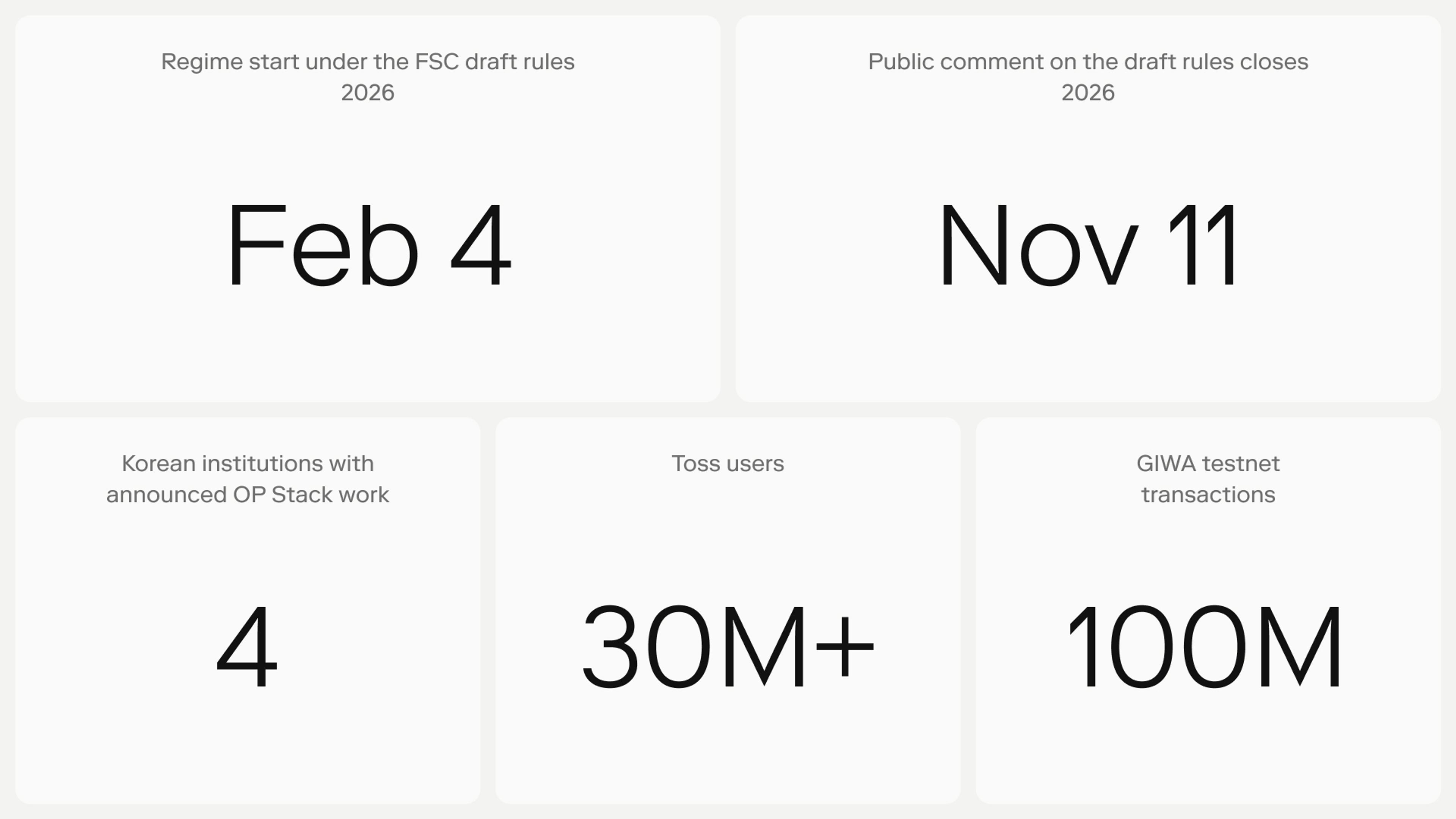
- Phase one starts February 4, 2027 under draft rules open for comment until November 11. Phases two and three have no dates.
- Toss, KB Securities, DB Securities, and Dunamu's GIWA are each at a different stage: a test, an MOU, a phased build, and a testnet.
- KB Securities plans OP Mainnet, a shared network. GIWA runs on a dedicated Self Managed OP Enterprise chain.
Korea has a date. On September 4, 2026, the Financial Services Commission published a roadmap that brings tokenized issuance to mainstream securities beginning in February 2027. Several large institutions have already started building.
What did Korea's FSC announce for February 2027?
On September 4, 2026, Korea's Financial Services Commission published a three-phase roadmap for tokenized securities. Phase one starts in February 2027 and covers institutional money market funds and bonds, unlisted stocks through trust structures, and publicly offered fractional investment securities. Phases two and three depend on phase one results and pending stablecoin legislation.
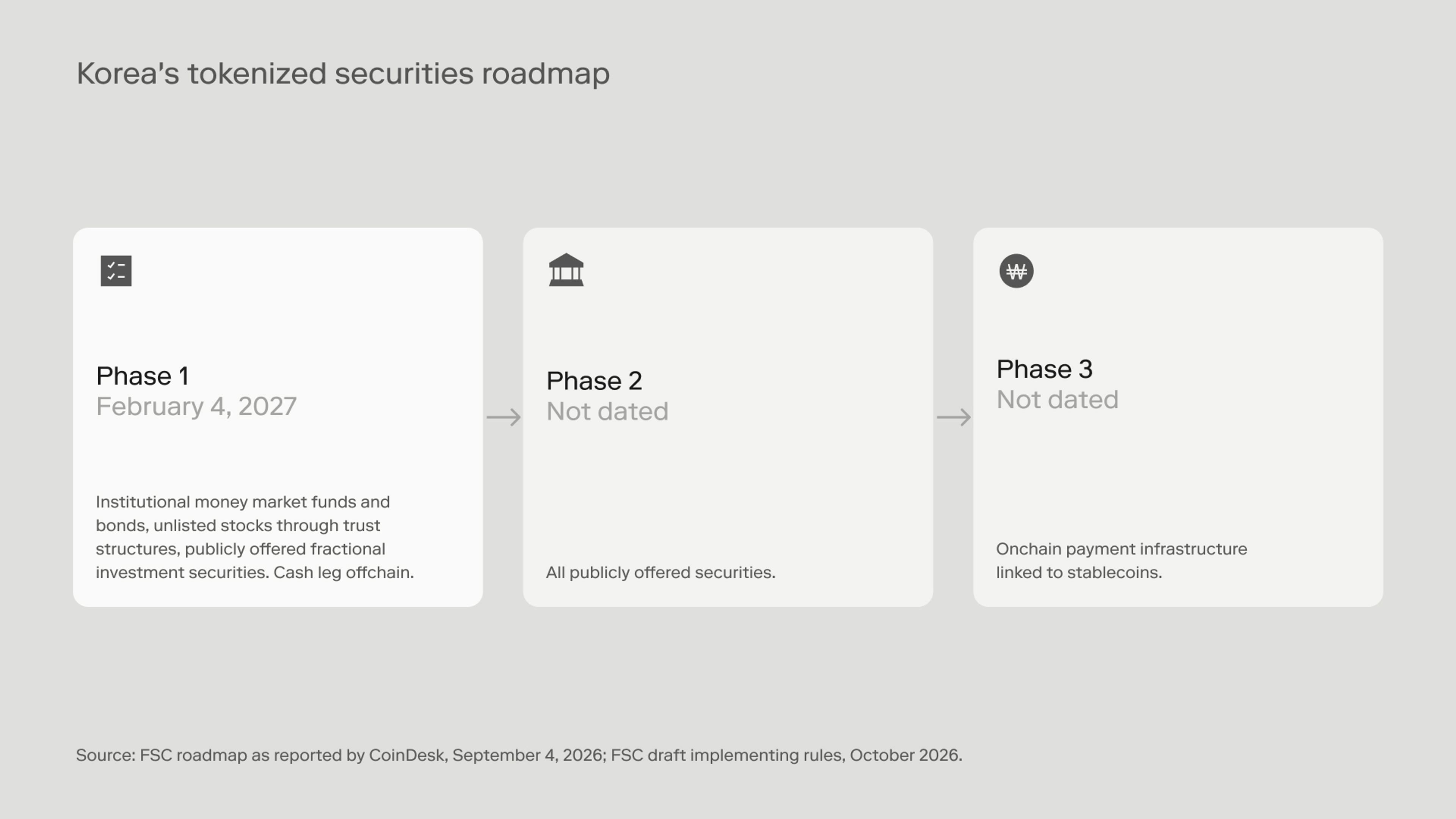
The FSC has since followed the roadmap with draft implementing rules, the last set needed before the regime starts on February 4, 2027. They put into practice legislation passed in January that lets a distributed ledger count as an official securities register. Public comment is open until November 11. After that, the FSC will decide whether to relax requirements such as the ledger-sharing rule described below.
How do the draft rules treat the central depository?
The Korea Securities Depository (KSD), the country's central securities depository, sits at the center of the draft. Every ledger used to register tokenized securities must be shared with the KSD and with at least two account managers, such as securities firms or banks. That is a more centralized design than Germany and Switzerland use. There, certain securities can be issued straight into DLT-based registers without a conventional depository operating the register. As drafted, ledger-sharing is a design requirement from day one.
Why is Korea steering institutions toward tokenized securities?
South Korea is one of the world's largest retail crypto markets. Kaiko research puts roughly a quarter of global crypto trading against fiat currencies in won, and the FSC counts 11.3 million verified crypto users. Institutions are a different story. Companies have been barred from trading crypto in principle since 2017. Authorities have started reopening the market to some corporates, but banks and other financial institutions remain excluded. Regulators have pointed those institutions toward tokenized securities on regulated capital-markets infrastructure instead, a route the FSC first outlined in 2023.
How will tokenized securities settle in cash?
That is still open. In phase one the cash leg stays offchain, and onchain payments linked to stablecoins arrive only in phase three. The Bank of Korea laid out its preferred order in a May note: tokenized assets should settle first in central bank money or bank deposits, with stablecoins in a supporting role. Project Hangang has tested that design, with commercial banks issuing deposit tokens on top of a wholesale central bank money layer. Nine banks are now preparing its second phase.
Banks are also positioning for stablecoins. Hana Financial leads a won stablecoin consortium with four other lenders. In May, Hana Bank agreed to buy a 6.55% stake in Dunamu, the company behind the Upbit exchange, for about KRW 1 trillion ($670 million), and the two agreed to build a won stablecoin ecosystem together. Securitize has also lined up Korean partners before February, with agreements on tokenized funds with KB Securities and on infrastructure with LG CNS.
Which Korean institutions are building on the OP Stack?
Four named Korean institutions have announced OP Stack work: Toss, KB Securities, DB Securities, and Dunamu's GIWA. Together they cover a payments test, institutional tokenized funds, real-world assets, and an exchange-backed chain. None is in production yet. Each announcement describes a test, an MOU, a phased build, or a testnet.
| Institution | What was announced | Network | Stage |
|---|---|---|---|
| Toss (with KOMSCO) | Stablecoin-payments partnership; full load, spend, and settle payment test | OP Stack | July 2026 MOU; September 2026 test in a separate environment, no go-live date |
| KB Securities (with Securitize and the Optimism Foundation) | Tokenized money market fund and a KB Asset Management fund for institutional clients | OP Mainnet | MOU signed September 21, 2026 |
| DB Securities | Tokenized Jeju smart-farming and livestock assets and Korean IP | OP Stack | Two-year phased build |
| Dunamu (GIWA) | Exchange-backed chain | Self Managed OP Enterprise | Testnet |
Toss and KOMSCO: a payment test in a separate environment
Toss is the app South Korea uses for banking, payments, investing, credit, and taxes. More than 30 million people use it, close to two-thirds of the country. In July 2026, Toss, Optimism, and Sunnyside Labs signed an MOU covering a stablecoin-payments Layer 2 partnership.
In September, Toss and KOMSCO, the Korea Minting and Security Printing Corporation, tested a full load, spend, and settle cycle for a local-currency voucher. Spending and settlement completed together in a single transaction on the OP Stack. The test ran in an environment separate from KOMSCO's live Local Love Gift Certificate service, and no go-live date has been set.
KB Securities: an MOU for institutional tokenized funds
On September 21, 2026, KB Securities signed an MOU with Securitize and the Optimism Foundation. KB Securities supplies the products, Securitize provides tokenization infrastructure, and the Optimism Foundation supports the blockchain network.
The first products are a tokenized money market fund and a fund from KB Asset Management, both for institutional clients and planned for OP Mainnet. Stocks, U.S. ADRs, corporate bonds, and government bonds follow as Korea's token securities rules progress.
DB Securities: a two-year phased build
DB Securities, a traditional securities and underwriting firm, has committed to a two-year phased build. It will tokenize Jeju smart-farming and livestock assets, plus Korean intellectual property, into security token and real-world asset formats.
Dunamu's GIWA: a Self Managed chain on testnet
Dunamu, the company behind the Upbit exchange, built GIWA on the OP Stack. GIWA is the first Self Managed OP Enterprise deployment, with roughly 100 million testnet transactions to date.
Why are these institutions choosing different operating models?
There is no single right setup for a Korean institution preparing for tokenized securities. The choice depends on who needs control over what. A shared public network gets a product into production fastest. A dedicated chain gives an institution its own capacity, configuration, economics, and chain-level controls, in exchange for more operating responsibility.
| Decision factor | Shared public network (OP Mainnet) | Dedicated chain (OP Enterprise) |
|---|---|---|
| Time to production | Fastest path, no chain to stand up | Longer, since the chain must be deployed and configured |
| Capacity and block space | Shared with other applications | Dedicated to the institution |
| Chain-level controls | Application-level controls | Chain-level configuration and permissioned access |
| Operating responsibility | No chain infrastructure to run | Self Managed: the institution runs the infrastructure with Optimism support. Fully Managed: Optimism deploys, operates, and upgrades it as a managed service |
| Economics | Shared network economics | The chain operator keeps sequencer revenue |
KB Securities' plan sits in the first column. GIWA sits in the second, under the Self Managed tier. Each is a sensible answer to a different question. An institution with a narrow first product and a short timeline weighs them differently from an exchange running its own chain.
What should institutions consider before February 2027?
Consider starting in a test environment now and settle the operating model once the product is defined. The work before phase one comes down to four steps.
- Define the product and who holds it. Phase one is institutional, so the first products are funds and bonds sold to institutional clients, as in KB Securities' plan.
- Decide how investor identity and custody will work for the clients the product serves.
- Treat stablecoin settlement as a later addition. Onchain payment infrastructure linked to stablecoins is phase three of the FSC roadmap and depends on legislation that is still pending.
- Check your launch timing against the FSC roadmap before committing to a date, since only phase one is dated.
What is still undecided?
The implementing rules are still drafts, and the FSC may change requirements such as ledger-sharing after the November 11 consultation closes. The FSC has not dated phases two and three. Stablecoin legislation has not passed. Korea has no timetable for an onchain cash leg, and it has not decided whether stablecoins, deposit tokens, or central bank money will settle these securities. No Korean project named here is in production: Toss and KOMSCO tested in a separate environment, the KB Securities MOU sets out plans rather than a launch date, and GIWA is on testnet. MOUs are statements of intent, so these announcements are early signals and no market is live yet.
Next, Toss and KOMSCO will decide whether to extend their test toward a live rollout on their own timeline. Optimism continues work with Toss under the July MOU. To see what a dedicated chain looks like in practice, read about OP Enterprise.
Frequently Asked Questions
When does Korea's tokenized securities rollout start?
Phase one starts in February 2027, according to the roadmap the Financial Services Commission published on September 4, 2026. It covers institutional money market funds and bonds, unlisted stocks through trust structures, and publicly offered fractional investment securities. Phases two and three have no set dates and depend on phase one results and pending stablecoin legislation.
Which Korean institutions are building on the OP Stack?
Toss, KB Securities, DB Securities, and Dunamu's GIWA have each announced OP Stack work. Toss and KOMSCO ran a payment test. KB Securities plans tokenized funds with Securitize and the Optimism Foundation. DB Securities plans tokenized real-world assets. GIWA is a Self Managed OP Enterprise chain on testnet.
What is KB Securities building with Securitize and the Optimism Foundation?
KB Securities signed an MOU on September 21, 2026 to build a tokenized securities business for institutional investors. It plans to start with a tokenized money market fund and a KB Asset Management fund on OP Mainnet. Stocks, ADRs, and bonds follow as Korean token securities rules develop.
What did Toss and KOMSCO test on the OP Stack?
They tested a full local-currency payment cycle: load, spend, and settle. Spending and settlement completed together in a single transaction. The test ran in an environment separate from KOMSCO's live Local Love Gift Certificate service, and no go-live date has been announced by either party.
What do Korea's draft tokenized securities rules require?
Every ledger used to register tokenized securities must be shared with the Korea Securities Depository and at least two account managers, such as securities firms or banks. The rules take effect February 4, 2027, and public comment runs until November 11. The FSC may relax requirements such as ledger-sharing after the consultation closes.
Is any of this live in production?
No. The Toss and KOMSCO test ran in a separate environment, the KB Securities agreement is an MOU, and GIWA is on testnet. Phase one of the FSC roadmap begins in February 2027, so production issuance of tokenized securities in Korea is still ahead. DB Securities has described a two-year phased build.
Should a Korean institution use OP Mainnet or a dedicated OP Enterprise chain?
It depends on the product and the timeline. OP Mainnet is a shared public network and the fastest path to production. A dedicated chain through OP Enterprise adds its own capacity, configuration, and chain-level controls. Its Self Managed and Fully Managed tiers split operating responsibility differently.
Glossary
- FSC: The Financial Services Commission, South Korea's financial regulator, which published the tokenized securities roadmap.
- Tokenized security: A traditional security, such as a fund unit or bond, issued and recorded on a blockchain.
- STO: A security token offering, the issuance of tokenized securities to investors.
- KSD: The Korea Securities Depository, South Korea's central securities depository, which sits at the center of the draft tokenized securities rules.
- KOMSCO: The Korea Minting and Security Printing Corporation, which produces South Korea's banknotes and coins and runs public payment services.
- OP Stack: The open-source, MIT-licensed technology that Ethereum Layer 2 chains are built on.
- OP Mainnet: Optimism's public Ethereum Layer 2, a shared network for deploying applications without running a chain.
- OP Enterprise: Optimism's commercial product for dedicated chains, offered as Self Managed and Fully Managed tiers.
Key sources
- Korea FSC tokenized securities roadmap, September 4, 2026
- CoinDesk: South Korea targets February 2027 rollout for full tokenized securities market
- Optimism: Toss and KOMSCO Just Showed Blockchain Payments Can Skip the Rebuild
- Optimism: Toss MOU announcement, July 2026
- Optimism: Optimism in Korea, August 10, 2026
- DigitalToday: KB Securities joins Securitize, Optimism to pursue STO business for institutions
- Korea FSC draft rules for the tokenized securities regime
- Kaiko: Stablecoins, Fiat Rails, and the Unique Characteristics of KRW Pairs
- Bank of Korea issue note, May 2026
- Securitize and LG CNS partnership
TL;DR: 한국 금융위원회는 2027년 2월을 토큰증권 단계적 도입의 시작 시점으로 정했습니다. 한국 금융기관 4곳이 이에 앞서 OP Stack 작업을 발표했으며, 아직 상용화된 곳은 없습니다.
- 1단계는 2027년 2월 4일에 시작하며, 11월 11일까지 의견을 받는 규칙 초안이 적용됩니다. 2단계와 3단계는 일정이 없습니다.
- Toss, KB증권, DB증권, Dunamu의 GIWA는 각각 테스트, MOU, 단계적 구축, 테스트넷으로 서로 다른 단계에 있습니다.
- KB증권은 공유 네트워크인 OP Mainnet을 계획하고 있습니다. GIWA는 전용 Self Managed OP Enterprise 체인에서 운영됩니다.
한국 시장에 구체적인 날짜가 생겼습니다. 2026년 9월 4일, 금융위원회는 2027년 2월부터 토큰증권 발행을 주류 증권으로 확대하는 로드맵을 발표했습니다. 대형 금융기관 여러 곳이 이미 구축에 나섰습니다.
금융위는 2027년 2월에 대해 무엇을 발표했나?
2026년 9월 4일, 한국 금융위원회는 토큰증권에 대한 3단계 로드맵을 발표했습니다. 1단계는 2027년 2월에 시작하며 기관 대상 MMF와 채권, 신탁 구조를 통한 비상장 주식, 공모 소액투자 증권을 다룹니다. 2단계와 3단계는 1단계 결과와 계류 중인 스테이블코인 입법에 달려 있습니다.
| 단계 | 시기 | 범위 | 조건 |
|---|---|---|---|
| 1 | 2027년 2월 4일 | 기관 대상 MMF와 채권, 신탁 구조를 통한 비상장 주식, 공모 소액투자 증권 | FSC 로드맵에 일정 명시 |
| 2 | 미정 | 모든 공모 증권 | 1단계 결과와 기술 도입에 따라 결정 |
| 3 | 미정 | 스테이블코인 연계 온체인 결제 인프라 | 계류 중인 스테이블코인 입법에 따라 결정 |
이후 FSC는 로드맵에 이어 시행 세칙 초안을 내놓았으며, 이는 2027년 2월 4일 제도 시작 전에 필요한 마지막 규정 묶음입니다. 초안은 1월에 통과된 법률, 즉 분산원장을 공식 증권 등록부로 인정하는 법률을 실무에 적용하는 내용입니다. 의견수렴은 11월 11일까지 열려 있습니다. 이후 FSC는 아래에 설명할 원장 공유 규칙 같은 요건을 완화할지 결정합니다.
규칙 초안은 중앙예탁기관을 어떻게 다루나?
초안의 중심에는 국가의 중앙증권예탁기관인 한국예탁결제원(KSD)이 있습니다. 토큰증권 등록에 쓰이는 모든 원장은 KSD 및 증권사나 은행 같은 계좌관리기관 최소 2곳과 공유되어야 합니다. 이는 독일과 스위스가 쓰는 방식보다 중앙집중적인 설계입니다. 두 나라에서는 일부 증권을 기존 예탁기관이 등록부를 운영하지 않고도 DLT 기반 등록부에 직접 발행할 수 있습니다. 초안대로라면 원장 공유는 첫날부터 적용되는 설계 요건입니다.
한국은 왜 금융기관을 토큰증권으로 이끄는가?
한국은 세계 최대 수준의 개인 투자자 중심 암호화폐 시장 중 하나입니다. Kaiko 리서치에 따르면 전 세계 법정화폐 대비 암호화폐 거래의 약 4분의 1이 원화로 이뤄지고, FSC는 인증된 암호화폐 이용자를 1,130만 명으로 집계합니다. 그러나 기관은 사정이 다릅니다. 법인은 2017년부터 원칙적으로 암호화폐 거래가 금지되어 왔습니다. 당국이 일부 기업에 시장을 다시 열기 시작했지만, 은행과 기타 금융기관은 여전히 제외되어 있습니다. 규제당국은 이들 기관을 대신 규제된 자본시장 인프라 위의 토큰증권으로 유도해 왔으며, 이 경로는 FSC가 2023년에 처음 제시했습니다.
토큰증권은 현금으로 어떻게 결제되나?
아직 정해지지 않았습니다. 1단계에서 현금 결제는 오프체인에 남고, 스테이블코인 연계 온체인 결제는 3단계에야 도입됩니다. 한국은행은 5월 노트에서 선호하는 순서를 밝혔습니다. 토큰화 자산은 먼저 중앙은행 화폐나 은행 예금으로 결제하고, 스테이블코인은 보조 역할을 해야 한다는 것입니다. 프로젝트 한강은 이 설계를 시험했으며, 시중은행이 도매 중앙은행 화폐 계층 위에서 예금토큰을 발행하는 방식입니다. 현재 9개 은행이 2단계를 준비하고 있습니다.
은행들은 스테이블코인에도 대비하고 있습니다. 하나금융은 다른 4개 은행과 함께 원화 스테이블코인 컨소시엄을 이끕니다. 5월에 하나은행은 업비트 거래소 운영사인 Dunamu의 지분 6.55%를 약 1조 원(약 6.7억 달러)에 인수하기로 합의했고, 두 회사는 원화 스테이블코인 생태계를 함께 구축하기로 했습니다. Securitize도 2월에 앞서 한국 파트너를 확보했습니다. KB증권과는 토큰화 펀드 관련 계약을, LG CNS와는 인프라 관련 계약을 체결했습니다.
어떤 한국 금융기관이 OP Stack 위에서 구축하고 있나?
한국 기관 4곳이 OP Stack 작업을 발표했습니다. Toss, KB증권, DB증권, Dunamu의 GIWA입니다. 이들은 함께 결제 테스트, 기관용 토큰화 펀드, 실물자산(RWA), 거래소 기반 체인을 아우릅니다. 아직 상용화된 곳은 없습니다. 각 발표는 테스트, MOU, 단계적 구축, 테스트넷 중 하나에 해당합니다.
| 기관 | 발표 내용 | 네트워크 | 단계 |
|---|---|---|---|
| Toss (KOMSCO와 함께) | 스테이블코인 결제 파트너십. 충전, 사용, 정산 전 과정 결제 테스트 | OP Stack | 2026년 7월 MOU. 2026년 9월 별도 환경에서 테스트, 상용화 일정 없음 |
| KB증권 (Securitize, Optimism Foundation과 함께) | 토큰화 MMF 및 기관 고객 대상 KB자산운용 펀드 | OP Mainnet | 2026년 9월 21일 MOU 체결 |
| DB증권 | 제주 스마트팜·축산 자산 및 한국 IP 토큰화 | OP Stack | 2년 단계적 구축 |
| Dunamu (GIWA) | 거래소 기반 체인 | Self Managed OP Enterprise | 테스트넷 |
Toss와 KOMSCO: 별도 환경에서의 결제 테스트
Toss는 한국에서 은행, 결제, 투자, 신용, 세금에 쓰는 앱입니다. 이용자는 3,000만 명이 넘어 국민의 3분의 2에 가깝습니다. 2026년 7월 Toss, Optimism, Sunnyside Labs는 스테이블코인 결제 Layer 2 파트너십을 다루는 MOU를 체결했습니다.
9월에는 Toss와 한국조폐공사(KOMSCO)가 지역화폐 상품권의 충전, 사용, 정산 전 과정을 테스트했습니다. 사용과 정산은 OP Stack 위에서 단일 트랜잭션으로 함께 완료되었습니다. 이 테스트는 KOMSCO의 실제 운영 서비스인 지역사랑상품권과 분리된 환경에서 진행되었으며, 상용화 일정은 정해지지 않았습니다.
KB증권: 기관용 토큰화 펀드를 위한 MOU
2026년 9월 21일, KB증권은 Securitize 및 Optimism Foundation과 MOU를 체결했습니다. KB증권은 상품을 공급하고, Securitize는 토큰화 인프라를 제공하며, Optimism Foundation은 블록체인 네트워크를 지원합니다.
첫 상품은 토큰화 MMF와 KB자산운용의 펀드로, 둘 다 기관 고객 대상이며 OP Mainnet에서 출시할 계획입니다. 주식, 미국 ADR, 회사채, 국채는 한국의 토큰증권 규정이 진전됨에 따라 뒤따릅니다.
DB증권: 2년 단계적 구축
전통 증권·인수 업무를 하는 DB증권은 2년 단계적 구축을 약속했습니다. 제주 스마트팜·축산 자산과 한국 지식재산권을 증권형 토큰과 RWA 형태로 토큰화할 예정입니다.
Dunamu의 GIWA: 테스트넷 단계의 Self Managed 체인
업비트 거래소를 운영하는 Dunamu는 OP Stack 위에 GIWA를 구축했습니다. GIWA는 최초의 Self Managed OP Enterprise 배포이며, 지금까지 테스트넷 트랜잭션이 약 1억 건입니다.
기관들은 왜 서로 다른 운영 모델을 선택하나?
토큰증권을 준비하는 한국 기관에 정답인 단일 구성은 없습니다. 누가 무엇을 통제해야 하는지에 따라 선택이 달라집니다. 공유 퍼블릭 네트워크는 상품을 가장 빠르게 상용화할 수 있습니다. 전용 체인은 기관에 자체 용량, 설정, 경제 구조, 체인 수준의 통제권을 주는 대신 운영 책임이 더 큽니다.
| 판단 요소 | 공유 퍼블릭 네트워크 (OP Mainnet) | 전용 체인 (OP Enterprise) |
|---|---|---|
| 상용화까지 시간 | 가장 빠름. 구축할 체인 없음 | 더 김. 체인을 배포하고 설정해야 함 |
| 용량과 블록 공간 | 다른 애플리케이션과 공유 | 기관 전용 |
| 체인 수준 통제 | 애플리케이션 수준 통제 | 체인 수준 설정과 권한 기반 접근 |
| 운영 책임 | 운영할 체인 인프라 없음 | Self Managed: 기관이 Optimism 지원을 받아 인프라 운영. Fully Managed: Optimism이 관리형 서비스로 배포, 운영, 업그레이드 |
| 경제 구조 | 공유 네트워크 경제 구조 | 체인 운영자가 시퀀서 수익 보유 |
KB증권의 계획은 첫 번째 열에 해당합니다. GIWA는 Self Managed 티어로 두 번째 열에 해당합니다. 각각 서로 다른 질문에 대한 합리적인 답입니다. 첫 상품이 좁고 일정이 짧은 기관은 자체 체인을 운영하는 거래소와는 다르게 저울질합니다.
2027년 2월 전에 기관은 무엇을 고려해야 하나?
지금 테스트 환경에서 시작하는 방안을 검토하고, 상품이 정해지면 운영 모델을 확정하는 것이 좋습니다. 1단계 전까지 할 일은 네 단계로 정리됩니다.
- 상품과 보유 주체를 정의합니다. 1단계는 기관 대상이므로, KB증권의 계획처럼 첫 상품은 기관 고객에게 판매하는 펀드와 채권입니다.
- 상품이 대상으로 하는 고객의 투자자 신원 확인과 수탁을 어떻게 처리할지 결정합니다.
- 스테이블코인 결제는 나중에 추가할 요소로 봅니다. 스테이블코인 연계 온체인 결제 인프라는 FSC 로드맵의 3단계이며, 아직 계류 중인 입법에 달려 있습니다.
- 출시 일정을 확정하기 전에 FSC 로드맵과 대조합니다. 일정이 정해진 것은 1단계뿐입니다.
아직 결정되지 않은 것은?
시행 세칙은 아직 초안이며, FSC는 11월 11일 의견수렴이 끝난 뒤 원장 공유 같은 요건을 바꿀 수 있습니다. FSC는 2단계와 3단계의 일정을 정하지 않았습니다. 스테이블코인 입법은 통과되지 않았습니다. 한국에는 온체인 현금 결제의 시간표가 없으며, 스테이블코인, 예금토큰, 중앙은행 화폐 중 무엇으로 이들 증권을 결제할지도 정해지지 않았습니다. 여기서 언급한 한국 프로젝트 중 상용화된 것은 없습니다. Toss와 KOMSCO는 별도 환경에서 테스트했고, KB증권 MOU는 출시 일정이 아니라 계획을 담고 있으며, GIWA는 테스트넷 단계입니다. MOU는 의향 표명이므로 이번 발표들은 초기 신호이며 아직 열린 시장은 없습니다.
다음으로 Toss와 KOMSCO는 자체 일정에 따라 테스트를 실제 도입으로 확장할지 결정합니다. Optimism은 7월 MOU에 따라 Toss와 계속 협력합니다. 전용 체인이 실제로 어떤 모습인지 보려면 OP Enterprise를 읽어보세요.
자주 묻는 질문
한국의 토큰증권 제도는 언제 시작하나?
금융위원회가 2026년 9월 4일 발표한 로드맵에 따르면 1단계는 2027년 2월에 시작합니다. 기관 대상 MMF와 채권, 신탁 구조를 통한 비상장 주식, 공모 소액투자 증권을 다룹니다. 2단계와 3단계는 일정이 없으며 1단계 결과와 계류 중인 스테이블코인 입법에 달려 있습니다.
어떤 한국 금융기관이 OP Stack 위에서 구축하고 있나?
Toss, KB증권, DB증권, Dunamu의 GIWA가 각각 OP Stack 작업을 발표했습니다. Toss와 KOMSCO는 결제 테스트를 진행했습니다. KB증권은 Securitize, Optimism Foundation과 토큰화 펀드를 계획합니다. DB증권은 토큰화 실물자산을 계획합니다. GIWA는 테스트넷 단계의 Self Managed OP Enterprise 체인입니다.
KB증권은 Securitize, Optimism Foundation과 무엇을 구축하나?
KB증권은 2026년 9월 21일 기관 투자자 대상 토큰증권 사업을 구축하기 위한 MOU를 체결했습니다. OP Mainnet에서 토큰화 MMF와 KB자산운용 펀드로 시작할 계획입니다. 주식, ADR, 채권은 한국 토큰증권 규정이 발전함에 따라 뒤따릅니다.
Toss와 KOMSCO는 OP Stack에서 무엇을 테스트했나?
지역화폐 결제 전 과정인 충전, 사용, 정산을 테스트했습니다. 사용과 정산은 단일 트랜잭션으로 함께 완료되었습니다. 테스트는 KOMSCO의 실제 운영 서비스인 지역사랑상품권과 분리된 환경에서 진행되었으며, 양측 모두 상용화 일정을 발표하지 않았습니다.
한국의 토큰증권 규칙 초안은 무엇을 요구하나?
토큰증권 등록에 쓰이는 모든 원장은 한국예탁결제원 및 증권사나 은행 같은 계좌관리기관 최소 2곳과 공유되어야 합니다. 규칙은 2027년 2월 4일 발효하며 의견수렴은 11월 11일까지입니다. FSC는 의견수렴이 끝난 뒤 원장 공유 같은 요건을 완화할 수 있습니다.
이 중에 실제로 상용화된 것이 있나?
아닙니다. Toss와 KOMSCO 테스트는 별도 환경에서 진행되었고, KB증권 계약은 MOU이며, GIWA는 테스트넷 단계입니다. FSC 로드맵의 1단계는 2027년 2월에 시작하므로, 한국에서 토큰증권의 실제 발행은 아직 앞으로 남은 일입니다. DB증권은 2년 단계적 구축을 밝혔습니다.
한국 금융기관은 OP Mainnet과 전용 OP Enterprise 체인 중 무엇을 써야 하나?
상품과 일정에 따라 다릅니다. OP Mainnet은 공유 퍼블릭 네트워크로 상용화까지 가장 빠른 경로입니다. OP Enterprise의 전용 체인은 자체 용량, 설정, 체인 수준 통제를 더합니다. Self Managed와 Fully Managed 티어는 운영 책임을 서로 다르게 나눕니다.
용어집
- FSC: 금융위원회. 토큰증권 로드맵을 발표한 한국의 금융 규제기관.
- 토큰증권(Tokenized security): 펀드 수익증권이나 채권 같은 전통 증권을 블록체인에서 발행하고 기록한 것.
- STO: 증권형 토큰 공개(Security Token Offering). 토큰증권을 투자자에게 발행하는 것.
- KSD: 한국예탁결제원. 한국의 중앙증권예탁기관으로, 토큰증권 규칙 초안의 중심에 있음.
- KOMSCO: 한국조폐공사. 한국의 지폐와 동전을 제조하고 공공 결제 서비스를 운영.
- OP Stack: 이더리움 Layer 2 체인의 기반이 되는 오픈소스 MIT 라이선스 기술.
- OP Mainnet: Optimism의 퍼블릭 이더리움 Layer 2. 체인을 운영하지 않고 애플리케이션을 배포하는 공유 네트워크.
- OP Enterprise: 전용 체인을 위한 Optimism의 상용 제품. Self Managed와 Fully Managed 티어로 제공.
Authored by
Optimism