
Toss and KOMSCO Just Showed Blockchain Payments Can Skip the Rebuild
TL;DR: Toss and KOMSCO tested a full local-currency payment cycle - load, spend, and settle - with spend and settlement completing together in a single blockchain transaction on the OP Stack. It's the first concrete result under Toss's partnership with Optimism, run inside a test environment separate from the live Local Love Gift Certificate service operated by KOMSCO.
A Korean payment body just tested whether blockchain settlement can plug into an existing public payment system without rebuilding it.
What did Toss and KOMSCO test on the OP Stack?
Toss and KOMSCO tested a full local-currency payment cycle, called a Local Love Gift Certificate, inside a test environment separate from the live Local Love Gift Certificate service operated by KOMSCO. The test loaded funds onto the certificate first, then spent it at a merchant and settled the funds together in a single blockchain transaction on the OP Stack.
Most blockchain payment pilots test one function at a time. A team mints a token, moves it, or records a single transaction. Toss and KOMSCO instead ran the entire lifecycle of a real local-currency voucher across one test: load first, then spend and settle together in a single blockchain transaction.
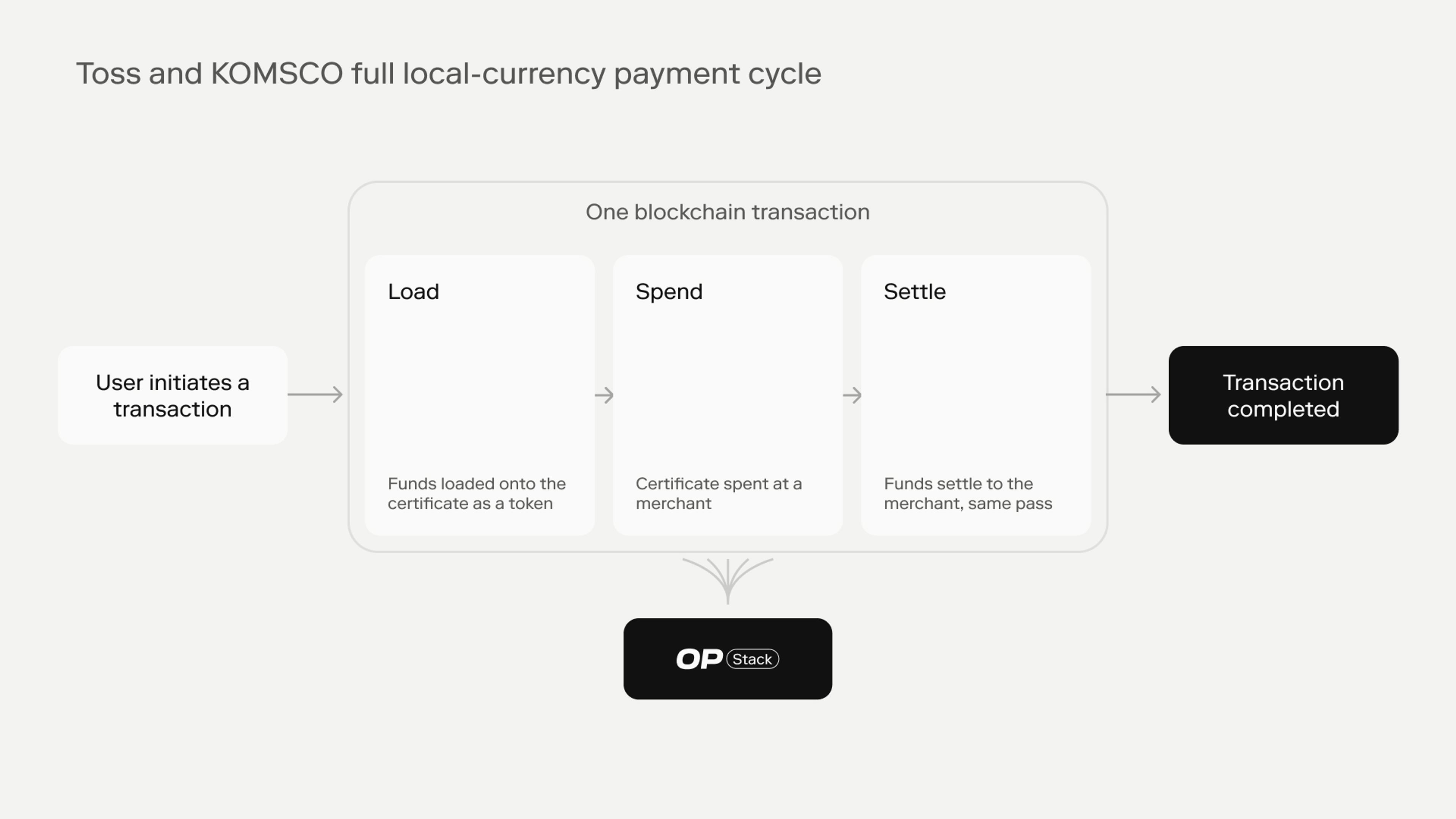
Spending and settling happen inside the same blockchain transaction, rather than as two separate steps; loading happens first, as a separate step that puts funds onto the certificate. The OP Stack is the technology framework behind Ethereum Layer 2 networks: it processes transactions itself and posts only the results back to Ethereum. That design keeps per-transaction costs low enough for a payments use case like this one.
Settlement is where the design differs most from a conventional card payment. Under a conventional system, a merchant waits several days after a customer pays before the funds actually land. In this design, payment and settlement happen inside the same transaction, so the merchant can move funds immediately.
| Step | Conventional card settlement | This test's design |
|---|---|---|
| Customer pays | Same | Same |
| Funds move to merchant | Days later, a separate settlement process | Same transaction as the payment |
| Merchant access to funds | Delayed | Immediate |
Toss and KOMSCO said a live version of this design would let small business owners get paid sooner and pay less to process it. The two organizations also tested a method for keeping transaction details off the public record, since a public blockchain is otherwise visible to anyone who looks. They confirmed the approach works, without publishing the underlying mechanics.
“Public payment infrastructure is something people use every day, so stability and personal data protection have to be proven first. Working within the rules set by regulators, we will keep testing payment and settlement infrastructure that can ease the burden on small business owners.”
Why did a Korean payment body test this?
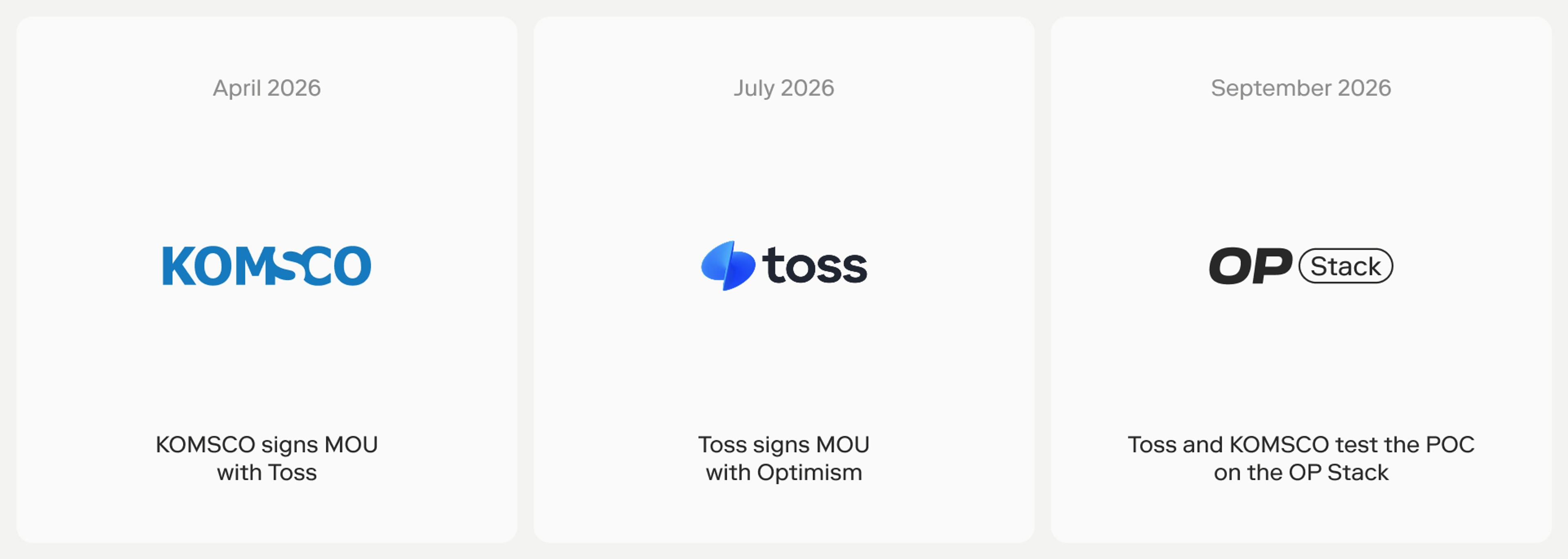
KOMSCO, the Korea Minting and Security Printing Corporation, is the body that produces South Korea's banknotes and coins and runs public payment services for government bodies. It signed a memorandum of understanding with Toss in April 2026 to test whether blockchain rails could support an existing public payment system without rebuilding it.
South Korea runs a large network of local-currency programs: vouchers that residents spend only at small businesses inside their own city or district. KOMSCO operates payment services for many of them, including the Local Love Gift Certificate used in this test.
Toss, Optimism, and Sunnyside Labs separately signed a broader three-way MOU in July 2026, covering a stablecoin-payments Layer 2 partnership, with Sunnyside Labs contributing privacy technology (Privacy Boost) to that partnership. This test is the first tangible output of the MOU, not a separate deal.
How does this fit into Optimism's broader activity in Korea?
This KOMSCO test is one proof point inside a wider set of conversations Optimism is having with Korean financial institutions and exchanges. It stands out because KOMSCO is an institution testing settlement infrastructure directly, a different bar than a private company piloting a single feature.
“The Toss partnership set out to produce a working result, and this is it. KOMSCO ran a full load-spend-settle cycle on the OP Stack and measured the result. That's the kind of proof point that moves a market.”

Other Korean financial institutions and exchanges are at earlier stages of their own conversations with Optimism, spanning exchange infrastructure and asset tokenization. None of those has produced a public test result yet.
None of this is live. The test ran in an environment separate from the live Local Love Gift Certificate service operated by KOMSCO, and no go-live date has been set. What it shows is narrower and more useful to an infrastructure provider: the existing shape of a public payment system didn't have to change to add blockchain-based settlement underneath it.
What's next
- Toss and KOMSCO evaluate whether to extend the test toward a live rollout, on their own timeline and at their own discretion.
- Optimism continues to work with Toss under the July MOU on the broader stablecoin-payments use case, including the privacy method tested here.
Learn more about OP Enterprise for dedicated blockchain deployments, read the July 2026 MOU announcement, and see Toss and KOMSCO's own announcement once their release is live.
Frequently Asked Questions
Is this a live payment system now?
No. Toss and KOMSCO ran the test in an environment separate from the live Local Love Gift Certificate service operated by KOMSCO. No go-live date has been announced.
What is a Local Love Gift Certificate?
A voucher South Korean local governments issue so residents can spend it only at small businesses inside their own city or district. The test used this existing program as its real-world case.
Does this replace the July 2026 MOU between Toss, Optimism, and Sunnyside Labs?
No. It's the first concrete result under that three-way MOU, not a separate deal. The MOU covers a broader stablecoin-payments partnership; this test is one POC running inside it.
Why does KOMSCO matter here?
KOMSCO produces South Korea's banknotes and coins and runs public payment services for government bodies. A government entity choosing to test settlement infrastructure directly is a different kind of validation than a private company piloting a feature.
What role did the OP Stack play in the test?
The OP Stack provided the Layer 2 technology for the environment the loading, spending, and settlement steps ran on. Toss and KOMSCO owned the payment system, point-of-sale, and currency design.
How is this test different from a typical blockchain payment pilot?
Most pilots test one function, minting, moving, or recording a transaction, in isolation. This test ran the full load, spend, and settle lifecycle of a real voucher in a single pass, with spend and settlement completing together inside one blockchain transaction.
What would have to happen for this to go live?
Toss and KOMSCO would need to decide to extend the test toward a live rollout, on their own timeline. No go-live date or commitment has been announced as of this test.
Glossary
- KOMSCO: the Korea Minting and Security Printing Corporation, the body that produces South Korea's banknotes and coins and runs public payment services for government bodies.
- Local Love Gift Certificate: a voucher South Korean local governments issue so residents can spend it only at small businesses inside their own city or district.
- Layer 2 (L2): a network that processes transactions itself and posts only the results back to Ethereum, keeping per-transaction costs lower than running everything directly on Ethereum.
- OP Stack: the open-source technology framework used to build Ethereum Layer 2 networks, including Optimism and other OP Stack-based chains.
- Memorandum of understanding (MOU): a non-binding agreement laying out what two or more parties intend to work on together, ahead of any binding contract.
- Settlement: the point at which a payment is finalized and the funds are actually available to the recipient, as distinct from the moment a customer initiates the payment.
- OP Enterprise: Optimism's commercial product for organizations deploying a dedicated blockchain, offered in Fully Managed and Self Managed tiers.
Authored by

Jing Wang