
- OP Stack documentation lists typical OP Mainnet inclusion at about two seconds and finalized status at about 15 to 30 minutes.
- A finalized transaction alone does not establish ownership or payment completion, so issuers often define the settlement event up front.
- On the OP Stack, an issuer can deploy on OP Mainnet or launch a dedicated chain through OP Enterprise.
Legal and regulatory requirements vary by jurisdiction and structure. This guide is informational and does not state what any issuer must do. Consult your own legal and regulatory advisors.
How does a token transfer settle on a Layer 2?
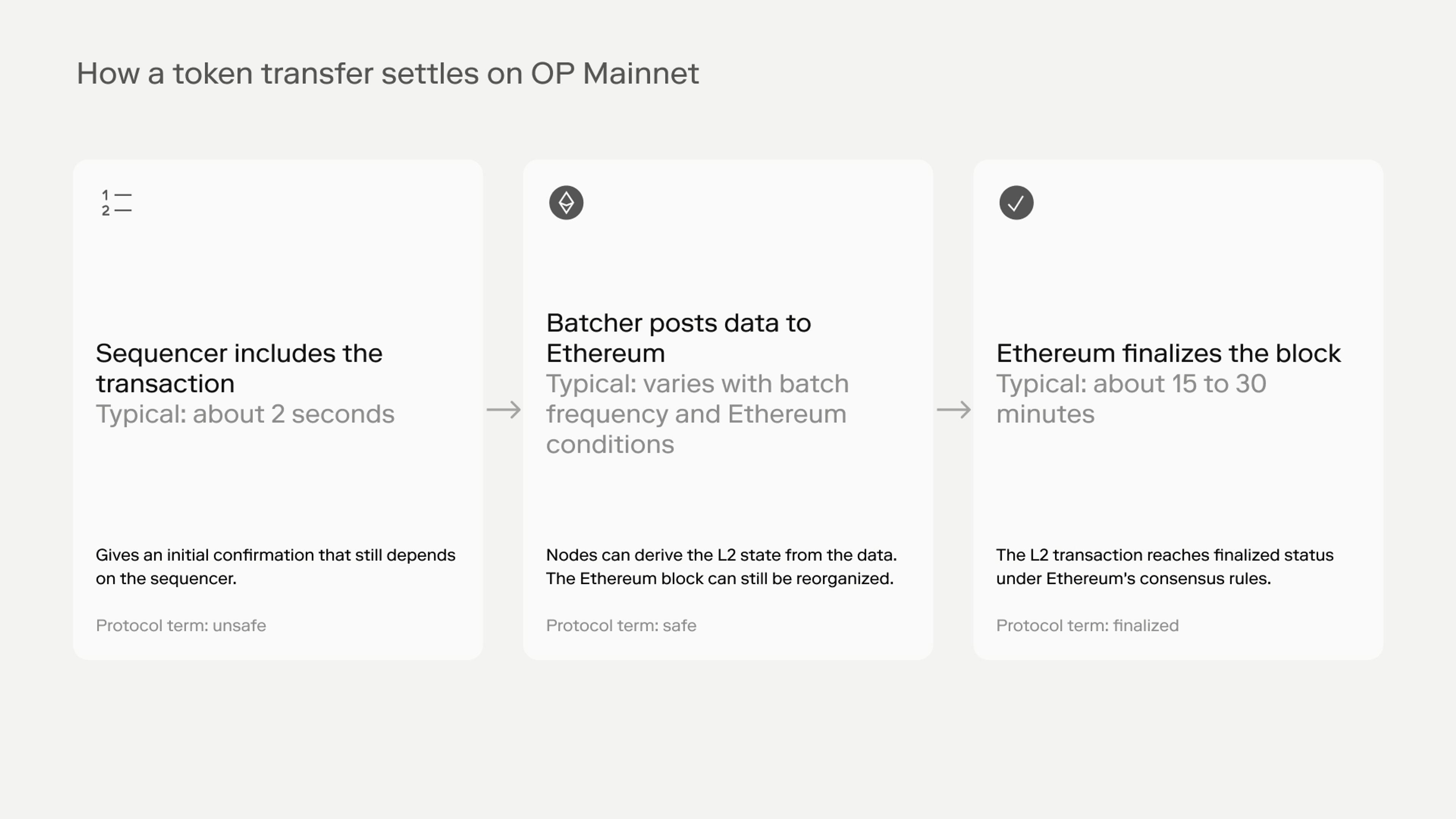
On OP Mainnet, a token transfer settles in three stages. The sequencer orders the transaction into an L2 block, the batcher posts the transaction data to Ethereum, and Ethereum finalizes the block that contains the data. The first confirmation depends on the sequencer, and the final status follows Ethereum's consensus rules.
Timings come from the OP Stack finality documentation. They are typical timings, not guarantees for every OP Stack chain. The standard withdrawal process to Ethereum has a separate minimum seven-day delay, and that delay does not apply to ordinary transfers within OP Mainnet.
When does the underlying asset change hands?
A finalized blockchain transaction alone does not establish when a holder's legal claim transfers or when a payment obligation is discharged. The token record, the ownership record and the payment obligation need to agree, so issuers often identify which record governs each asset and how the three are reconciled.
A chain that accepts transactions over the weekend does not establish the operating hours of a custodian, transfer agent or redemption service.
What questions help test a settlement layer?
Three questions help test any settlement layer: which event counts as settlement, whether the asset can be used as collateral, and how the chain connects to existing systems. Asking every provider the same three questions keeps the comparison fair.
Which event counts as settlement?
Issuers often define whether settlement refers to L2 inclusion, Ethereum finality, a bridge withdrawal, payment completion or the update to the authoritative ownership record. Comparing providers on the same event, and recording what happens during an outage, keeps results comparable.
| Candidate event | What it measures | Typical timing and source |
|---|---|---|
| L2 inclusion | The sequencer includes the transaction in an L2 block | About two seconds on OP Mainnet (OP Stack documentation) |
| Ethereum finality | Ethereum finalizes the block that contains the transaction data | About 15 to 30 minutes on OP Mainnet (OP Stack documentation) |
| Bridge withdrawal | The standard withdrawal process from the L2 to Ethereum | Seven days on OP Mainnet; configurable on other OP Stack chains (OP Stack documentation) |
| Payment completion | The payment obligation is complete | Set by the payment arrangement, not by the chain |
| Ownership record update | The authoritative ownership record is updated | Set by the record keeper, not by the chain |
Can a tokenized asset be used as collateral?
Issuers often confirm that the intended venue accepts the asset, supports its transfer restrictions, and has a process for valuation and liquidation. If collateral use requires a transfer to another chain, the bridge and the destination token's ownership and redemption terms are worth checking. A connection to a lending venue does not establish that the venue accepts the asset.
How does a tokenized asset connect to existing systems?
Issuers may map the custody, transfer-agent, registry and reporting integrations. They often identify which system governs ownership, how discrepancies are resolved and which integrations are live.
Where do OP Stack chains fit for an issuer?
Issuers on the OP Stack have two paths. OP Mainnet is a shared, permissionless public Ethereum Layer 2 network, so an issuer can deploy contracts without operating a chain. A dedicated chain through OP Enterprise, the Optimism Foundation's product, gives an issuer more control over configuration and access policies, subject to its protocol and governance arrangements.
| Question | OP Mainnet | Dedicated chain through OP Enterprise |
|---|---|---|
| What it is | A shared, permissionless public Ethereum Layer 2 network built on the OP Stack | A dedicated chain built on the OP Stack, offered through OP Enterprise as Self Managed or Fully Managed |
| Who operates the chain | No chain for the issuer to operate | Self Managed: the customer runs the chain infrastructure with technical support provided by the Optimism Foundation's subcontractor, OP Labs. Fully Managed: chain deployment, operations, and upgrades are provided as a managed service from OP Labs, and the customer owns the chain. |
| Configuration and access policies | Shared network, not set per issuer | More control over configuration and access policies, subject to protocol and governance arrangements |
Transaction volume, reliability and asset support need to be assessed separately for the chain under consideration.
This guide covers deploying contracts on OP Mainnet and launching a dedicated chain through OP Enterprise. Other OP Stack networks and providers are also available. See the product overview.
Starting on OP Mainnet keeps a dedicated chain open as a later option. A move may need a plan for contracts, balances, custody integrations and the underlying asset records.
How can an issuer run a pilot?
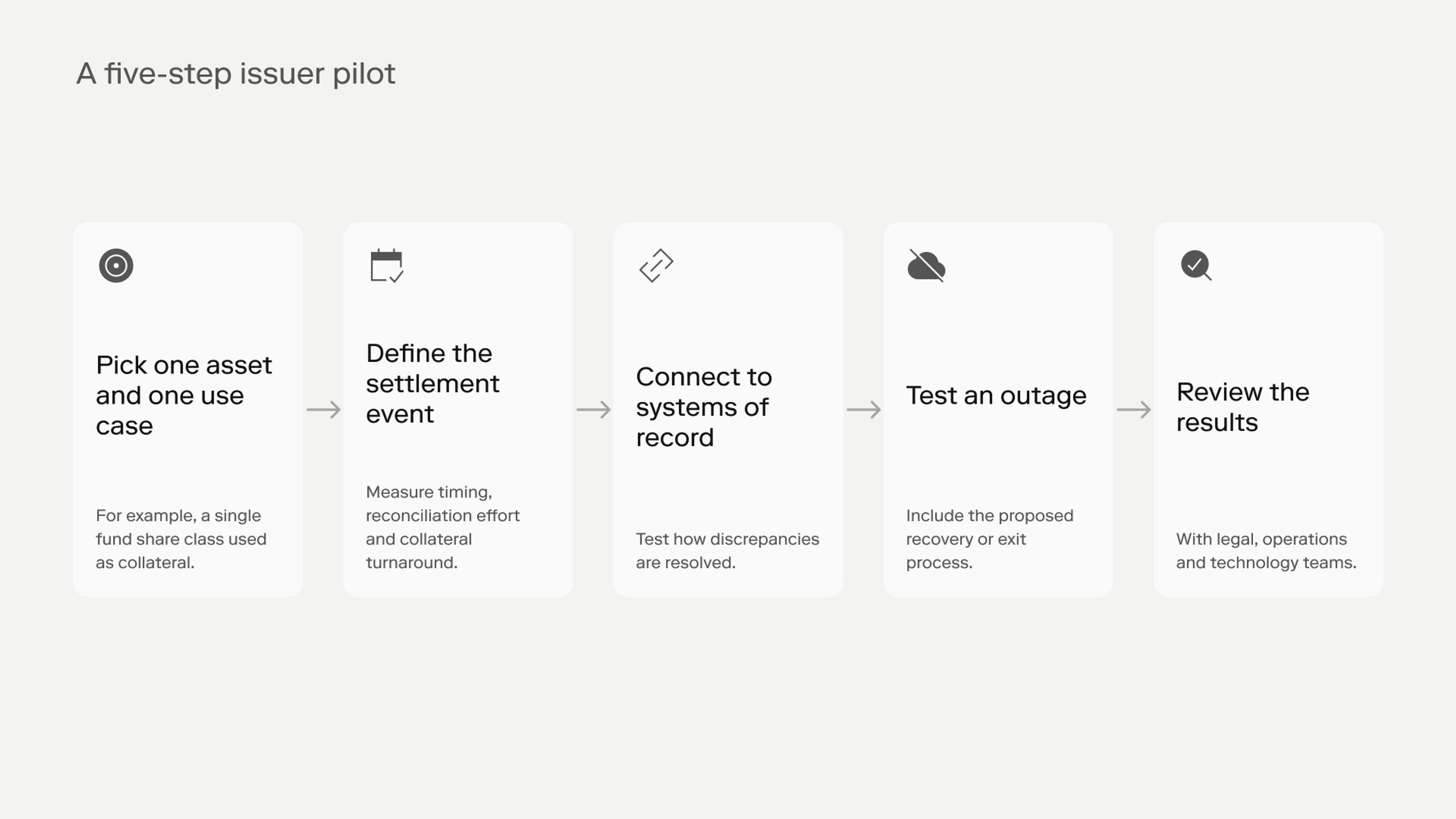
A pilot may start with one asset and one use case, define the settlement event, and measure timing, reconciliation effort and collateral turnaround against the systems of record. It may also test an outage and the recovery or exit process before the results go to legal, operations and technology teams.
A pilot may include these steps:
- Pick one asset and one use case, such as a single fund share class used as collateral.
- Define the settlement event and measure its timing, reconciliation effort and collateral turnaround.
- Connect the pilot to the relevant systems of record and test how discrepancies are resolved.
- Test an outage and the proposed recovery or exit process.
- Review the results with legal, operations and technology teams.
Frequently Asked Questions
How does a token transfer settle on a Layer 2?
On OP Mainnet, a token transfer settles in three stages. The sequencer includes the transaction in an L2 block, the batcher posts the transaction data to Ethereum, and Ethereum finalizes the block that contains the data. The first confirmation depends on the sequencer, and the final status follows Ethereum's consensus rules.
How long does a transaction take to finalize on OP Mainnet?
OP Stack documentation lists typical OP Mainnet inclusion at about two seconds and finalized status at about 15 to 30 minutes. These are typical timings, not guarantees for every OP Stack chain. Batch frequency and Ethereum conditions affect the wait.
Does the seven-day withdrawal delay apply to every transfer?
No. On OP Mainnet, the standard withdrawal process to Ethereum has a seven-day delay. That delay does not apply to ordinary transfers within OP Mainnet, and it is separate from how long a transaction takes to reach finalized status. Other OP Stack chains, including dedicated chains, can configure a different withdrawal delay and proof system, so issuers often confirm the settings of the chain they are evaluating.
When does a holder's claim to the underlying asset transfer?
Technical finality on the chain does not necessarily constitute legal transfer of the claim, or when a payment obligation must be discharged. Issuers often identify the authoritative ownership record for each asset and how it is reconciled with the token. They may also consider how payment and asset delivery are coordinated.
What may a crypto exchange consider when choosing a blockchain for tokenized assets?
A crypto exchange may consider which event it treats as settlement, whether the venues it uses accept the asset as collateral, how the chain connects to its custody, registry and reporting systems, and what happens during an outage. The same questions apply to any chain an exchange compares.
What may a bank consider when choosing a blockchain for tokenized assets?
A bank may consider which record is authoritative for ownership, how payment and asset delivery are coordinated, how custody, transfer-agent and reporting systems connect, and how outages and exits are handled. Requirements vary by jurisdiction and structure, so banks should consult their own legal and regulatory advisors.
Can a tokenized asset be used as collateral?
Whether a tokenized asset can be used as collateral depends on the venue, not only the chain. Issuers often confirm that the intended venue accepts the asset, supports its transfer restrictions, and has a process for valuation and liquidation. A connection to a lending venue does not necessarily establish that the venue accepts the asset.
What is the difference between OP Mainnet and a dedicated OP Enterprise chain?
OP Mainnet is a shared, permissionless public Ethereum Layer 2 network, so an issuer can deploy contracts without operating a chain. A dedicated chain through OP Enterprise, offered Self Managed or Fully Managed, gives the issuer more control over configuration and access policies, subject to its protocol and governance arrangements.
Does the Optimism Foundation issue, custody or verify assets?
No. The Optimism Foundation does not issue, custody or verify assets. Its role is limited to the underlying blockchain software.
Glossary
- OP Stack: The open source software stack for building Ethereum Layer 2 chains. It is EVM equivalent.
- OP Mainnet: OP Mainnet is a shared, permissionless public Ethereum Layer 2 network built on the OP Stack and open to any developer or user.
- OP Enterprise: The Optimism Foundation's product for a dedicated chain built on the OP Stack, offered Self Managed or Fully Managed.
- Sequencer: The component that orders transactions and includes them in L2 blocks. A transaction's initial confirmation depends on it.
- Batcher: The component that posts L2 transaction data to Ethereum so nodes can derive the L2 state from it.
- Safe: The status of a transaction whose data has been posted to Ethereum. The Ethereum block can still be reorganized.
- Finalized: The status of a transaction once Ethereum finalizes the block that contains its data, under Ethereum's consensus rules.
- Settlement event: The specific event an issuer defines as settlement, such as L2 inclusion, Ethereum finality, a bridge withdrawal, payment completion or an update to the authoritative ownership record.
- Authoritative ownership record: The record an issuer identifies as governing who holds an asset, such as a custodian, transfer agent or registry record.
- Tokenized asset: A digital token that is linked to an asset held or managed outside the chain, as described by its issuer.
- Withdrawal delay: The wait in the standard withdrawal process from an OP Stack chain to Ethereum. It is seven days on OP Mainnet and can be configured differently on other OP Stack chains. It does not apply to ordinary transfers within a chain.
- OP Labs and The Optimism Foundation: The Optimism Foundation is the technology service provider for the Ethereum Layer 2 services, while OP Labs is the Foundation's primary subcontractor for these services. Labs also provides the Foundation with business development and deal structuring support for its Layer 2 commercial offerings.
Related reading
- OP Stack finality documentation
- What is the OP Stack?
- What is OP Mainnet?
- What is OP Enterprise?
- Stablecoin and tokenization infrastructure for financial institutions
This page is informational. It does not offer or promote any financial product and is not legal, regulatory or financial advice.
Authored by

Optimism