
Equities, money market funds and private credit each add their own considerations, and the path may depend on how much control an issuer is looking for. Last updated: November 2026.
Legal and regulatory requirements vary by jurisdiction and structure. This guide is informational and does not state what any issuer must do. Consult your own legal and regulatory advisors.
OP Stack by the numbers
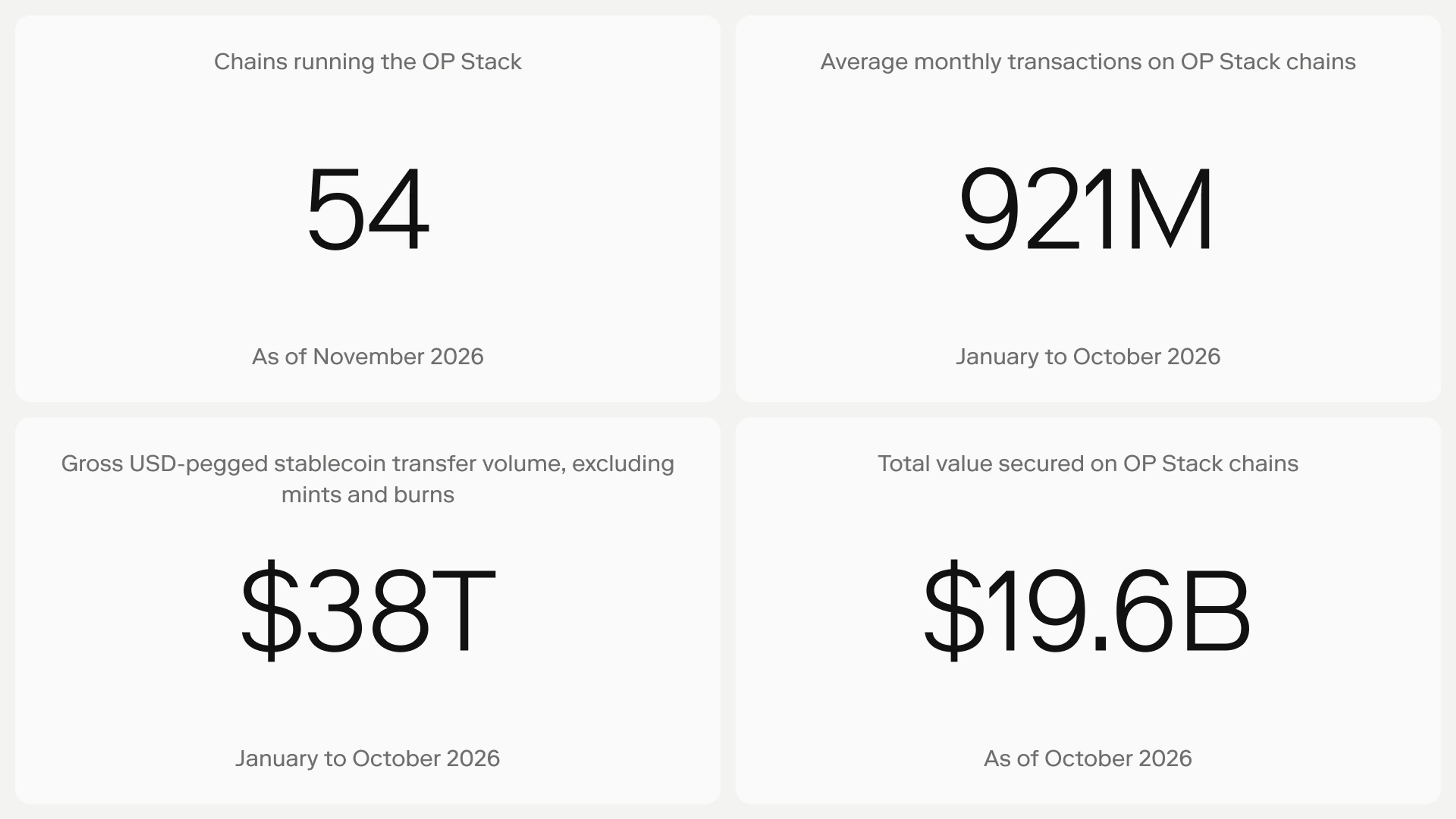
Source: optimism.io/stats. Total value secured is reported by ethbeat.org.
What do issuers often consider when choosing a blockchain to tokenize assets?
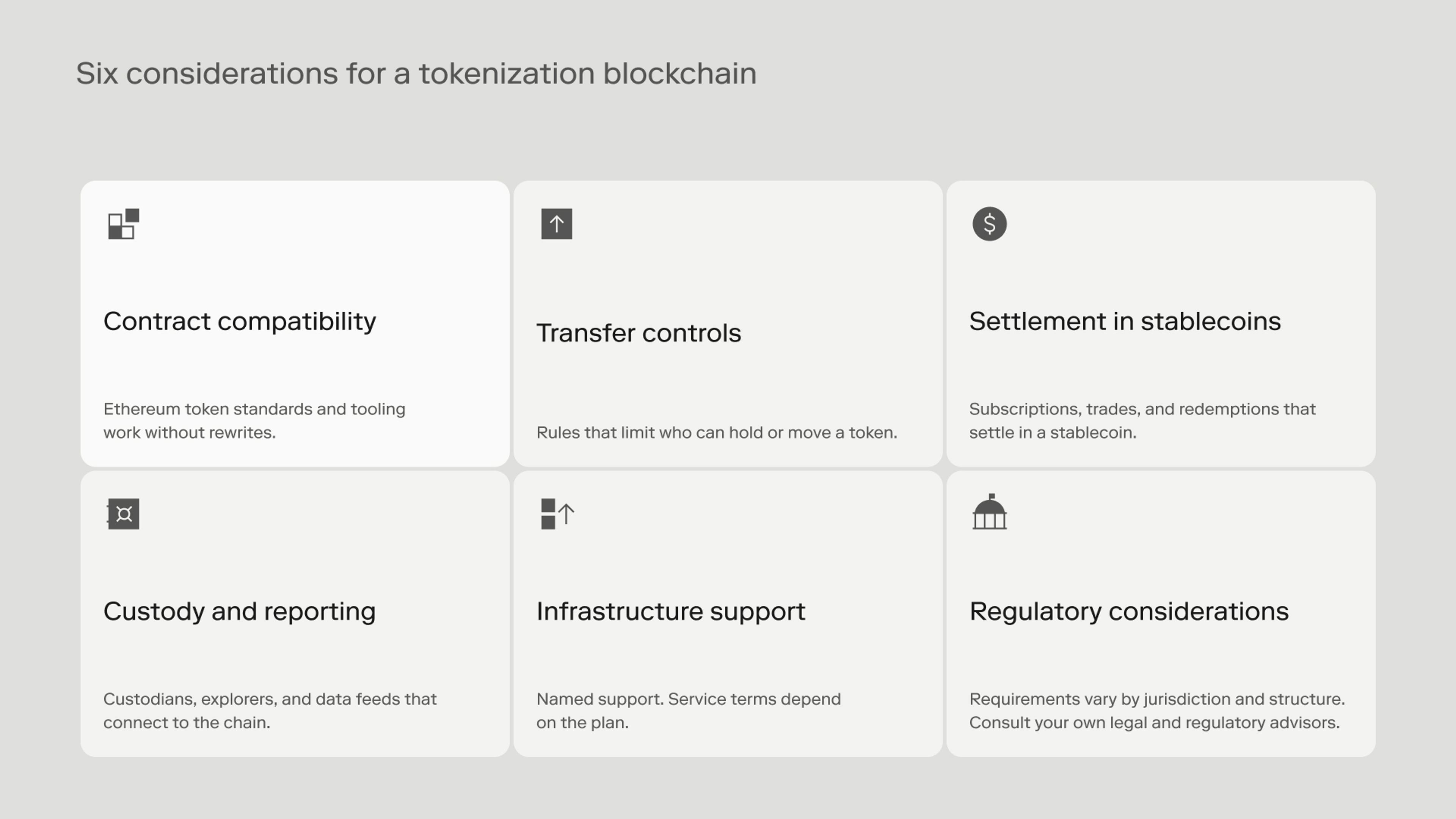
Issuers often consider six areas when comparing a tokenization blockchain: contract compatibility, transfer controls, stablecoin settlement, custody and reporting integration, regulatory considerations, and infrastructure support. A blockchain provides the technology. The Optimism Foundation does not issue, custody or verify assets.
This guide covers the OP Stack. Other chains also support these use cases, so the same six considerations apply to any chain you compare. For stablecoin context, read Stablecoin and tokenization infrastructure for financial institutions.
Which OP Stack path fits: OP Mainnet or a dedicated OP Enterprise chain?
OP Mainnet is a shared public network where issuers deploy contracts and reach existing liquidity and users. A dedicated chain through OP Enterprise is a separate chain built on the OP Stack, with chain-level controls and SLA-backed support. The path may depend on how much control, privacy and access to existing liquidity an issuer is looking for.
| Question | OP Mainnet | Dedicated chain through OP Enterprise |
|---|---|---|
| What it is | A shared public network | The Optimism Foundation's product for a dedicated chain built on the OP Stack |
| Access | Permissionless | Dedicated to the customer |
| Who runs the chain | No chain for the issuer's application team to operate | The customer (Self Managed) or OP Labs (Fully Managed) |
| Time to production | Days | 6 to 8 weeks for a standard managed launch |
| Controls | Transfer rules set in the token contract and issuer platform | Chain-level options configured for the customer |
| Best fit | Issuers that want existing liquidity and users | Issuers and platforms that want a dedicated chain and SLA-backed support |
Under Fully Managed, OP Labs deploys, operates and upgrades the chain infrastructure through OP Enterprise, and the customer owns its chain. Under Self Managed, the customer runs the chain infrastructure with OP Labs support. The 6 to 8 week estimate assumes a standard configuration and an open launch slot. Custom builds and other launches in the queue can extend it.
How do the considerations change by asset class?
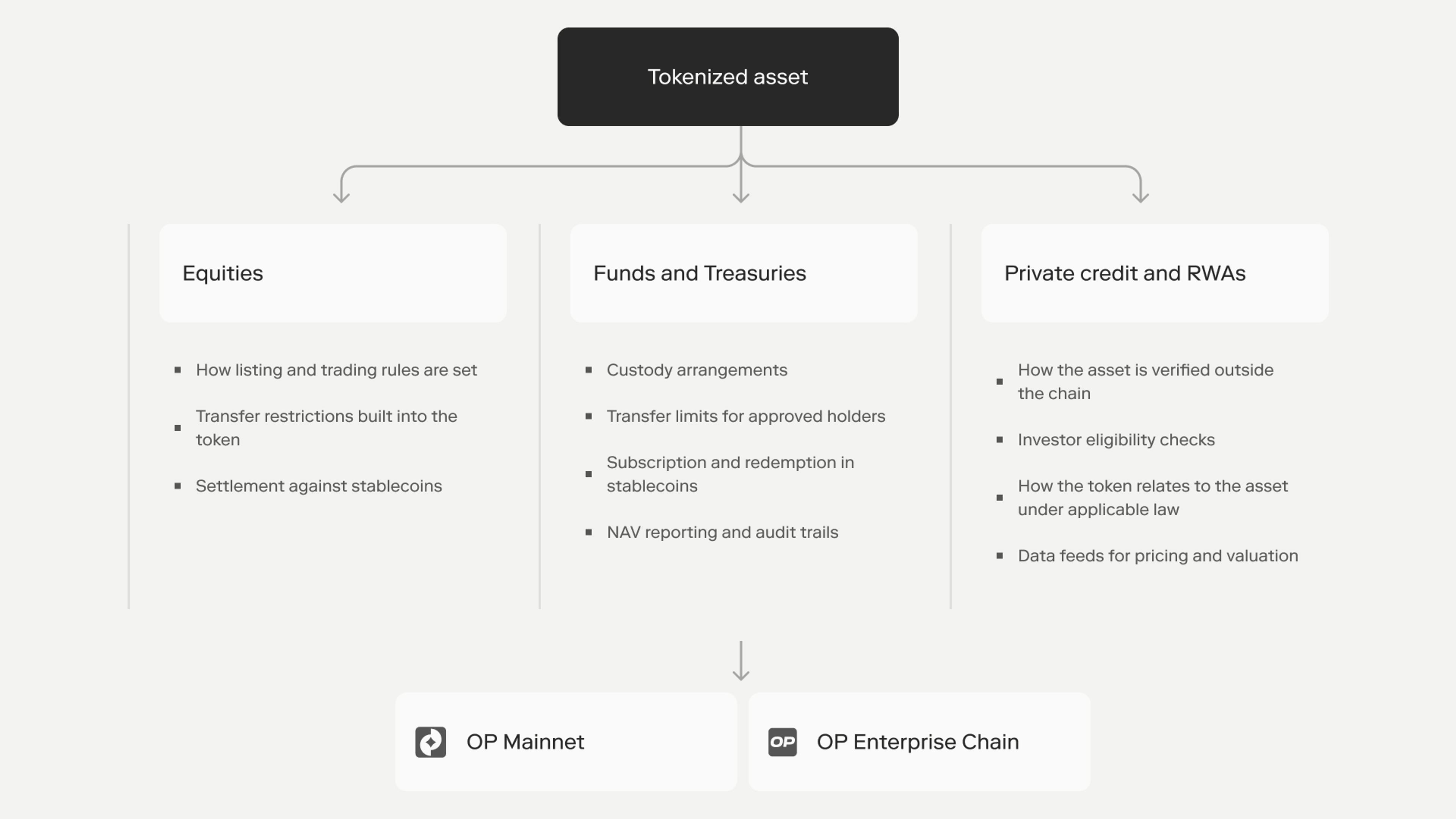
Each asset class may add its own considerations on top of the six core areas. Equities often involve listing and trading rules, funds often involve custody and reporting, and private credit often involves verification and eligibility checks. Requirements vary by jurisdiction and structure.
What do tokenized equity issuers often consider?
Tokenized equity issuers often consider how listing and trading rules are set, how transfer restrictions are built into the token, and how settlement against stablecoins works. The chain provides contract execution and settlement infrastructure. The Optimism Foundation does not set listing or trading rules.
- How listing and trading rules are set
- Transfer restrictions built into the token
- Settlement against stablecoins
What do tokenized fund and Treasury issuers often consider?
Issuers of tokenized money market funds and Treasuries often consider custody arrangements, transfer limits for approved holders, subscription and redemption in stablecoins, and NAV reporting with audit trails. The chain provides infrastructure, and the Optimism Foundation does not issue, custody or verify assets.
- Fund management and custody arrangements
- Transfer limits for approved holders
- Subscription and redemption in stablecoins
- NAV reporting and audit trails
- Risk disclosures
What do private credit and real-world asset issuers often consider?
Issuers tokenizing bonds, private credit, real estate or commodities often consider how the asset is verified outside the chain, how investor eligibility is checked, how the token relates to the underlying asset under applicable law, and how pricing and valuation data reach the chain. A blockchain records token activity. It does not verify that an underlying asset exists, and the Optimism Foundation does not verify assets.
- How the asset is verified outside the chain
- Investor eligibility checks
- How the token relates to the underlying asset under applicable law
- Data feeds for pricing and valuation
What tokenized asset projects exist on the OP Stack?
Public announcements describe two projects. MDC announced Zipangcoin on OP Mainnet in April 2026, and DB Securities and the Optimism Foundation signed an MOU on July 7, 2026. The MOU records intent to collaborate, and its platform is in planning.
| Project | Status | What it is | Date |
|---|---|---|---|
| MDC (Mitsui & Co. Digital Commodities) | On OP Mainnet | Zipangcoin, which MDC describes as a digital asset backed by physical gold, silver and platinum | April 2026 |
| DB Securities and the Optimism Foundation | MOU | Promotion of Jeju-specific STO and real-world asset businesses in South Korea. The parties intend to start with smart-farming, livestock and Korean IP assets. The platform is in planning and is not live. | Signed July 7, 2026 |
Frequently Asked Questions
What do tokenized equity issuers often consider when choosing a blockchain?
Tokenized equity issuers often consider how listing and trading rules are set, how transfer restrictions are built into the token, and how stablecoin settlement works. On the OP Stack, issuers can deploy on OP Mainnet or a dedicated OP Enterprise chain. The Optimism Foundation does not set listing, trading or transfer rules, and legal requirements vary by jurisdiction and structure.
What do tokenized fund and Treasury issuers often consider when choosing a blockchain?
Fund and Treasury issuers often consider custody arrangements, transfer limits for approved holders, stablecoin subscription and redemption, and NAV reporting. On the OP Stack, fund issuers can use OP Mainnet or a dedicated chain through OP Enterprise. The Optimism Foundation does not issue, custody or verify assets, and legal requirements vary by jurisdiction and structure.
What do real-world asset issuers often consider when choosing a blockchain?
Real-world asset issuers often consider how the asset is verified outside the chain, how investor eligibility is checked, how the token relates to the underlying asset under applicable law, and how valuation data reaches the chain. MDC announced Zipangcoin on OP Mainnet in April 2026, which MDC describes as a digital asset backed by physical gold, silver and platinum. The Optimism Foundation does not verify assets.
What may a bank consider when evaluating a blockchain for tokenized assets?
A bank may consider custody arrangements, reporting integration, regulatory considerations in its jurisdictions and infrastructure support. On the OP Stack, OP Enterprise is offered Self Managed or Fully Managed with named support, and service terms depend on the plan. The Optimism Foundation does not issue, custody or verify assets.
What may a crypto exchange consider in a blockchain for tokenized assets?
An exchange may consider stablecoin settlement, transfer controls and infrastructure that scales with its users. Some exchanges and fintechs run dedicated OP Stack chains. Bitpanda announced Vision Chain on OP Enterprise in March 2026. The Optimism Foundation does not issue, custody or verify assets.
What is the DB Securities MOU for Jeju?
DB Securities and the Optimism Foundation signed an MOU on July 7, 2026 to promote Jeju-specific STO and real-world asset businesses. An MOU records intent to collaborate. The platform is in planning and is not live.
What is the difference between OP Mainnet and a dedicated OP Enterprise chain?
OP Mainnet is a shared public network with existing liquidity and users. A dedicated OP Enterprise chain is separate infrastructure with chain-level controls and SLA-backed support. Issuers looking for chain-level controls or custom configuration may evaluate a dedicated chain. Issuers looking for open liquidity may start on OP Mainnet.
Glossary
- OP Stack: The open source software stack for building Ethereum Layer 2 chains. It is EVM equivalent.
- OP Mainnet: A shared, permissionless public network built on the OP Stack.
- OP Enterprise: The Optimism Foundation's product for dedicated chains built on the OP Stack, offered Self Managed or Fully Managed.
- Tokenized asset: A digital token that is linked to an asset held or managed outside the chain, as described by its issuer.
- Transfer restrictions: Rules in the token contract or issuer platform that limit who can hold or move a token.
- NAV: Net asset value, the per-share value of a fund, reported on a schedule such as daily.
- STO: Security token offering, a term used for token offerings that may be subject to securities rules depending on jurisdiction and structure.
- MOU: A memorandum of understanding. It records the parties' intent to collaborate and is not a launch.
- EVM equivalence: Compatibility with Ethereum's virtual machine, so Ethereum smart contracts and tooling work on the chain without modification.
- OP Labs and The Optimism Foundation: The Optimism Foundation is the technology service provider for the Ethereum Layer 2 services, while OP Labs is the Foundation's primary subcontractor for these services. Labs also provides the Foundation with business development and deal structuring support for its Layer 2 commercial offerings.
Related reading
- Stablecoin and tokenization infrastructure for financial institutions
- What is the OP Stack?
- What is OP Enterprise?
- DB Securities Signs MOU to Build STO and RWA Infrastructure for Jeju on the OP Stack
The Optimism Foundation does not issue, custody or verify assets. Legal and regulatory requirements vary by jurisdiction and structure, so consult your own legal and regulatory advisors. Third-party products and companies named in this article, including Circle's USDC and CCTP, MDC's Zipangcoin, DB Securities and Bitpanda's Vision Chain, belong to their respective owners, and naming them does not imply endorsement. This page is informational. It is not legal, regulatory or financial advice, or an offer.
Authored by

Optimism