
A bank choosing blockchain infrastructure faces one structural decision before any vendor question: share a network with other applications, or run a dedicated chain. The answer depends on the product, the timeline, and how much operating responsibility the bank wants.
What are banks evaluating blockchain for?
Banks are evaluating four use cases most often: settlement, tokenized deposits, cross-border payments, and tokenized funds or securities. Each places different demands on the infrastructure underneath it.
| Use case | What changes onchain | What it asks of the infrastructure |
|---|---|---|
| Settlement | Transfers and payments settle in one step instead of several | Predictable fees, fast confirmation, uptime commitments |
| Tokenized deposits | Customer balances are represented as programmable tokens | Control over who can hold and move the token |
| Cross-border payments | Fewer intermediaries between sender and receiver | Low per-transaction cost, access to stablecoin liquidity |
| Tokenized funds and securities | Fund units or bonds are issued and recorded on a chain | Access to custody and liquidity partners, institutional-grade operations |
What does a bank need from a blockchain for institutional DeFi?
Institutional DeFi means using onchain markets, stablecoins, and tokenized assets inside an institution's own compliance controls. A bank can test a network against seven requirements before it compares vendors.
| Requirement | Shared network (OP Mainnet) | Dedicated chain (OP Enterprise) |
|---|---|---|
| Compliance and permissioning | OP Mainnet is public and permissionless. It does not provide customer-specific compliance at the protocol level, so controls sit in the application. | The bank configures permissioned access at the chain level. The bank and its service providers remain responsible for meeting regulatory obligations. |
| Privacy | Activity is public. | Participants can be restricted. Private configurations are an area Optimism is collaborating on with institutions. |
| Liquidity, stablecoins, and ecosystem | Access to the existing OP Mainnet user base and applications, including DeFi, payments, and institutional assets. | Access to more than 30 pre-vetted OP Enterprise integrations across wallets, custody, oracles, indexers, RPC, and compliance providers. |
| Operations and uptime | No chain infrastructure to run. Historical uptime of 99.99%, per the OP Enterprise page. | Self Managed or Fully Managed. Fully Managed carries a 99.9% uptime SLA. Mission-Critical Support raises it to 99.95% with a 15-minute response. |
| Integration with existing systems | Standard Ethereum-compatible tooling. | Same tooling, plus configuration for the bank's environment. |
| Time to production | Shortest. No chain to stand up. | Longer for Self Managed. Shorter for Fully Managed. |
| Changing the operating model later | A team can start here and move to a dedicated chain later without a new smart contract platform. | Self Managed and Fully Managed use the same OP Stack architecture and tooling. |
How to evaluate any chain for institutional DeFi
- Where do compliance controls sit, in the protocol, the application, or the chain?
- Who can see transactions, and can the bank restrict participants?
- Which stablecoins, custody providers, and oracles are available today?
- Who operates the infrastructure, and what uptime and response times are contractual?
- How does the chain connect to the bank's existing core, custody, and reporting systems?
- How long until the first product is in production?
- Can the bank change its operating model later without rebuilding?
What choices does a bank have?
A bank has three practical choices on the OP Stack. It can deploy on OP Mainnet, the shared public network. It can run a dedicated chain through OP Enterprise Self Managed. Or it can take a dedicated chain through OP Enterprise Fully Managed, where Optimism operates the infrastructure.
The OP Stack is open source and MIT licensed. A bank can also deploy a chain without a commercial agreement, though it then carries all operating responsibility.
How do the options compare on what banks care about?
| Criterion | OP Mainnet (shared) | OP Enterprise Self Managed | OP Enterprise Fully Managed |
|---|---|---|---|
| Time to production | Shortest. No chain to stand up | Longer. The bank deploys and configures a chain in its own cloud environment | Shorter than Self Managed. Optimism deploys the chain as a service |
| Capacity | Shared block space with other applications | Dedicated to the bank | Dedicated to the bank |
| Configuration and control | Application-level controls | Chain-level configuration and permissioned access | Chain-level configuration and permissioned access |
| Who operates the infrastructure | Nobody on the bank's side. No chain infrastructure to manage | The bank, in its own cloud or VPC, with Optimism engineering support | Optimism deploys, operates, and upgrades infrastructure |
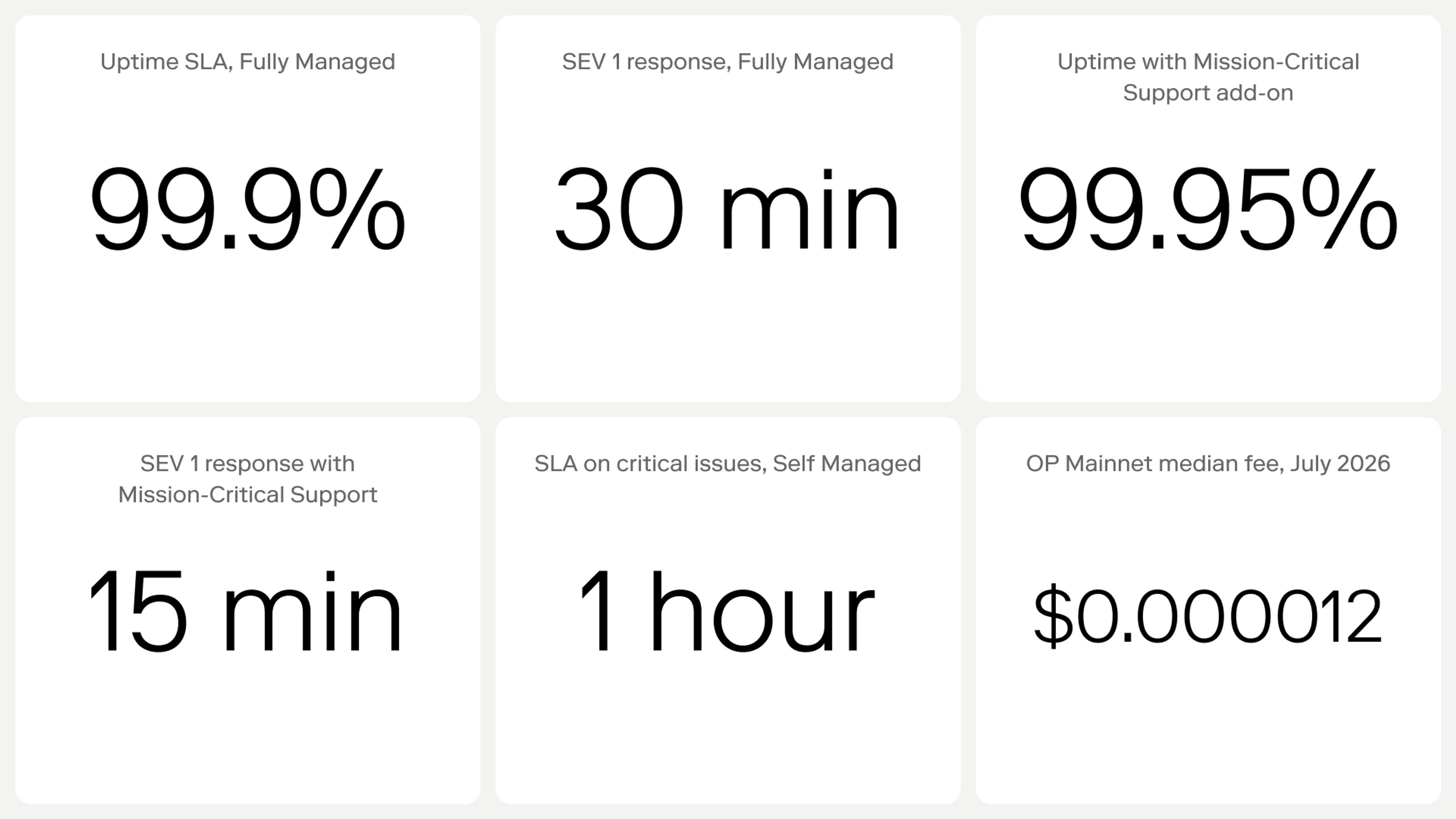
| Service commitments | Historical uptime of 99.99% on OP Mainnet | 24/7 incident response, one-hour SLA on critical issues | 99.9% uptime SLA and 30-minute SEV 1 response. Mission-Critical Support adds 99.95% and 15 minutes |
| Economics | Shared network economics. No upfront cost to deploy | Chain operator keeps sequencer revenue, and carries infrastructure cost | Chain operator keeps sequencer revenue, and pays for the managed service |
Mission-Critical Support is an add-on to any OP Enterprise tier. It also brings multi-region deployment and a dedicated technical account manager.
When does a shared network fit a bank?
A shared network fits when speed matters more than control. A bank testing a first tokenized product, running a pilot, or issuing to a defined group of institutions can reach production without standing up a chain. OP Mainnet's median transaction fee was $0.000012 in July 2026, per growthepie.
A shared network also fits teams that want to learn first. The bank can move to a dedicated chain later if volume or control requirements grow.
When does a dedicated chain fit a bank?
A dedicated chain fits when capacity, configuration, or economics must belong to the bank. A high-volume payments product that cannot share block space is one case. A product that needs permissioned access at the chain level is another. A bank that wants to keep sequencer revenue is a third.
The tradeoff is operating work. Self Managed puts infrastructure in the bank's own cloud, under its own security posture. Fully Managed hands deployment, operation, and upgrades to Optimism under a contractual SLA.
Who is responsible for compliance on a shared network or a dedicated chain?
Compliance obligations stay with the institution. On OP Mainnet, which is public and permissionless, compliance controls sit at the application level, with the bank or its application provider. On a dedicated chain, the bank can configure chain-level permissioning, and it and its service providers still determine and meet their own regulatory obligations. Optimism supplies open-source technology and shared infrastructure. It does not provide partner-specific compliance, and it does not issue or promote partner products.
OP Enterprise offers programmable compliance tooling. The chain operator sets the rules, and they are enforced at the sequencer level.
| Question | Shared network (OP Mainnet) | Dedicated chain (OP Enterprise) |
|---|---|---|
| Where controls sit | At the application level, with the bank or its application provider | At the chain level, configured by the bank, plus application controls |
| Regulatory obligations | The bank and its service providers | The bank and its service providers |
| What Optimism supplies | Open-source technology and shared infrastructure | Open-source technology and shared infrastructure |
| What Optimism does not do | Provide partner-specific compliance, or issue or promote partner products | Provide partner-specific compliance, or issue or promote partner products |
What do financial institutions on the OP Stack show so far?
Public references so far include securities firms, exchanges, and fintechs. They are useful as adjacent examples of how institutions are approaching the choice.
| Institution | Product | Operating model | Stage |
|---|---|---|---|
| KB Securities (with Securitize and the Optimism Foundation) | Tokenized money market fund and a KB Asset Management fund | OP Mainnet (planned) | MOU signed September 21, 2026 |
| Bitpanda | Vision Chain for a European trading platform | OP Enterprise, Fully Managed | Announced, mainnet planned for H2 2026 |
| Dunamu | GIWA, an exchange-backed chain | OP Enterprise, Self Managed | Testnet, about 100 million transactions |
| Toss | Local-currency payment test with KOMSCO | OP Stack | Tested in a separate environment, no go-live date |
In these examples, KB Securities plans to use the shared network, while Dunamu and Bitpanda are building dedicated chains.
The institutions named above are third parties. Their inclusion is not an endorsement, and the stages shown reflect public statements as of October 2026.
What are banks planning for tokenized funds and deposits on the OP Stack?
The clearest public reference so far is in tokenized funds. KB Securities, with Securitize and the Optimism Foundation, signed an MOU on September 21, 2026 to pursue tokenized money market and investment funds for institutional clients, with the Optimism Foundation supporting the blockchain network. Tokenized deposits and settlement are earlier in their evaluation. None of the institutions in this guide is in production on the OP Stack yet.
Can a bank keep onchain activity private?
Some banks want a network restricted to approved participants so activity is not publicly visible. A dedicated chain already supports permissioned access at the chain level, and private configurations are an area Optimism is collaborating on with institutions. A bank weighing a private chain has three questions to settle first: who can read data, who can submit transactions, and which regulator or auditor needs access. If a private chain is what your bank is weighing, reach out to the OP Enterprise team to talk it through.
How does a chain connect to a bank's existing systems?
Banks evaluate a chain only if it works with what they already run. A rip-and-replace plan rarely survives a technology review. The useful question is which existing systems the chain must connect to: core banking, custody, payments, and compliance reporting. OP Enterprise lists more than 30 pre-vetted integrations across wallets, custody, oracles, indexers, RPC, and compliance providers. How each one connects to a bank's core and reporting systems is a question for the OP Enterprise team.
How can a bank run the evaluation?
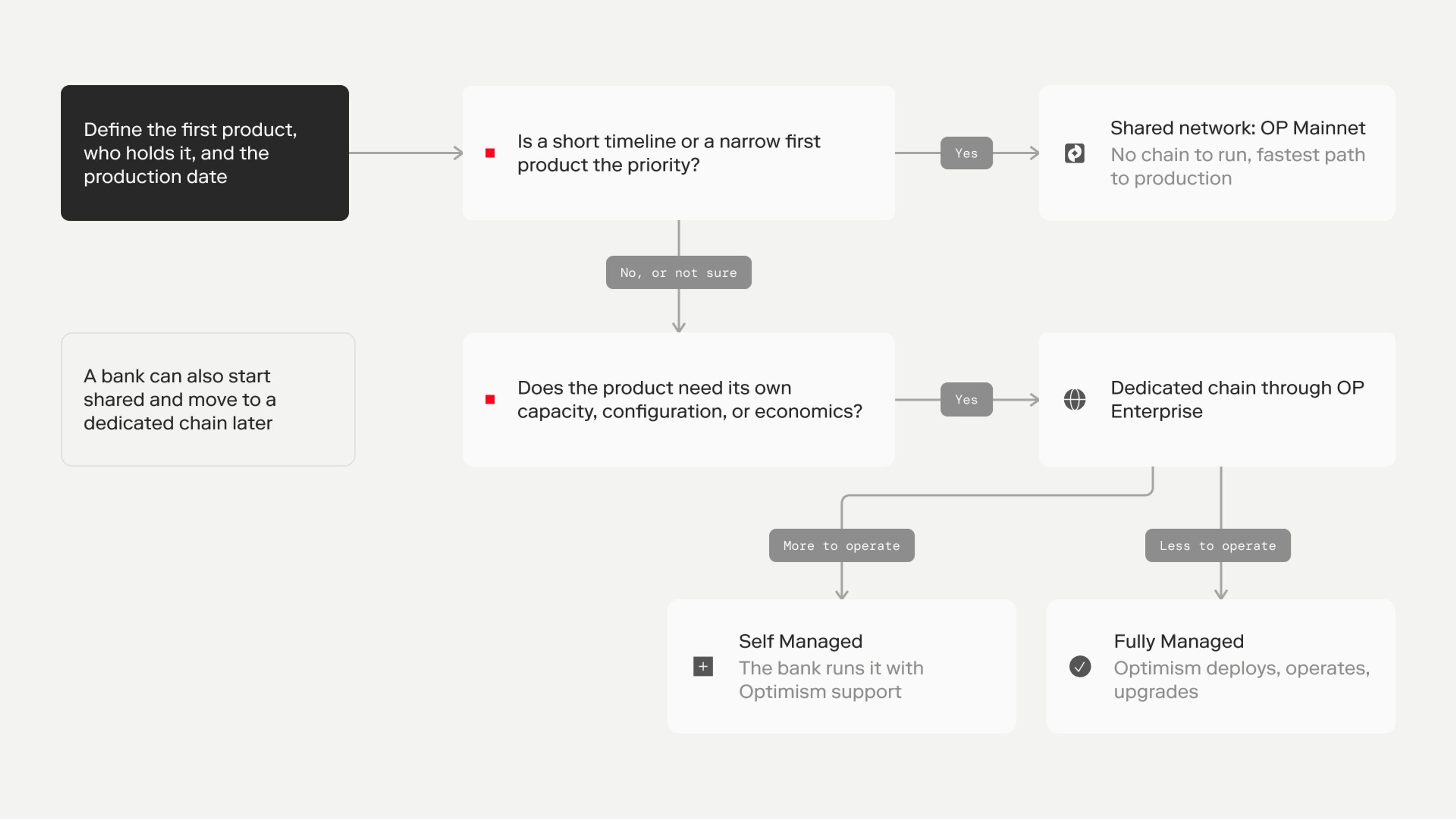
Start with four steps.
- Define the first product and who holds it.
- Set the timeline, since production dates drive the shared-versus-dedicated choice.
- Decide how much infrastructure the bank wants to operate.
- Test in a sandbox or on testnet before committing to a model.
Frequently Asked Questions
Which blockchain best supports institutional DeFi for a bank?
It depends on where compliance and control need to sit. A shared network such as OP Mainnet reaches production sooner, with compliance handled at the application level. A dedicated chain through OP Enterprise adds chain-level permissioning, dedicated capacity, and a choice between operating it in-house or under a contractual SLA.
Who is responsible for compliance when a bank uses the OP Stack?
The bank and its application and service providers. Optimism supplies open-source technology and shared infrastructure, and it does not provide partner-specific compliance.
Can a bank keep onchain activity private?
A dedicated chain supports permissioned access at the chain level. Private configurations are an area Optimism is collaborating on with institutions. Banks interested in a private chain can contact the OP Enterprise team.
Can a bank use tokenized funds or deposits on the OP Stack today?
Public references so far are at the MOU, planned-mainnet, testnet, and test stages. Check current announcements before citing any institution.
What are the main blockchain use cases for banks?
Settlement, tokenized deposits, cross-border payments, and tokenized funds or securities. Each asks different things of the infrastructure, from predictable fees to control over token holders.
Should a bank use a shared network or a dedicated chain?
It depends on the product and timeline. A shared network reaches production sooner. A dedicated chain gives the bank its own capacity, configuration, and economics, with more operating responsibility.
What is the difference between Self Managed and Fully Managed?
With Self Managed, the bank runs the chain infrastructure in its own cloud with Optimism support. With Fully Managed, Optimism deploys, operates, and upgrades the infrastructure as a service.
What uptime commitments does OP Enterprise offer?
Fully Managed carries a 99.9% uptime SLA and 30-minute SEV 1 response. Mission-Critical Support, an add-on, raises that to 99.95% uptime and 15-minute response.
Can a bank start on a shared network and move later?
Yes. A bank can deploy on OP Mainnet first and take a dedicated chain through OP Enterprise when volume or control needs grow.
Which institutions have announced OP Stack work?
Public references so far include KB Securities, Bitpanda, Dunamu, and Toss, at MOU, planned-mainnet, testnet, and test stages. Check current announcements before citing any institution.
Glossary
- Shared network: A public chain where many applications share block space, such as OP Mainnet.
- Dedicated chain: A chain built for one business, with its own capacity, configuration, and economics.
- Self Managed: An OP Enterprise model where the customer runs chain infrastructure in its own cloud with Optimism support.
- Fully Managed: An OP Enterprise model where Optimism deploys, operates, and upgrades the chain infrastructure.
- Sequencer: The component that orders and batches transactions on a Layer 2 chain.
- SLA: A service level agreement, a contractual commitment on uptime and response times.
- Tokenized deposit: A bank deposit represented as a token on a blockchain.
Key sources
- OP Enterprise product page
- Optimism: What is OP Mainnet
- Optimism in Korea: the partners, the proof, and where to find us at KBW
- DigitalToday: KB Securities joins Securitize, Optimism to pursue STO business for institutions
- Optimism: Bitpanda launches Vision Chain as the first Fully Managed OP Enterprise chain
Authored by

Optimism