
TL;DR: When you distribute a product on a blockchain you do not control, that network sets the fees and takes a share of every transaction. Owning your own chain reverses it: every transaction on your network earns fees for you instead of a platform taking a cut.
This year, one of the most-watched moves in finance was a consumer platform putting real-world assets like stocks onchain and earning a fee every time a customer traded them. The headlines focused on the volume and the fees it generated. The more interesting story is who kept that money, and why.
What does owning your own chain mean?
Owning your chain means running the blockchain network your product operates on, instead of launching on one another company controls. When you own it, you set the fee structure and keep the transaction revenue. When you build on someone else's network, that network sets the terms and takes a share of every transaction.
Why does distribution decide who keeps the revenue?
Whoever owns the distribution sets the terms. That is as true onchain as it is anywhere else. When you launch a product on a blockchain you do not control, you are building on rented rails. The network sets the fee structure and captures a share of every transaction.
Consider an asset issuer, say a large ETF provider, deciding to distribute its products onchain. It can go to a platform that already has the customers and ask to be listed. The platform will say yes, and it will set a price, because it owns the distribution. The issuer gets the reach, and the platform keeps the fees.
Own your chain: who captures the value?
When you own the chain, you collect the fees instead of paying them.
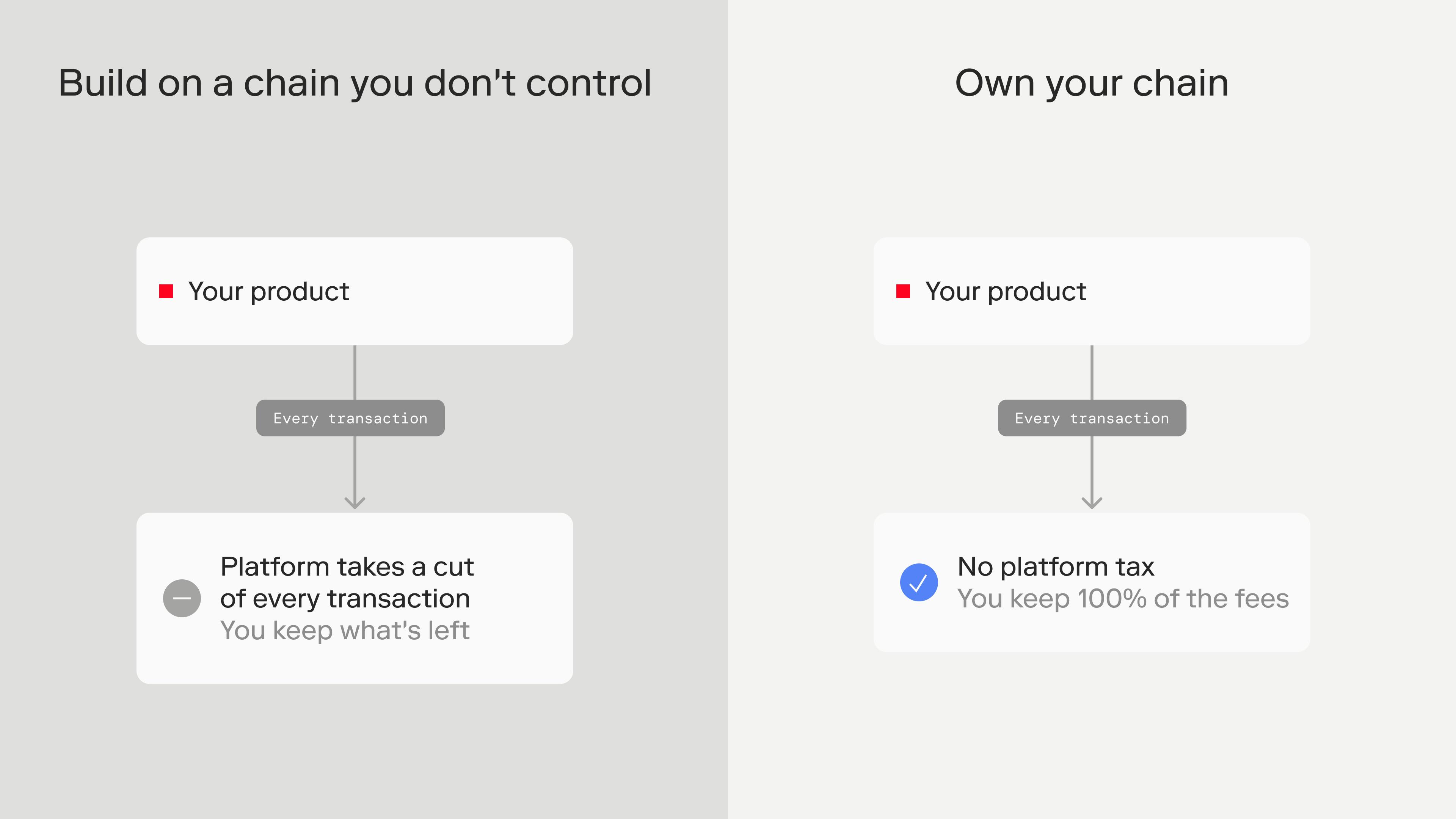
| Build on a chain you don't control | Own your chain | |
|---|---|---|
| Transaction revenue | Shared with the network | Kept in full (100%) |
| Fee structure | Set by the network | Set by you |
| Fees from partners on your chain | Captured by the platform | Captured by you |
| Platform tax | A cut of every transaction | None |
| Your relationship to the rails | Tenant | Owner |
Does the economic case hold up?
Independent analysis from Messari found that for every dollar enterprises spent in transaction fees running on the OP Stack, they generated ten dollars in application revenue. Across partners, that came to $415 million in the second half of 2025 alone.
Can a regulated institution do this compliantly?
The economics are the easy part. Compliance is the hard part. A regulated institution cannot simply put customer transactions on a public network and hope the auditors are comfortable. It has to meet know-your-customer and anti-money-laundering requirements, keep transaction data private, and still give regulators and its own compliance team the visibility they are required to have. Those requirements have historically pulled in opposite directions. Public networks are transparent by design, and institutions need privacy by obligation.
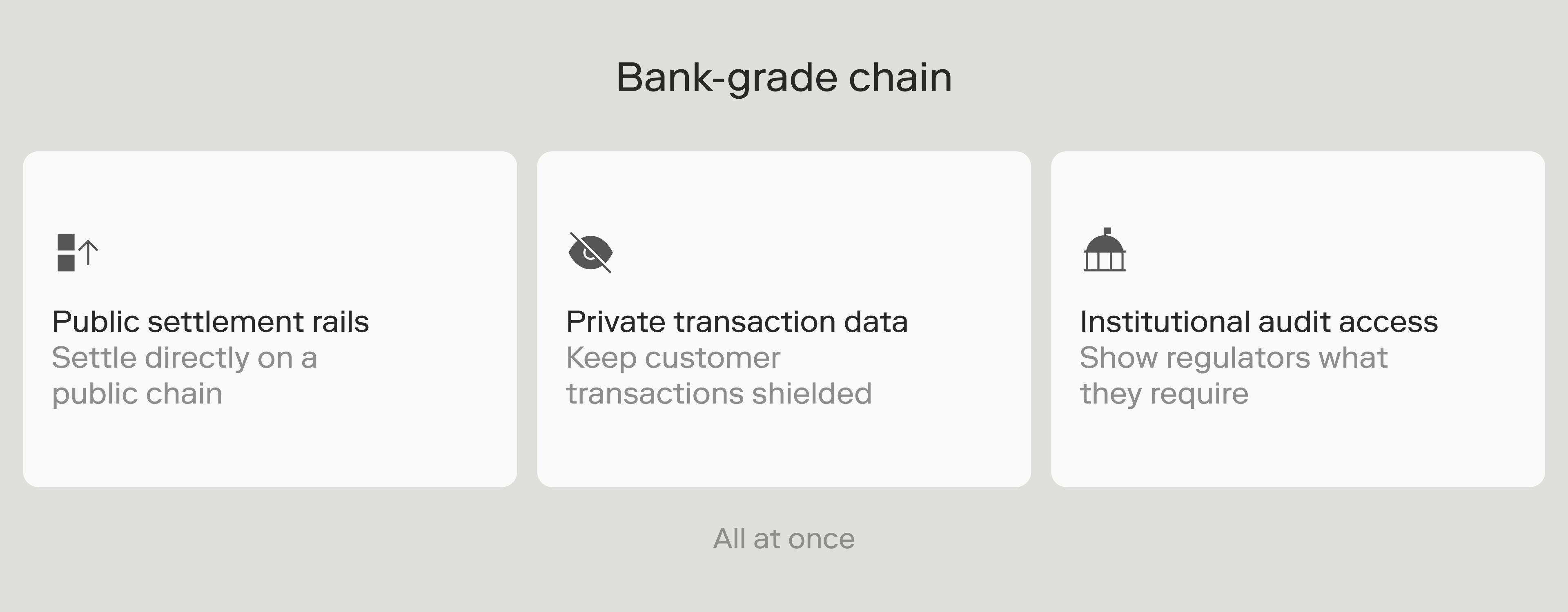
That problem is being tested right now. In Korea, Toss, the payments app used by a large share of the country, has signed an agreement to run a three-month proof of concept with Optimism and Sunnyside Labs, exploring stablecoin infrastructure for the Korean won on the OP Stack. The test is whether a financial institution can manage settlement directly, meet its compliance obligations, and protect transaction privacy on a public network at the same time.
Frequently Asked Questions
What does it mean to own your own blockchain?
It means operating the network your product runs on rather than launching on one another company controls. Ownership means you set the fee structure, keep the transaction revenue, and are not subject to a platform taking a cut of every transaction.
Why do enterprises build their own chain instead of using an existing one?
To capture the economics of their own distribution. On a network they do not control, the operator takes a share of every transaction. On their own chain, that revenue stays with the business, which is why institutions from exchanges to asset issuers are moving this way.
What is the OP Stack?
The OP Stack is the open-source software framework used to run these networks. More than fifty companies operate production chains on it, including Base, Sony's Soneium, and Kraken's Ink.
Can a regulated financial institution use a public blockchain compliantly?
That is the question the industry is actively testing. An institution must meet KYC and anti-money-laundering rules and keep transaction data private while still giving compliance teams and regulators the visibility they require. Solving all three at once on a public chain is the current technical frontier.
What is the Toss stablecoin proof of concept?
Toss, a major Korean payments app, signed an agreement for a three-month proof of concept with Optimism and Sunnyside Labs to explore Korean won stablecoin infrastructure on the OP Stack. It tests whether an institution can manage settlement, meet compliance rules, and protect transaction privacy on a public chain simultaneously.
Is building on someone else's blockchain ever the better choice?
Renting distribution can be worth it for speed and reach, especially early. The point is understanding that the platform captures part of your economics in exchange for access to its audience.
Glossary
Onchain: recorded and processed on a blockchain network rather than on a company's private systems.
Rails: the underlying infrastructure that moves and settles a transaction. Renting rails means running on infrastructure someone else owns and controls.
OP Stack: the open-source framework companies use to run their own production blockchain networks.
Stablecoin: a digital asset designed to hold a stable value, typically pegged to a currency such as the Korean won or US dollar.
KYC / AML: know-your-customer and anti-money-laundering, the identity and monitoring rules regulated institutions must follow.
Settlement: the final, recorded transfer of value that completes a transaction.
Platform tax: as used here, the share of every transaction that a network operator takes from products built on a chain they control.
Authored by

Optimism