
The institution that issues a token owns the product, its eligibility rules, and its obligations to the jurisdictions where it operates.
What does tokenized asset infrastructure need to do?
Tokenized asset infrastructure is the network where an issuer creates, records, and transfers tokens that represent real-world assets such as funds, treasuries, private credit, or commodities. Institutions usually evaluate four things: settlement, custody compatibility, issuer controls, and fee design. Settlement works the same way on both options in this guide, because both settle to Ethereum.
| Requirement | What it covers | OP Mainnet | Dedicated OP Enterprise chain |
|---|---|---|---|
| Settlement | Where transactions settle | Ethereum | Ethereum |
| Custody compatibility | Whether the issuer's chosen custodian can hold and move the token | The issuer connects its custodian at the application level | The issuer selects its custodian. OP Enterprise lists custody providers among its 30+ integrations |
| Issuer controls | Eligibility checks and transfer rules for token holders | Built into the token or application, because the network is open | Built into the token or application, with chain-level permissioned access available on top |
| Fee design | Which token pays network fees | ETH | A custom gas token can be configured, an OP Stack feature |
How do OP Mainnet and a dedicated OP Enterprise chain compare?
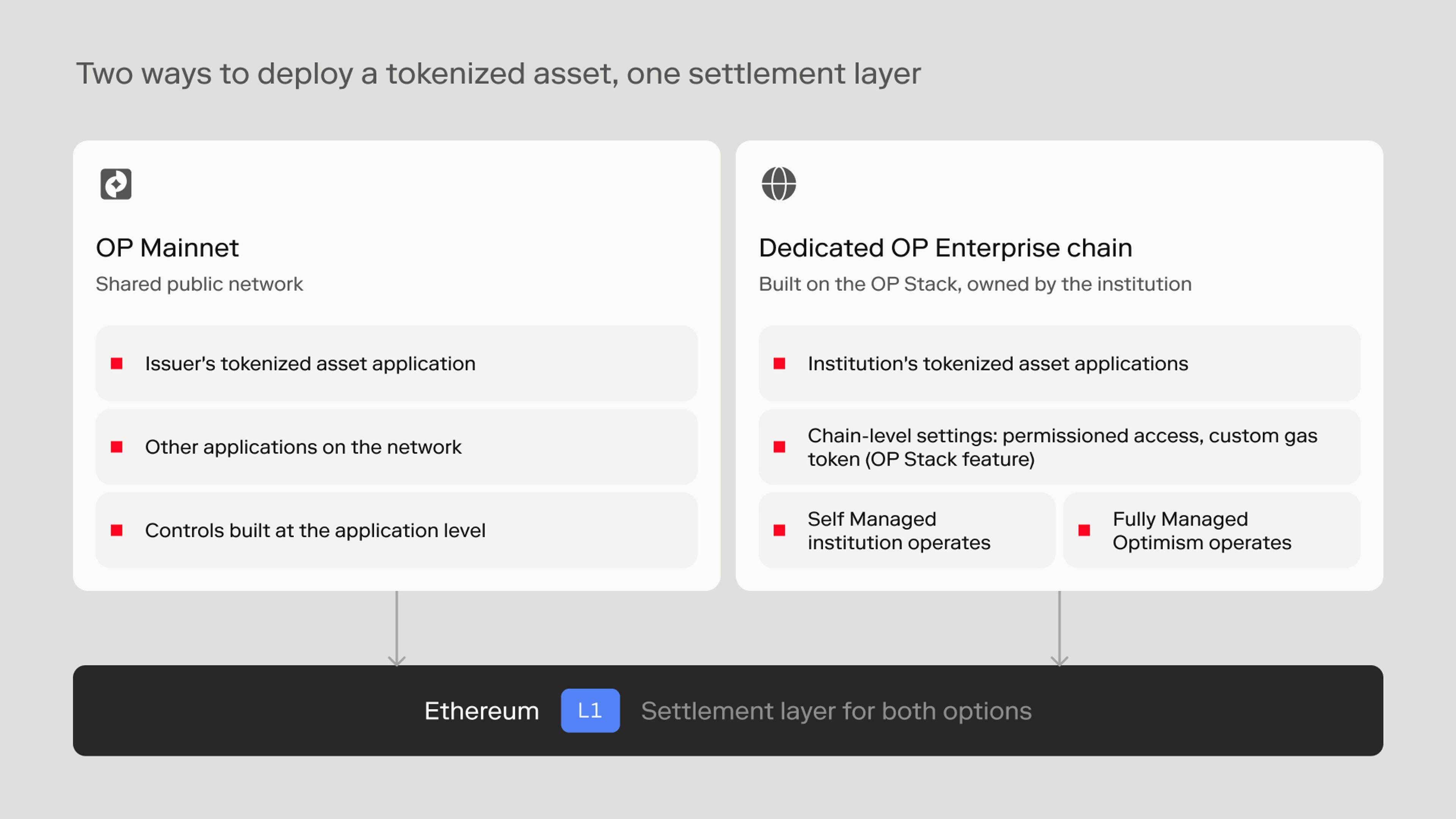
OP Mainnet is a public network where an issuer deploys an application and has no chain to operate. A dedicated OP Enterprise chain is built on the OP Stack for one institution and runs under a service tier. Both settle to Ethereum, so the real differences are capacity, access control, and operations.
| Criterion | OP Mainnet (shared public network) | OP Enterprise dedicated chain |
|---|---|---|
| What it is | A public, permissionless network that many applications share | A chain dedicated to one institution, built on the OP Stack |
| Settlement | Settles to Ethereum | Settles to Ethereum |
| Capacity | Shared block space with other applications | Dedicated to the institution |
| Access control | Application level, because the network is open | Chain-level permissioned access, set by the chain owner |
| Fee token | ETH | A custom gas token can be configured, an OP Stack feature |
| Who operates the infrastructure | No chain infrastructure for the issuer to manage | Self Managed: the institution. Fully Managed: Optimism |
| Reliability | Historical uptime of 99.99% | By tier: 99.9% (Fully Managed), 99.95% (Mission-Critical Support) |
| Upfront cost | No upfront cost to deploy | Set by the OP Enterprise tier and agreement |
| Compliance responsibility | The issuer | The issuer |
What service levels does OP Enterprise publish?
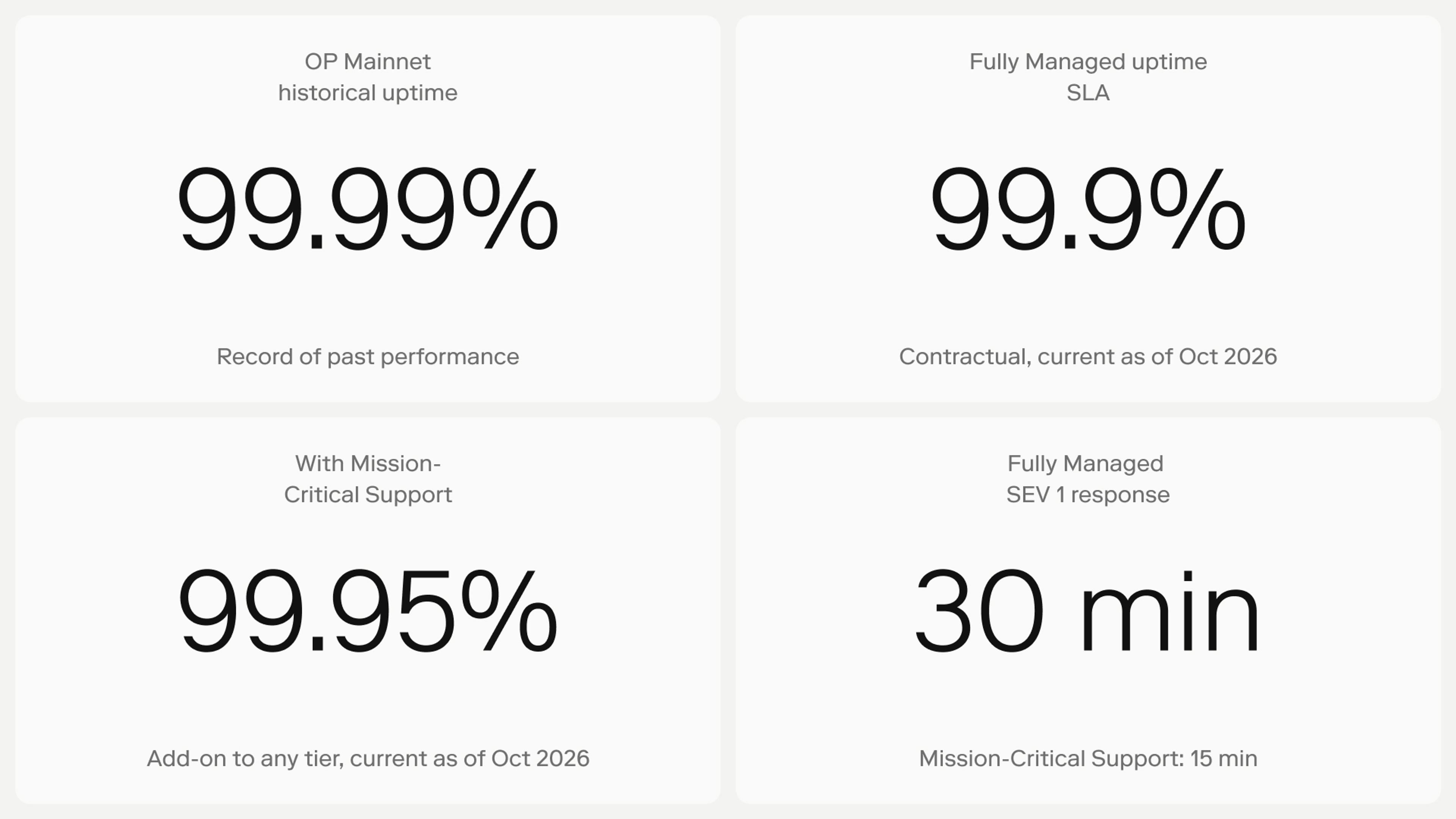
OP Enterprise publishes service levels by tier. Fully Managed carries a 99.9% uptime SLA and 30-minute SEV 1 response. Mission-Critical Support, an add-on to any tier, raises that to 99.95% uptime and 15-minute SEV 1 response. Self Managed includes 24/7 incident response with a one-hour SLA on critical issues.
| Tier | Who operates the chain | Uptime commitment | Incident response |
|---|---|---|---|
| Self Managed | The institution, in its own cloud | No OP-side uptime SLA | 24/7 response, one-hour SLA on critical issues |
| Fully Managed | Optimism | 99.9% uptime SLA | 30-minute SEV 1 response |
| Mission-Critical Support (add-on to any tier) | Same as the base tier | 99.95% uptime | 15-minute SEV 1 response |
OP Mainnet's historical uptime is 99.99%. That figure describes past performance. Mission-Critical Support also brings multi-region deployment and a dedicated technical account manager. Details are on the OP Enterprise page.
When does OP Mainnet fit a tokenized asset?
OP Mainnet fits an issuer that wants to deploy an application without operating a chain. Optimism describes it as a way to test an onchain product before committing to a chain of its own.
- The issuer builds eligibility rules and transfer controls into its token or application.
- The issuer shares block space with other applications on the network.
- There is no upfront cost to deploy.
When does a dedicated OP Enterprise chain fit?
A dedicated chain fits an institution that needs settings at the chain level: its own capacity, permissioned access, a custom gas token, or a contractual uptime SLA. Self Managed puts the infrastructure in the institution's own cloud. Fully Managed has Optimism deploy, operate, and upgrade the chain as a service.
Dedicated OP Stack chains in production include Soneium and Uniswap's Unichain.
What have institutions announced on OP Mainnet and the OP Stack?
Mitsui & Co. Digital Commodities (MDC) announced Zipangcoin (ZPG) on OP Mainnet on April 17, 2026. ZPG is a token backed by gold, silver, and platinum, and Optimism's announcement describes it as the first commodity-backed cryptoasset issued by a Japanese company to launch on the network. The Defiant reported the same day that it is ZPG's first deployment on a public blockchain since launching in 2022.
DB Securities and the Optimism Foundation have announced an MOU for security token offering (STO) and real-world asset (RWA) infrastructure for Jeju, South Korea, on the OP Stack. The first initiative covers smart-farming, livestock, and Korean IP assets. DB Securities plans to build and operate the platform, and Optimism provides the blockchain infrastructure.
| Institution | Asset or initiative | Network | Status |
|---|---|---|---|
| Mitsui & Co. Digital Commodities | Zipangcoin (ZPG), backed by gold, silver, and platinum and issued by MDC | OP Mainnet | Announced April 17, 2026 |
| DB Securities | STO and RWA infrastructure for Jeju, South Korea. First initiative: smart-farming, livestock, and Korean IP assets | OP Stack | MOU announced |
Who is responsible for compliance on a tokenized asset?
The issuer is. Eligibility rules, investor checks, and regulatory obligations belong to the institution that issues the asset and to the jurisdictions where it operates.
- On OP Mainnet, issuer-specific controls sit at the application level, because the network is open.
- On a dedicated chain, the chain owner can also set permissioned access at the chain level.
How can an institution decide between the two paths?
Start with four steps.
- Define the asset and who issues it.
- Decide whether the issuer's controls can live at the application level on a shared network.
- If not, decide whether the product needs chain-level settings, a custom gas token, or a contractual uptime SLA.
- For a dedicated chain, decide who operates it: the institution (Self Managed) or Optimism (Fully Managed). Mission-Critical Support can be added to either.
Frequently Asked Questions
What is asset tokenization?
Asset tokenization is the process of representing a real-world asset, such as a fund, a treasury, private credit, or a commodity, as a token on a blockchain. The institution that issues the token owns the product, its eligibility rules, and its regulatory obligations. The blockchain provides the record and the transfer mechanism.
What infrastructure requirements matter for tokenizing assets?
Four requirements come up most often: settlement, custody compatibility, issuer controls, and fee design. Settlement works the same way on OP Mainnet and on a dedicated OP Enterprise chain, because both settle to Ethereum. Issuer controls, fee design, and who operates the infrastructure are where the two options differ.
What is the difference between OP Mainnet and a dedicated OP Enterprise chain?
OP Mainnet is a public, permissionless network that many applications share, with no chain for the issuer to operate. A dedicated OP Enterprise chain is built on the OP Stack for one institution, with its own capacity, chain-level settings, and a service tier. Both settle to Ethereum.
Does settlement differ between OP Mainnet and a dedicated chain?
No. OP Mainnet and a dedicated OP Stack chain both settle to Ethereum, so settlement is the same question on either path. The choice turns on capacity, access control, fee token, who operates the infrastructure, and the service levels that apply to each option.
What service levels does OP Enterprise publish?
Fully Managed carries a 99.9% uptime SLA and 30-minute SEV 1 response. Mission-Critical Support, an add-on to any tier, raises that to 99.95% uptime and 15-minute SEV 1 response. Self Managed includes 24/7 incident response with a one-hour SLA on critical issues.
Who is responsible for compliance on a tokenized asset?
The issuer is. Eligibility rules, investor checks, and regulatory obligations belong to the institution that issues the asset and to the jurisdictions where it operates, at the application level.
Can an institution start on OP Mainnet and move to a dedicated chain later?
Yes. Optimism describes OP Mainnet as a way to test an onchain product before committing to a chain of its own. An institution can deploy there first and take a dedicated chain through OP Enterprise when it needs chain-level settings, dedicated capacity, or a contractual uptime SLA.
Which institutions have announced tokenized asset work with OP Mainnet or the OP Stack?
Mitsui & Co. Digital Commodities announced Zipangcoin, a token backed by gold, silver, and platinum, on OP Mainnet. DB Securities and the Optimism Foundation announced an MOU for STO and RWA infrastructure for Jeju, South Korea, on the OP Stack. Each institution issues and operates its own product.
Where can an institution learn more about OP Enterprise?
The OP Enterprise page at optimism.io/op-enterprise lists the three paths to production, OP Mainnet, Self Managed, and Fully Managed, along with Mission-Critical Support and the published service levels. Institutions with a specific tokenization project can schedule a meeting with the OP Enterprise team from that page.
Glossary
- Asset tokenization: Representing a real-world asset, such as a fund, treasury, private credit, or commodity, as a token on a blockchain.
- OP Mainnet: A public, permissionless network built on the OP Stack that many applications share. It settles to Ethereum.
- OP Stack: The open-source, MIT-licensed technology that OP Mainnet and other chains are built on.
- OP Enterprise: Optimism's commercial product for institutions: managed and self-managed chains built on the OP Stack, with service tiers and add-ons.
- Dedicated chain: A chain built for one institution, with its own capacity and chain-level settings, built on the OP Stack.
- Self Managed: An OP Enterprise model where the customer runs the chain infrastructure in its own cloud, with Optimism engineering support.
- Fully Managed: An OP Enterprise model where Optimism deploys, operates, and upgrades the chain infrastructure as a service.
- SLA: A service level agreement, a contractual commitment on uptime and incident response times.
- Security token offering (STO): An offering of tokenized securities issued on a blockchain.
Key sources
- OP Enterprise product page
- Optimism: Mitsui & Co. Digital Commodities Launches Zipangcoin on OP Mainnet, April 17, 2026
- The Defiant: Mitsui & Co.'s Crypto Arm Brings Tokenized Metals Asset Zipangcoin to OP Mainnet, April 17, 2026
- Optimism: What is OP Mainnet
- OP Stack documentation: Custom Gas Token
- Optimism: DB Securities Signs MOU to Build STO and RWA Infrastructure for Jeju on the OP Stack
Authored by

Optimism