
What decision does an institutional DeFi team face?
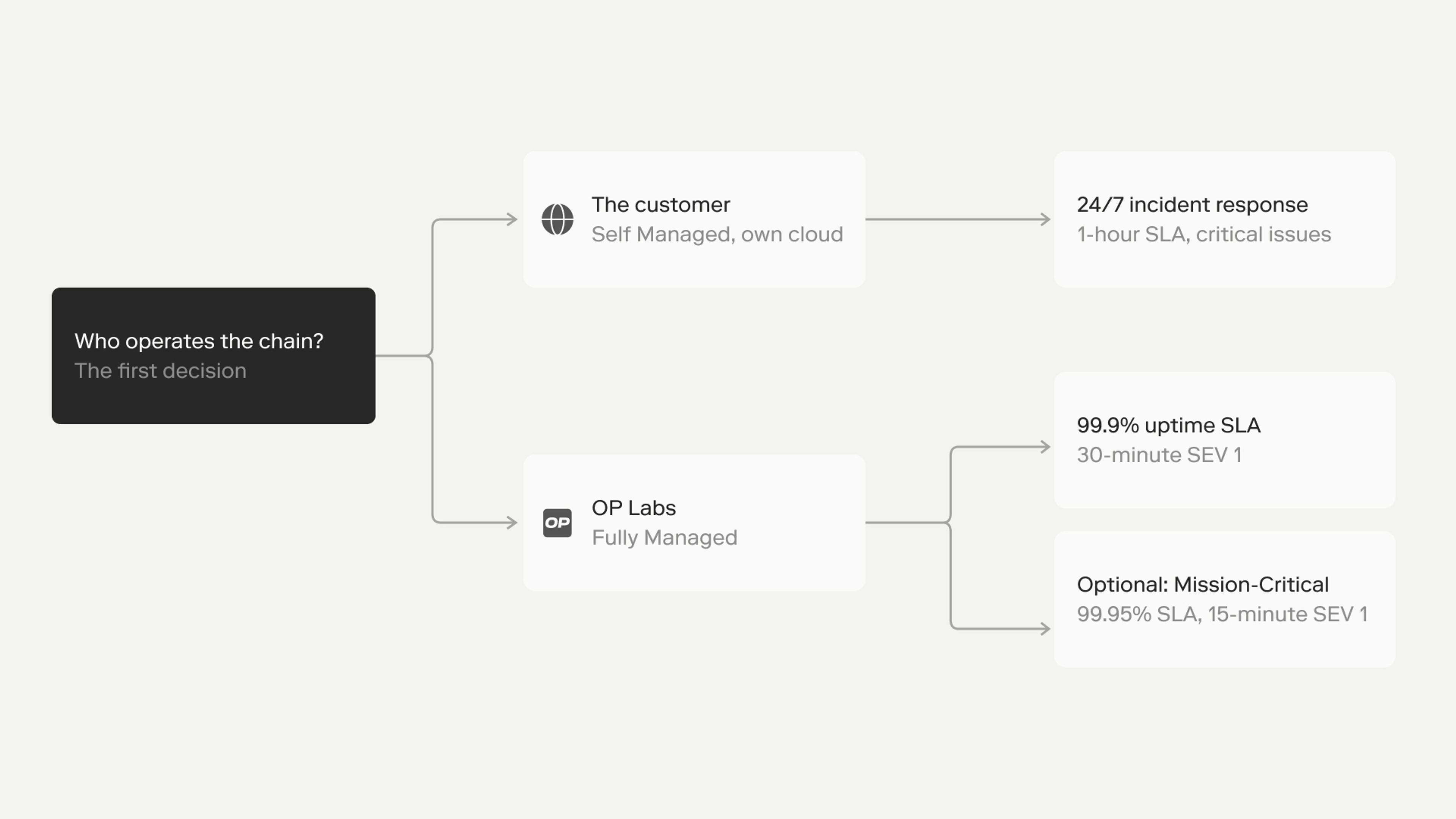
Launching a chain takes weeks, and running it takes years. For an institution, a public outage or security incident is the risk that matters most, so the first decision is who carries the operating work: the sequencer, protocol upgrades, round-the-clock monitoring, and incident response. The second decision is what that party commits to when something breaks.
How do the OP Enterprise operating tiers compare?
OP Mainnet is the shared public option, Self Managed puts operations with the customer, and Fully Managed puts them with Optimism. Mission-Critical is an add-on that raises the commitments.
| Operating tier | Who operates it | Uptime commitment | Best for |
|---|---|---|---|
| OP Mainnet (shared) | Shared public network | Not a dedicated customer SLA | The fastest path to a public launch without standing up a chain |
| Self Managed (dedicated) | Customer, in its own cloud, with OP Labs support | No uptime SLA is listed. 24/7 incident response, 1-hour SLA on critical issues | Teams with strong infrastructure capacity that want full control |
| Fully Managed (dedicated) | OP Labs deploys and operates it; the customer keeps control of its chain's configuration, economics, and product roadmap | 99.9% uptime SLA. 30-minute SEV 1 response | Institutions that want a dedicated chain without running it |
| Mission-Critical (add-on) | OP Labs | 99.95% uptime SLA. 15-minute SEV 1 response | Institutions where uptime is the deciding factor |
Source: optimism.io/op-enterprise, verified October 23, 2026.
What do the service commitments cover?
Reliability commitments scale with the tier. An SLA is a written commitment with a stated response time, and a best-effort promise is not.
- Self Managed: no uptime SLA is listed, because the customer runs the infrastructure. OP Labs commits to 24/7 incident response and a 1-hour SLA on critical issues.
- Fully Managed: 99.9% uptime SLA and 30-minute SEV 1 response. OP Labs handles monitoring, upgrades, sequencer operations, and incident response.
- Mission-Critical: 99.95% uptime SLA, 15-minute SEV 1 response, multi-region deployment, and a dedicated technical account manager.
Who is responsible for what on each tier?
The split of operating work is the practical difference between the two dedicated tiers.
| Responsibility | Self Managed | Fully Managed |
|---|---|---|
| Sequencer and node operations | Customer | OP Labs |
| Protocol upgrades | Customer, with OP Labs support | OP Labs |
| Monitoring and incident response | Customer, with 24/7 OP Labs incident response | OP Labs |
| Chain configuration, economics, and roadmap | Customer | Customer |
| Compliance obligations | Operator | Operator |
What does the OP Stack look like in production?
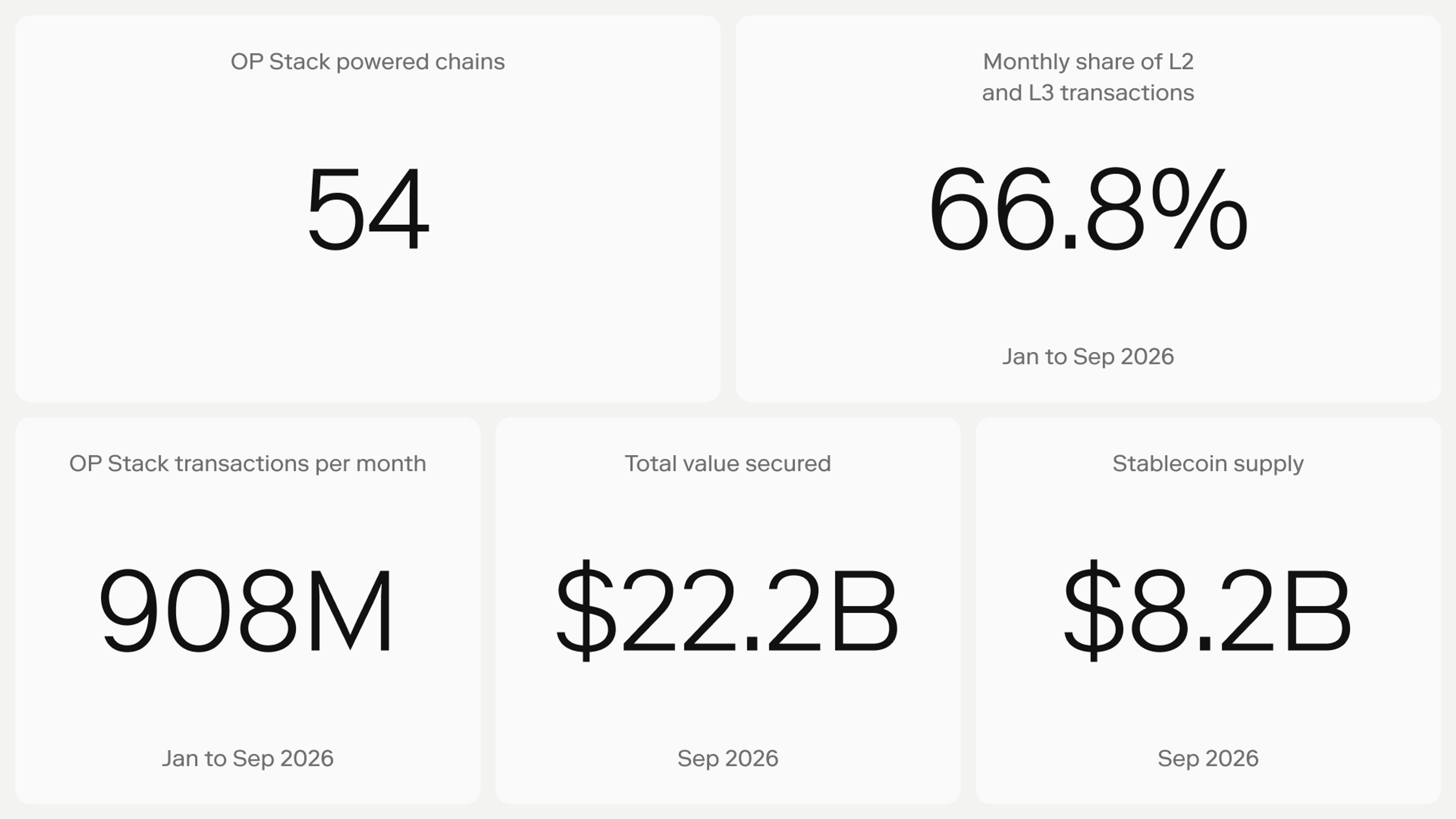
The OP Stack is open source and MIT licensed. These figures come from optimism.io/stats.
- 54 mainnet chains deployed on the OP Stack, as of October 2026.
- 66.8% average monthly share of L2 and L3 transactions, January to September 2026. Source: OP Labs, using Dune, Goldsky, L2BEAT, and growthepie.
- 908M average transactions per month across OP Stack chains, January to September 2026. Includes reverted transactions. Source: OP Labs.
- $22.2B total value secured, September 2026. Source: L2BEAT.
- $7.5B of assets active in DeFi, end of September 2026. Source: DefiLlama.
- $8.2B stablecoin supply, end of September 2026. Source: DefiLlama and L2BEAT.
- $35T gross stablecoin transfers, January to September 2026. Excludes mints and burns. Source: Dune Analytics.
How long does launch take?
OP Enterprise's July 2026 announcement listed a launch timeline of 6 to 8 weeks for Fully Managed and Self Managed. A self-operated OP Stack chain takes 8 to 12 weeks, and OP Mainnet can take days (optimism.io, July 2026).
What changes when a team runs the chain itself?
A self-managed OP Stack chain puts monitoring, upgrades, sequencer operations, and incident response on the operator's own staff. It also puts the compliance and security tooling that OP Enterprise bundles on the operator. There is no sourced failure-rate figure for self-operated chains, so this guide makes no comparison.
Where should a team start?
A team can start on OP Mainnet to validate a product with real users and liquidity, then move to a dedicated OP Stack chain using the same codebase and tooling.
Next step: Tell the OP Enterprise team which tier you are weighing, and ask for the current SLA terms in writing.
Frequently Asked Questions
What is OP Enterprise?
OP Enterprise is the Optimism Foundation's managed infrastructure offering for institutions that launch a dedicated OP Stack chain or deploy on OP Mainnet.
What is the difference between Fully Managed and Self Managed?
With Fully Managed, OP Labs deploys and operates the chain, and the customer keeps control of its configuration, economics, and roadmap. With Self Managed, the customer runs the chain in its own cloud, with OP Labs support.
What uptime does OP Enterprise commit to?
Fully Managed carries a 99.9% uptime SLA with 30-minute SEV 1 response. Mission-Critical raises that to 99.95% with 15-minute SEV 1 response. Self Managed lists no uptime SLA and carries 24/7 incident response with a 1-hour SLA on critical issues.
How quickly can an institution launch?
OP Enterprise lists 6 to 8 weeks for Fully Managed and Self Managed, and days on OP Mainnet (optimism.io, July 2026). Confirm live figures with the OP Enterprise team.
Can a team move from OP Mainnet to its own chain?
Yes. A team can validate on OP Mainnet, then migrate to a dedicated OP Stack chain with the same codebase and tooling.
How is OP Enterprise built for performance?
It is built for high throughput and low latency, with auto-scaling, multi-provider RPC redundancy, high availability, and optimized transaction processing.
What does OP Enterprise cost?
Pricing varies by tier and requirements. Contact OP Labs for tier-specific pricing.
Glossary
- Sequencer: The component that orders and batches transactions on an OP Stack chain before they post to Ethereum for settlement.
- OP Stack: The open-source, MIT-licensed framework used to build Ethereum Layer 2 chains, including OP Mainnet and dedicated enterprise chains.
- Dedicated chain: A chain with its own capacity, configuration, and economics, as opposed to shared infrastructure such as OP Mainnet.
- Address screening: Compliance tooling that checks addresses against screening providers at the sequencer before transactions proceed.
- SEV 1: The highest severity level for an incident. OP Enterprise tiers state a response-time commitment for it.
Further reading
Authored by

Optimism