
The gap between a 99.9% uptime SLA and a 99.99% one is about 8 hours of downtime a year. A feature list won't show you that gap, but a contract will.
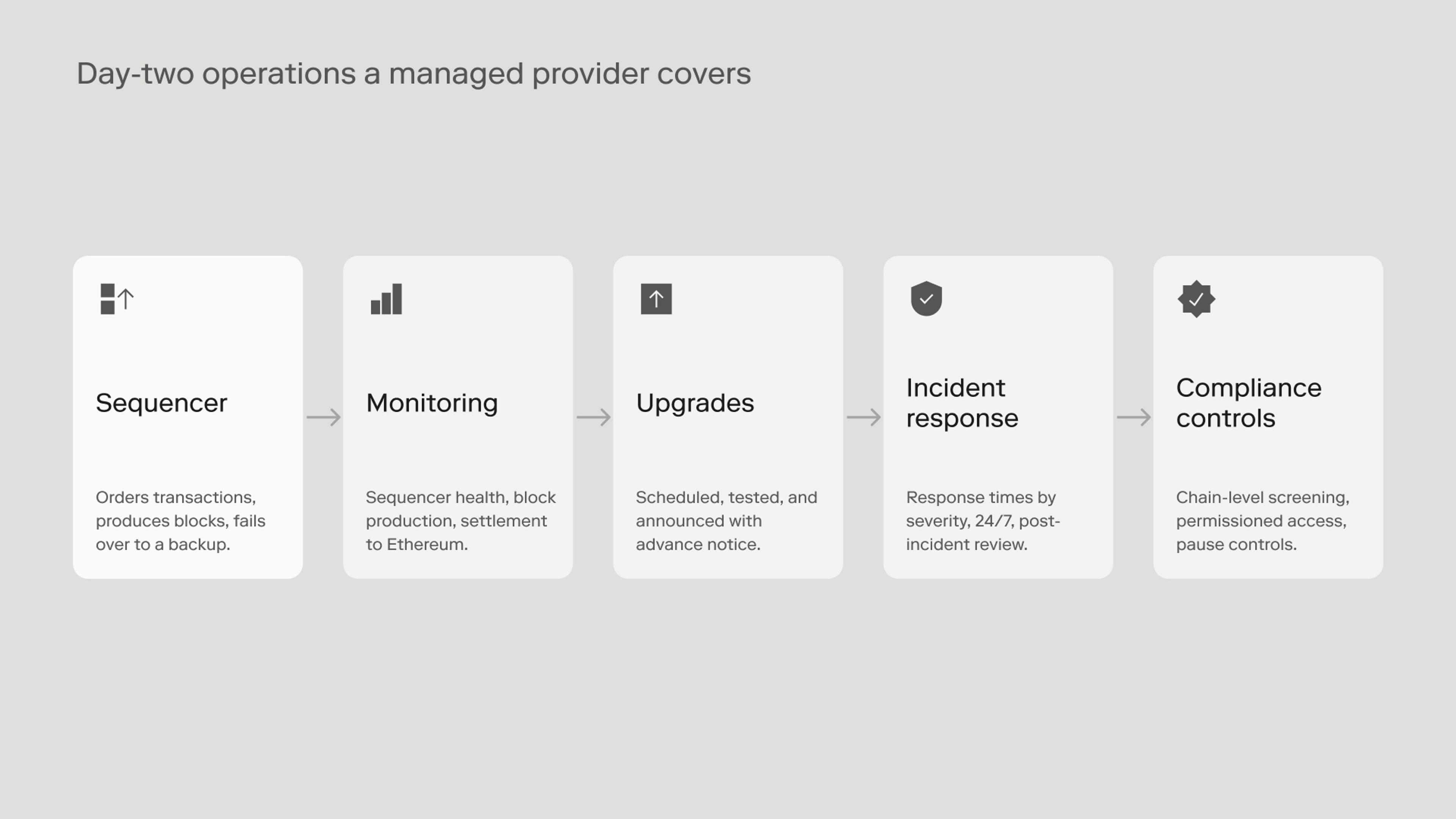
Deploying a chain is the easy part. On day two, someone has to run the sequencer, coordinate upgrades, watch the chain around the clock, and respond when something breaks. Most provider comparisons stop at features. These ten questions compare commitments instead, and each one can go straight into an RFP.
What should you look for when choosing a managed blockchain provider?
Look for ten things: a defined uptime SLA, clear remedies when it's missed, sequencer failover, incident response times, 24/7 monitoring, upgrade management, compliance controls built into the infrastructure, security assurance, control over configuration and economics, and a documented exit path. A provider that puts all ten in the contract is ready for production. If the answers only appear in a sales deck, keep asking.
What are the 10 questions to ask a managed blockchain provider?
Each question below can go straight into an RFP. Where OP Enterprise has a published answer, it appears in italics under the question.
1. What uptime does the provider guarantee?
Ask for a contractual percentage, not a target. A 99.9% commitment allows about 8.8 hours of downtime a year. At 99.99%, that drops to about 53 minutes. Ask how uptime is measured and what counts as an exclusion.
OP Enterprise (as of October 2026): Fully Managed includes a 99.9% uptime SLA. Mission-Critical Support raises it to 99.95%.
| Uptime SLA | Allowed downtime per year | OP Enterprise tier (as of October 2026) |
|---|---|---|
| 99% | 87.6 hours (about 3.7 days) | |
| 99.9% | 8.76 hours | Fully Managed |
| 99.95% | 4.38 hours | Mission-Critical Support |
| 99.99% | 52.6 minutes |
2. What happens when the provider misses the SLA?
A headline percentage means little without remedies. Ask how incidents are classified, how credits are calculated, who approves them, and whether credits arrive automatically or must be claimed.
3. How does the sequencer fail over?
The sequencer orders transactions and produces blocks. If it stops, the chain stops. Ask whether a backup sequencer exists, what triggers failover, how long it takes, and who owns the decision.
4. How fast does the provider respond to a critical incident?
Ask for response times by severity, the escalation path, whether coverage runs 24/7, and whether you get a written post-incident review.
OP Enterprise (as of October 2026): Fully Managed commits to a 30-minute response for SEV 1 incidents. Mission-Critical Support cuts that to 15 minutes. Self Managed includes 24/7 incident response with a one-hour SLA for critical issues.
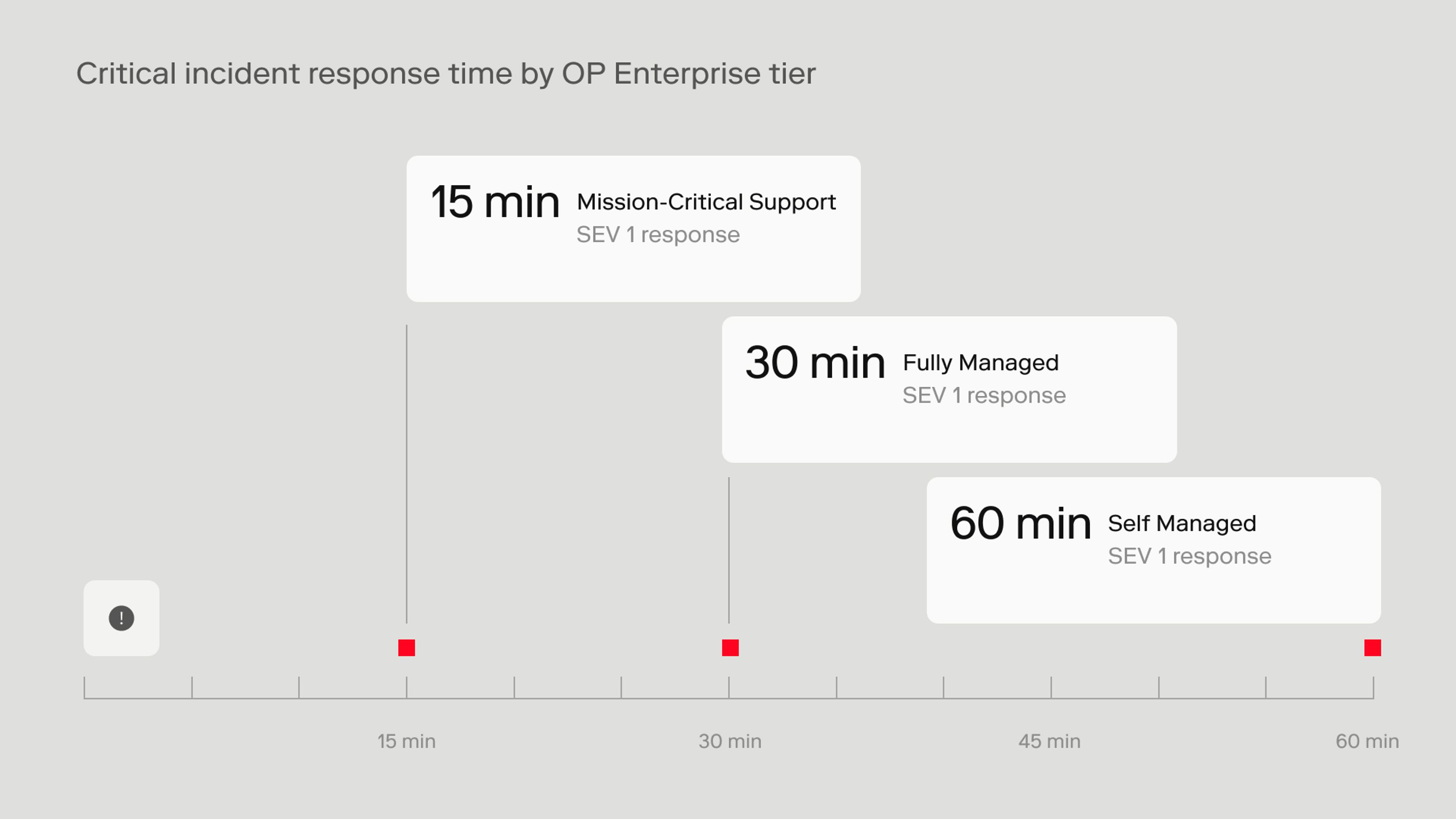
| OP Enterprise tier (as of October 2026) | Incident response commitment | Coverage |
|---|---|---|
| Mission-Critical Support | 15 minutes for SEV 1 | |
| Fully Managed | 30 minutes for SEV 1 | |
| Self Managed | 1 hour for critical issues | 24/7 incident response |
5. What does the provider monitor, and who is on call?
Chain monitoring is different from API monitoring. Ask whether the provider watches sequencer health, block production, and settlement to Ethereum, and who gets the alert at 2 a.m.
6. Who coordinates upgrades?
Protocol upgrades carry risk. Ask who schedules them, who tests them, how much notice you get, and what your team does versus what the provider handles.
7. Which compliance controls are available at the chain level?
For many buyers this is the biggest blocker. Sanctions and address screening, permissioned access, and other controls available at the chain level as well as in the application level. Ask which controls exist at the chain level and which you have to build.
OP Enterprise: Dedicated chains support sequencer-level sanctions and address screening and permissioned chain access, with policies set by the chain operator. These describe how the chain is designed. They are not a regulatory certification.
8. What security assurance does the provider offer?
Ask for audit reports, penetration test summaries, and incident history. Ask how the provider handles a security event that becomes public.
9. Who controls configuration and economics?
You should keep control of your chain's configuration and the transaction revenue it earns. Ask what the provider can change without your approval and how its fees scale with your volume.
OP Enterprise: Customers keep control of their chain's configuration and economics. With Fully Managed, Optimism handles deployment, operations, and upgrades.
10. Can you leave?
Most buyers skip this one. Ask whether you can move to self-managed operations, which data and keys you take with you, and what notice and fees apply. Ask whether the underlying software is open source.
OP Enterprise: The OP Stack is MIT licensed, so the core technology is open source.
How do the ten questions compare side by side?
Read down the middle column for what a strong answer looks like, and the right column for the vague answers that should slow you down.
| Question | A strong answer | A red flag |
|---|---|---|
| Uptime SLA | Contractual percentage, defined measurement | "Highly available" with no number |
| SLA remedies | Defined credits, clear claim process | No remedy language |
| Sequencer failover | Backup sequencer, documented failover | Single sequencer, manual recovery |
| Incident response | Response time by severity, 24/7 | Business-hours support only |
| Monitoring | Sequencer, block production, settlement | Generic infrastructure monitoring |
| Upgrades | Provider-coordinated, advance notice | Customer-owned with no support |
| Compliance | Chain-level controls | Application layer only |
| Security | Third-party audits on request | Self-attested claims |
| Control and economics | Customer keeps configuration and revenue | Provider controls the fee levers |
| Exit | Documented path, open-source stack | Proprietary lock-in |
How do you score providers?
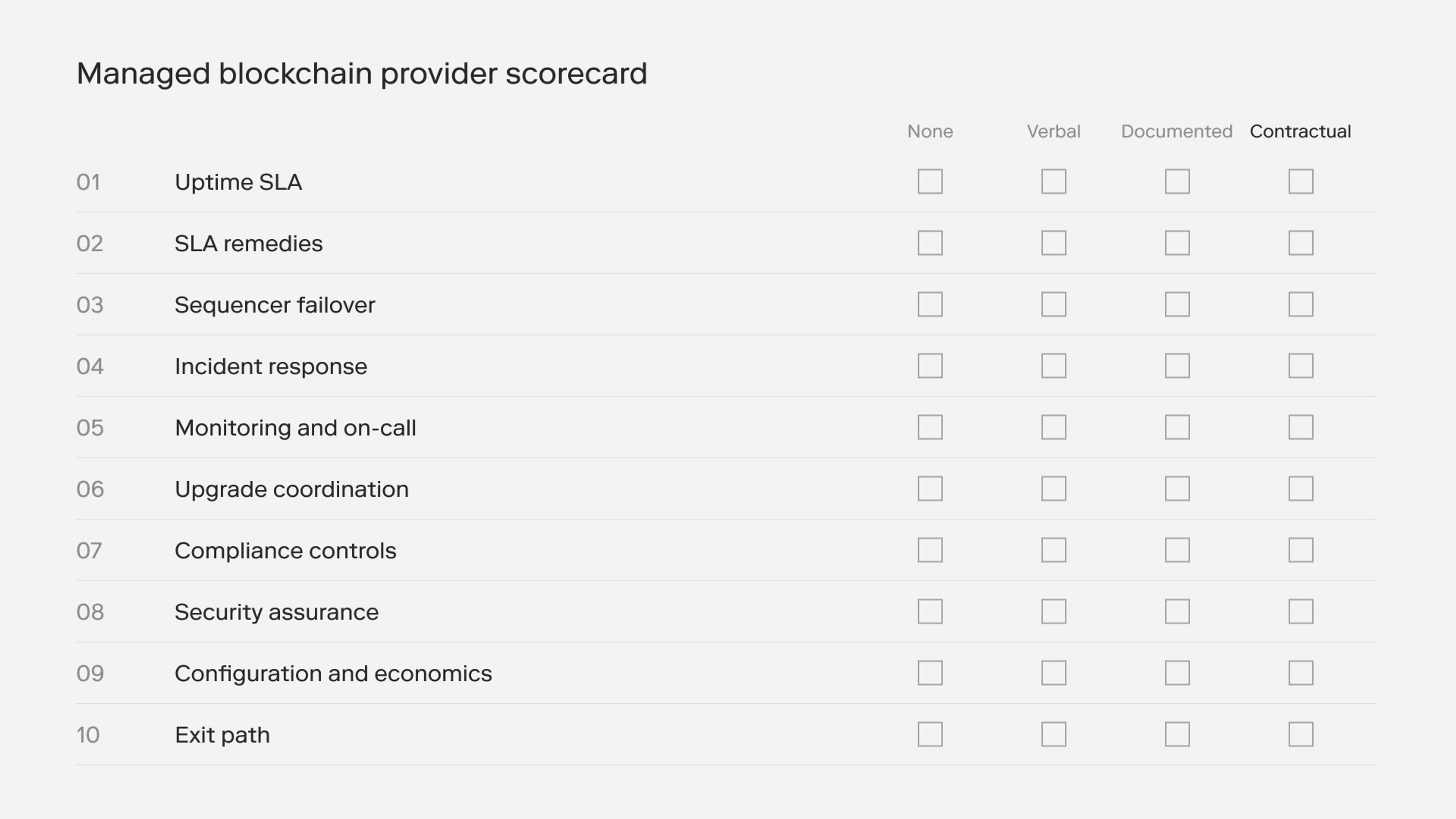
Rate each question from 0 to 3. Give a 0 when the provider has no answer, a 1 for a verbal answer, a 2 for a written answer in documentation, and a 3 for a contractual commitment. Weight compliance and exit higher if your compliance team drives the decision. Weight uptime and failover higher if you process payments or settlement.
| Score | Meaning | What you hold |
|---|---|---|
| 0 | None | The provider has no answer |
| 1 | Verbal | An answer given in conversation |
| 2 | Documented | A written answer in documentation |
| 3 | Contractual | A commitment in the contract |
Ready to put these ten questions to OP Enterprise? Get in touch.
FAQ
Frequently Asked Questions
What is a managed blockchain provider?
A managed blockchain provider runs the operational layer of a blockchain deployment for you. That usually covers sequencers or nodes, monitoring, upgrades, and incident response, so your team can focus on the product.
What is a good uptime SLA for enterprise blockchain infrastructure?
99.9% is a common baseline for managed services. Payment and settlement use cases often need 99.95% or higher. Check how the provider measures uptime and what remedies apply when it misses.
What is sequencer failover?
Sequencer failover moves block production to a backup sequencer when the primary one fails. Ask providers how quickly it triggers and who decides.
How is a managed blockchain provider different from a node API provider?
A node API provider gives you read and write access to existing networks. A managed chain provider operates a dedicated chain for you, including the sequencer and upgrades.
What does OP Enterprise include?
OP Enterprise is the commercial product for institutions that want a managed or dedicated chain built on the OP Stack. It offers Self Managed and Fully Managed operating models, and the OP Stack core is MIT licensed.
Glossary
- Sequencer is the component that orders transactions and produces blocks.
- SLA is a service level agreement, the contractual commitment on availability and response.
- SEV 1 is the highest-severity incident class.
- Guardian pause is a control that lets an authorized party pause chain activity in an emergency.
Further reading
OP Enterprise, which OP Enterprise tier is right for you, and enterprise blockchain reliability. SLA terms are dated and change, so confirm current terms with the OP Enterprise team.
Authored by

Greg Bresnitz