
Enterprises evaluating blockchain infrastructure face one question before they face any other: Should I build my own chain or on someone else's?
The right answer depends on one question: Do you have the DevOps capacity to operate a chain yourself? That means running sequencers, managing upgrades, monitoring infrastructure, and owning incident response when issues arise.
- If the answer is yes, one path makes sense.
- If the answer is no, and chain operations need to stay off your engineering team's plate entirely, a different path is likely the better fit.
Your answer places you in one of three categories.
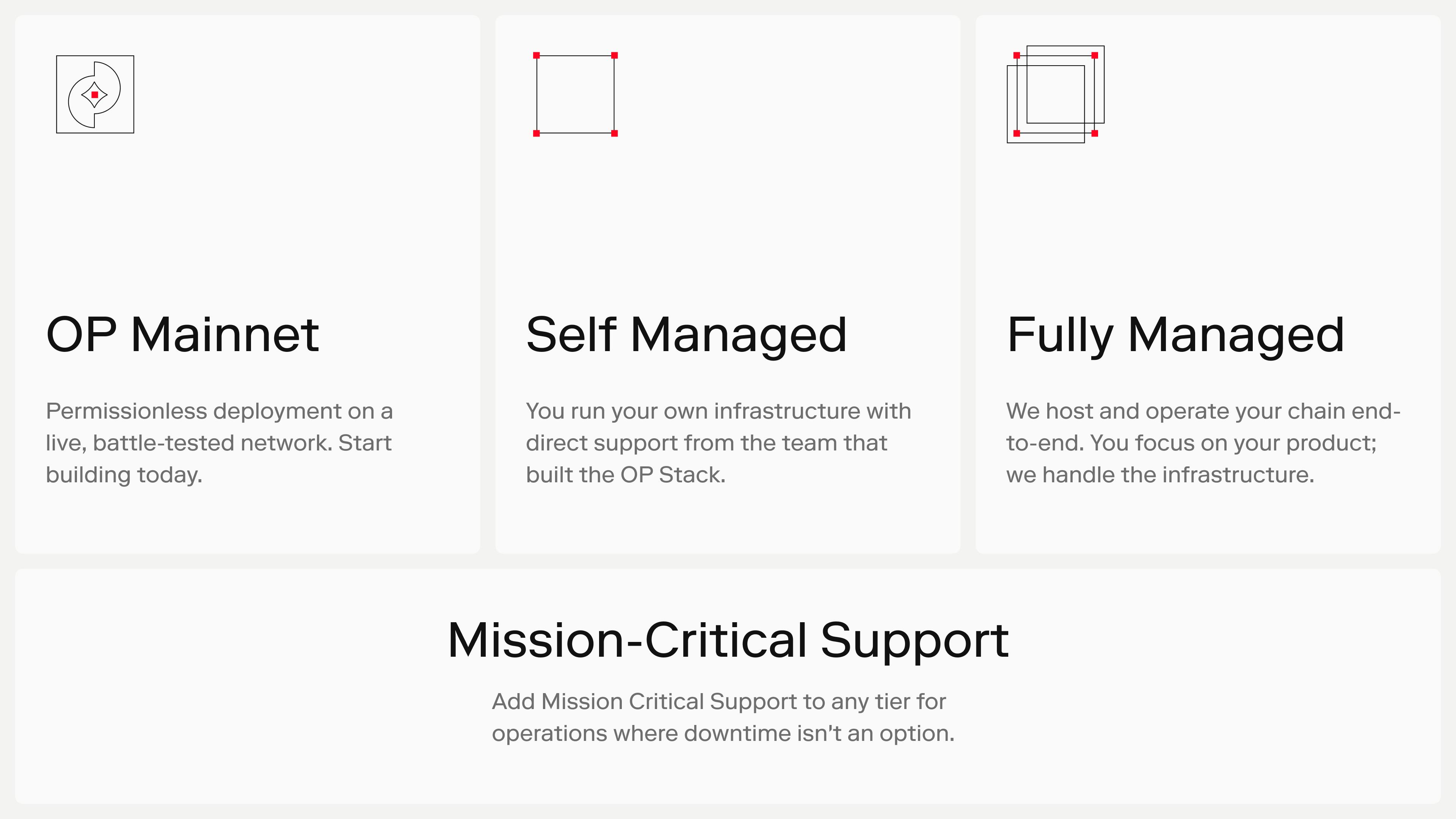
OP Mainnet: Start here if you don't need a dedicated chain yet
The infrastructure, liquidity, and ecosystem relationships are already in place: stablecoin integrations, block explorers, bridges, wallet support. The setup work that takes months on a new chain is already done.
It's the right starting point for teams validating a product, building on existing liquidity, or operating at a scale where a dedicated chain isn't necessary. As requirements evolve, there is a path to greater control. Teams that need sovereignty, a dedicated gas token, custom economics, or custom block building policies can graduate to a dedicated chain when the time is right.
Fully Managed: OP runs your chain
Fully Managed is for organizations whose team wants to ship products, not run infrastructure. OP Labs operates the sequencer, batcher, proposer, and all chain infrastructure as a SaaS service on Optimism's servers. Customers receive a production mainnet and testnet with no infrastructure to manage. Designed for teams that want to run a dedicated chain without building or operating the underlying stack.
Self Managed: You run your chain, OP backs you up
For organizations that run their own chain on their own infrastructure and want OP Labs expertise behind them. The customer controls the sequencer and all node infrastructure. OP Labs provides support, security and bridge monitoring with runbooks, custom engineering hours, and security and performance assessments. Designed for teams with strong internal infrastructure capacity that want OP Labs coverage without giving up operational control.
Mission Critical: For chains where downtime has a measurable cost
Mission Critical is an add-on available on Fully Managed Advanced and Self Managed. It upgrades the incident response model: 15-minute initial response for P1 incidents, updates every 30 minutes until resolution, a dedicated Technical Account Manager, quarterly business reviews, and OP engineer presence in your war room for critical incidents or major launch events.
| Self-Operated | Fully Managed | Self Managed | OP Mainnet | |
|---|---|---|---|---|
| Launch timeline | 8–12 weeks | 6–8 weeks | 6–8 weeks | Days |
| Sequencer ops | You own it | SLA-backed, 24/7 managed | You own it | Shared |
| Security patching | You schedule & apply | Handled by OP Labs | You schedule & apply | Handled by OP Labs |
| Compliance tooling | Custom build | Included | Customer-managed | N/A |
| Custom engineering hours | None | Included (year 1) | Included (year 1) | N/A |
| Engineering access | OP Labs docs | Direct line to OP Labs | Ticket portal | OP Labs docs |
How to choose
The decision comes down to operational ownership.
Do you have a team that can run blockchain infrastructure, manage upgrades, monitor systems, and respond to incidents? Or would those responsibilities fall to an engineering team that already has a full roadmap?
If chain operations are not a core competency, Fully Managed is usually the right answer.
If infrastructure ownership is strategic and you have the team to support it, Self Managed gives you operational control with expert backup when you need it.
If you're still validating the product, building on existing liquidity, or don't yet need a dedicated chain, start on OP Mainnet.
| Tier | Operating model | Best for |
|---|---|---|
| Fully Managed | OP Labs operates everything on OP infrastructure | Teams that want a dedicated chain without running the underlying stack |
| Self Managed | Customer runs own infrastructure; OP Labs provides support and monitoring | Teams with in-house blockchain infrastructure expertise that want additional coverage. |
| OP Mainnet | Deploy on the existing chain | Teams that want Ethereum scale, liquidity, and distribution without operating a chain. |
The important thing is that the choice isn't permanent. The OP Stack powers more than 50 production chains and processed over 6 billion transactions in 2025. Teams can start where their operational needs are today and move to a different model as those needs evolve.
Authored by

Optimism