
The Billion-User Moment Nobody Will See Coming
I got into blockchain through culture, and the finance came later.
I became CEO of Friends With Benefits in winter 2022. FWB was a crypto-native community built around the idea that tokens could unlock belonging, that ownership could be the foundation of a creative economy, that web3 would bring its next hundred million users in through music and art and shared identity. We weren't wrong to believe it, and a lot of brilliant people did. For a window it felt like the path, and then it wasn't.
Being wrong taught me where to look. The billion-user transformation this industry has promised since the beginning is finally in motion, and it looks nothing like what anyone was told to watch for. It's coming through the institutions. I've run the cultural side of this business and now I work on the financial side, and the second seat is the one that shows you the whole board.
What the board shows is simple: culture starts the revolution, and finance is what makes it hold.
We had the sequence wrong
I've spent enough time in this industry now to say that clearly, without regret. The realization arrived slowly, through the meetings. Running FWB meant a steady line of blockchains and crypto companies coming through to introduce themselves, all of them wanting to be framed inside a larger cultural world. At the height of NFTs this felt like confirmation. Culture looked set to stand alongside finance as the technology's dominant use case, and we were the front door.
Then the cycles kept turning, and somewhere around the second or third crash I started hearing those same meetings differently. The companies came to us for warmth. Culture was a way to buy time and goodwill while the actual technology matured, and a community like ours made the wait look good. The use case underneath was financial the whole time.
The communities were real and so was the creativity, but the thesis still failed, because culture can't be the infrastructure. The UX was too hard, the volatility too destabilizing, the speculative energy too consuming for anything durable to take root at scale. You need stability under people's feet before they'll dance on it.
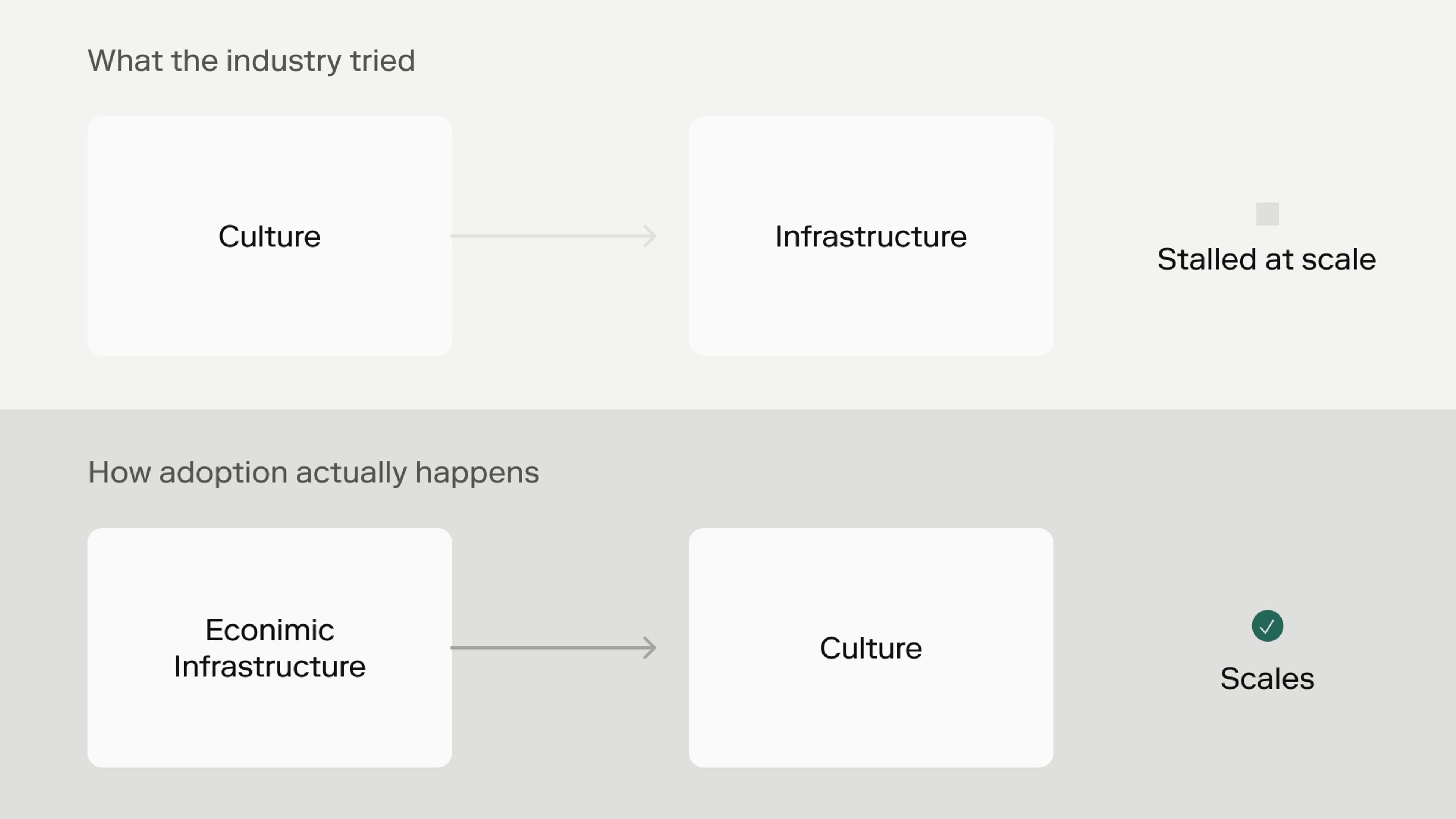
Culture has never scaled without economic infrastructure underneath it, and every movement that broke through to mass adoption did it when the rails caught up. We had the sequence wrong, which is different from failing. We were early, and impatient about it.
Hip hop, YouTube, the Medici
Hip hop
Hip hop was born in the South Bronx in 1973, a cultural revolution built from almost nothing by communities the economy had abandoned, out of DJs and block parties and cardboard laid flat on sidewalks. By the 90s and 2000s the genre was commercially massive, tens of millions of records sold, yet the official rankings still favored rock, propped up by physical sales and legacy radio.
Streaming changed that, and by 2017 hip hop and R&B together ranked as the most consumed music in America, long after hip hop had infiltrated fashion, film, language, advertising, and global identity. Streaming's contribution was bookkeeping: it let the metrics catch up to a reality that had been true for two decades. It did the artists no favors on the money, since fractions of a cent per stream is its own kind of robbery, but that's the part worth holding onto. Measurement arrived, fairness didn't, and the culture keeps waiting on rails that would pay it what it was owed.
YouTube
The creator economy followed the same arc. Before 2007, YouTube was serving 100 million video views a day with almost no way for creators to earn from them, so the platform captured all the value. Creators made content anyway, because the creative impulse doesn't wait for the economics, but there was no way to make a living from it, no careers, no industry.
Then YouTube launched the Partner Program and gave creators 55% of ad revenue. That single structural decision, aligning the platform's incentives with the creator's, set off an explosion of new formats and new careers, and a generation of people who'd been locked out of traditional media built global audiences and real businesses. In the four years through 2024, YouTube paid creators more than $100 billion. The creativity had been there all along, waiting on economics fair enough to release it.
The Medici
The same dynamic runs back centuries, to the Italian Renaissance of Botticelli, Michelangelo, Leonardo, and Brunelleschi, remembered as one of the greatest cultural flowerings in human history and funded, less famously, by bankers. The Medici built one of the most sophisticated banks in 15th-century Europe and turned that wealth into a patronage machine, and none of it was charity.
The commissions glorified the family, laundered a banking fortune into legitimacy, and came with a patron's leash on what got made. The artists took the deal because it was the only deal on offer. Without the economic system the Medici built there is no Primavera and no young Michelangelo sketching in Lorenzo's garden, but the price of the scaffolding was answering to the people who owned it.
The pattern, and the 2021 problem
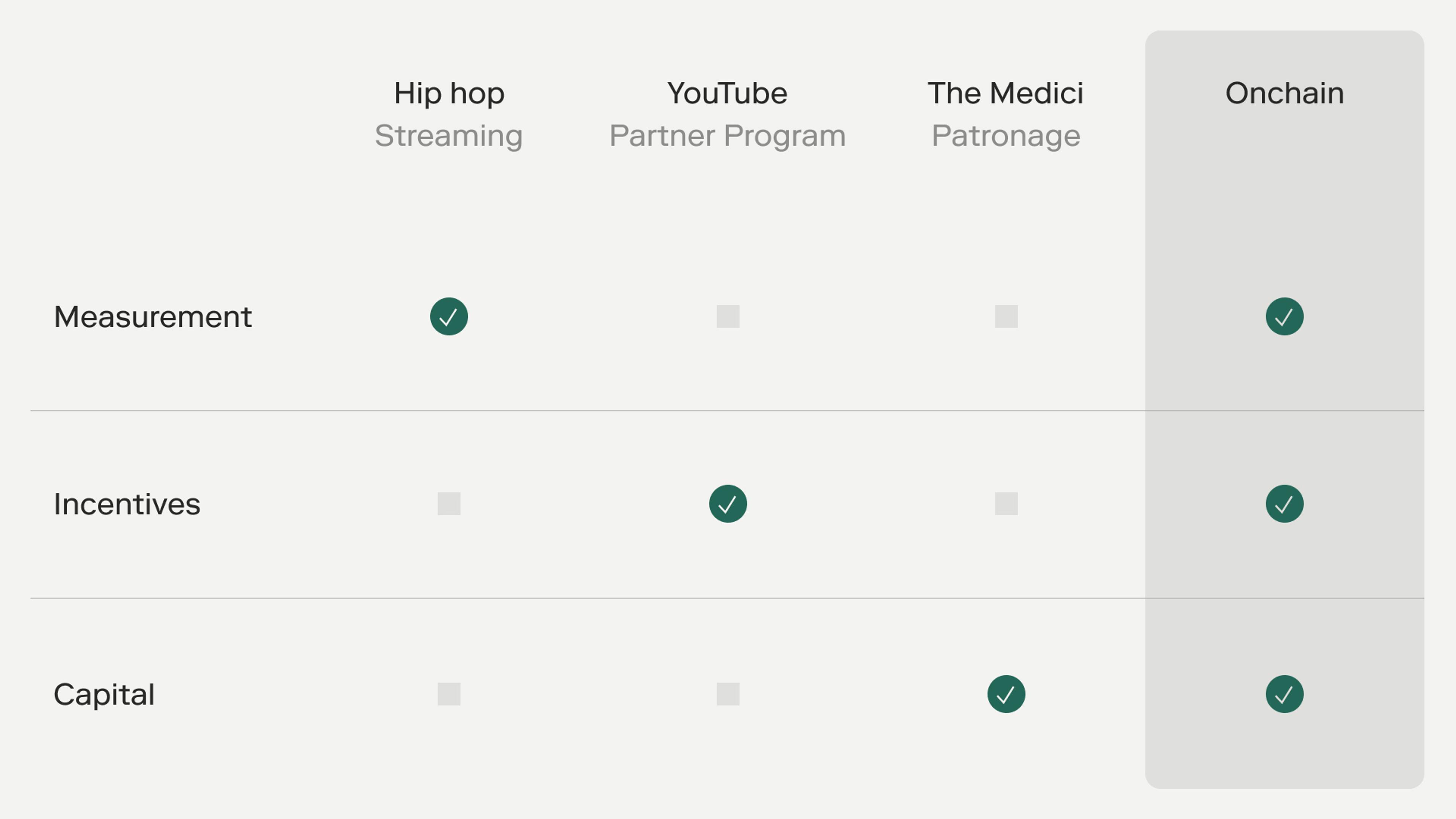
The pattern holds every time: culture sparks, struggles, then explodes once the economic infrastructure arrives. But the three stories fix three different problems. Streaming fixed measurement, because hip hop's value had existed for two decades before the charts could count it. The Partner Program fixed incentives, since the value of all that creator output was flowing entirely to the platform. And the Medici fixed capital, because the Renaissance couldn't happen until someone paid for it. Culture has stalled on each of those three at different points in history, and the infrastructure being built right now is the first I've seen that addresses all of them in one system: value recorded on a shared ledger instead of waiting decades for the charts, revenue splits written into the asset instead of set by the platform, and capital that reaches anyone with a wallet instead of anyone with a Medici.
Anyone who lived through 2021 has earned the right to be skeptical here. NFTs and community tokens were culture, made by artists, and they took off on rails that were nowhere near ready. For about a year it looked like culture would simply route around the missing infrastructure, and then fees spiked, prices collapsed, and most of it came down. I watched that from the inside, and the collapse reads to me as the strongest evidence for the sequence argument, because culture without an economic foundation burns hot and leaves nothing to build on.
I believe blockchain is at that exact point in the sequence, and it's why I moved my own work from the cultural layer to the financial one. I've seen enough history to know culture thrives when the economics underneath it are fair and stable. For the first time, that layer is being built by institutions with the balance sheets and the distribution to finish the job, which is what brought me to Optimism in January 2026.
I'm aware of how convenient that conclusion is coming from someone in my seat. I sell this infrastructure for a living now, so discount accordingly, but the history is still the history. And the seat has one advantage: I've been in the rooms where culture gets made and the rooms where infrastructure gets bought, and they're describing the same future without knowing it. The moment is already underway, and most people are looking for it in the wrong place.
What's already in production
JPMorgan is processing more than $5 billion a day in tokenized payments through its Kinexys platform and has moved more than $3 trillion since inception. In December 2025 it launched its first tokenized money market fund on public Ethereum. Its deposit token, JPMD, has been settling on OP Stack rails since November 2025. BlackRock's tokenized treasury fund has crossed $2.5 billion in assets, and Larry Fink, who spent years as a skeptic, now says every stock, every bond, every fund, every asset can be tokenized. Visa ran its stablecoin settlement program to a $3.5 billion annualized run rate in 2025 and brought USDC settlement live for US banks at the end of the year.
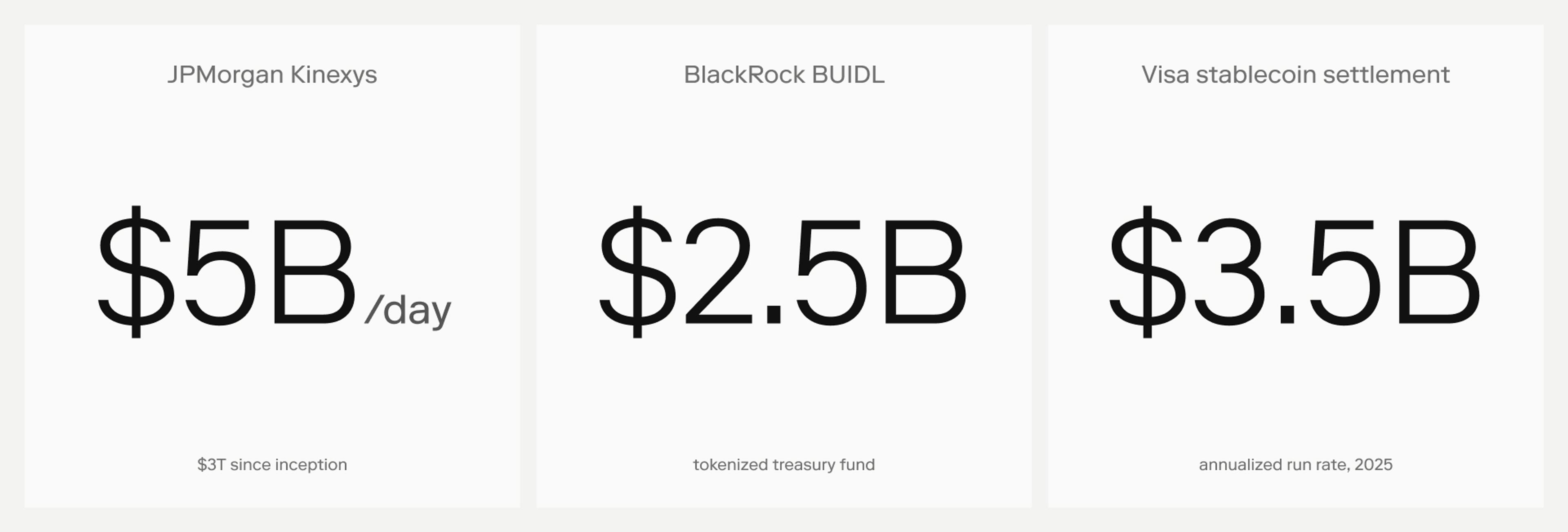
The payment networks that process most of the world's consumer transactions are rebuilding their rails onchain. The reasons are unsentimental: settlement is faster, the economics are better, and decentralization as a philosophy never comes up in those meetings.
Notice that the rails vary. JPMorgan's fund settles on public Ethereum, its deposit token clears on OP Stack infrastructure, Visa settles stablecoins on a different network entirely, and the DTCC is wiring into several at once. The institutions are betting on the category, and the category is bigger than any one ecosystem, including the one I work in.
None of this was technically or economically possible three years ago. Transaction costs on Ethereum's second-layer networks dropped roughly 10x after a March 2024 network upgrade, and then the regulatory frameworks arrived: the GENIUS Act became the first federal stablecoin law in July 2025, the OCC reaffirmed that banks can custody digital assets and act as verification nodes, and MiCA brought a unified European licensing regime live for the first time. The compliance objection that killed a thousand enterprise blockchain conversations over the past decade has become hard to sustain.
Pull back far enough and the same motion is visible on every continent. Washington conditionally approved five new trust bank charters for digital asset firms in December, the SEC's draft five-year plan makes digital assets a strategic priority through 2030, and a market structure bill is sitting on the Senate calendar this summer. In June, Tokyo's three megabanks, rivals in everything else, moved to issue a joint yen stablecoin targeting March 2027, and next month the convenience chain Lawson starts testing stablecoin payments at the register. Hong Kong granted its first stablecoin licenses this spring from a field of three dozen applicants. Eight major Korean commercial banks are building a won-pegged coin together, and this month the Bank of Korea told the National Assembly that bank-led groups should be the ones to issue first. No one coordinated this. Rival banks and policymakers on three continents are reading the same map, and the stable economic layer culture has been waiting on is being poured everywhere at once.
How institutions actually move
Enterprise buyers move when they can defend the decision to their board if something goes wrong. They're risk managers first, and once you understand that, it stops being a frustration and starts being a feature. The Medici were risk managers too, as careful with capital as any bank CTO is today, and the art compounded on top. When institutions like that finally move, they move with resources and distribution no community-led effort can match.
That's why the JPMorgan and BlackRock deployments matter beyond their own volume numbers. Every bank CTO in the world now has a conversation to have with their CEO: JPMorgan is doing this at production scale, what are we doing? Competitor FOMO is one of the most powerful forces in enterprise technology adoption, and it runs on a single input, one named peer who went first. Those peers exist now.
The next six to twenty-four months are when the shift becomes hard to argue with. The DTCC settles essentially every traditional security trade in the United States, and in December 2025 the SEC cleared it to begin a pilot tokenizing Russell 1000 constituents, major ETFs, and US Treasury bills, bonds, and notes. Initial production trades began this month, and the full launch follows in October.
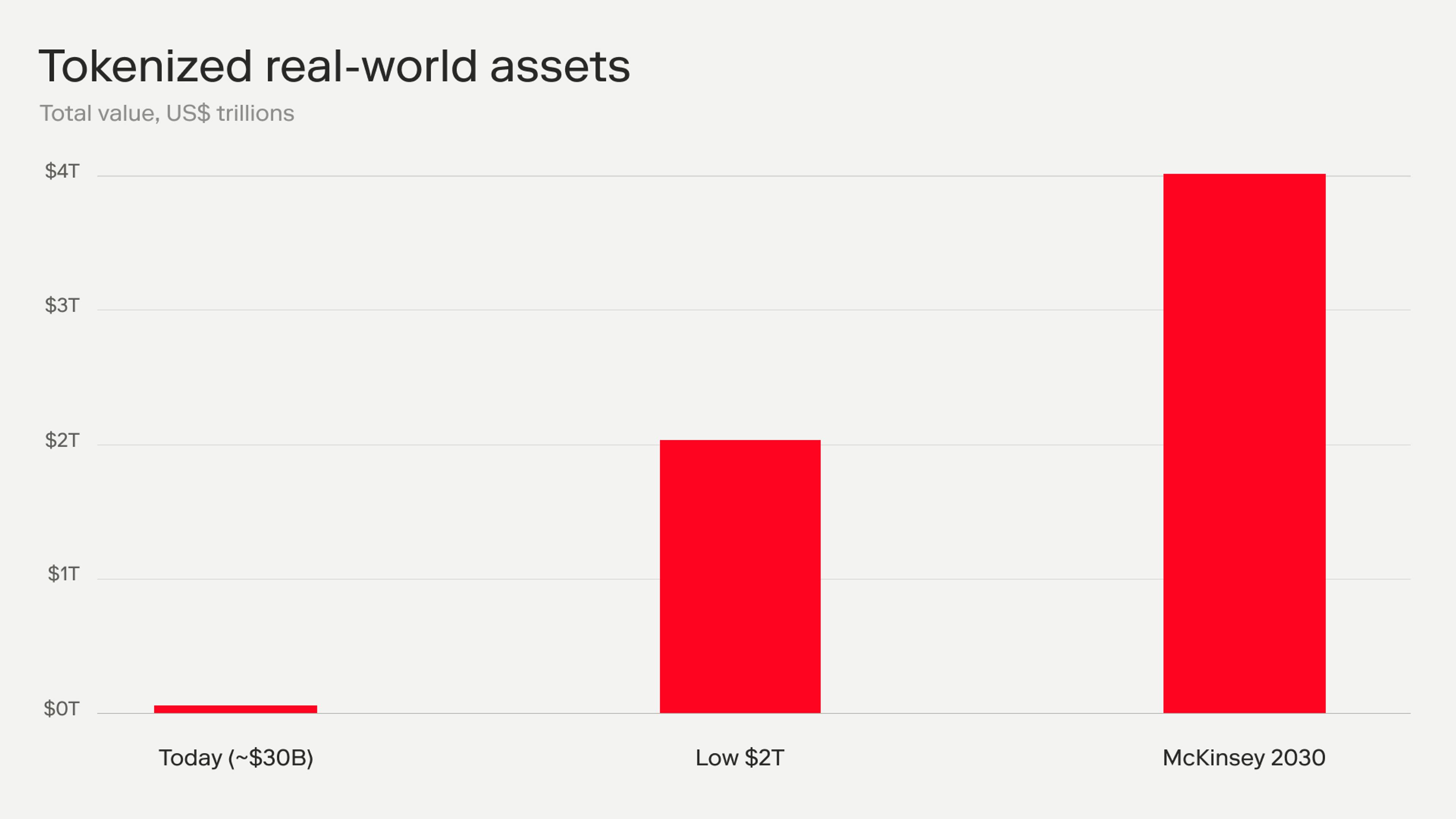
Tokenized real-world assets have passed $30 billion on their way toward McKinsey's $2 to $4 trillion projection for 2030. And below the headlines, consumer products built on blockchain rails are reaching hundreds of millions of people. Sony runs Soneium for media and entertainment, Kraken built Ink for its exchange, and World operates an identity network serving tens of millions, all built on the OP Stack. ether.fi runs its card business on OP Mainnet and moved more than $100 million in payments in June alone. The people using these products will never know what the plumbing is, and the value moves either way.
Run the arithmetic on distribution: Visa has roughly 4.7 billion cards in circulation, Sony's PlayStation Network alone clears 120 million monthly active users, and the DTCC sits behind effectively every American brokerage and retirement account. The billion users in this story are already customers of the companies doing the rebuilding, so once the rails go live underneath those platforms, adoption stops being a recruitment problem and becomes an accounting one.
What comes after the rails
When programmable money becomes as invisible and reliable as the internet, the cultural explosion I believed in at FWB finally gets the foundation it was missing. The financial revolution is the precondition for the cultural one.
There's an objection to that from my old world, and it's the one I take most seriously. When Visa, Sony, and the DTCC own the rails, the likely outcome looks less like a renaissance and more like the Spotify problem all over again: culture optimized into paste by whoever controls the infrastructure. It's a fair worry, and my honest answer is that it depends entirely on how the rails are built. Part of why I ended up where I did is that the OP Stack is open source under an MIT license, every line of it public, which means a community that doesn't like how the owner behaves can take the code and leave. No artist could ever do that to Spotify. That doesn't guarantee culture stays free on these rails, but it's the first version of the deal where leaving is written into the contract.
The version of this future I think about is small and specific. An artist sells a piece and the split pays every collaborator at the moment of sale instead of ninety days later through three intermediaries. A community treasury holds its reserves in tokenized treasuries instead of having to outrun every cycle. A fan in Manila buys a membership that costs cents to issue and still works in five years because the chain underneath didn't fold. None of it is utopian, which is what I like about it.
And for the record, FWB ran without any of those tools and still worked: more than $2 million a year in revenue through events and partnerships, a treasury that came out of multiple bears intact, an operation that turned a profit on its own strategy. As of this writing, FWB is still here, producing community-led events and heading into year five of FEST. I'm proud of that. But it took an unreasonable amount of skill and effort just to hold ground, and the next community like ours shouldn't have to be that good at survival simply to exist.
I came in through culture and stayed because I found the financial evolution that was always underneath it, and that evolution is what brings the next billion people in: enterprises making boring infrastructure decisions that compound into something stable enough to build on. The most important adoption story in this industry's history is unfolding in procurement reviews and bank charters that nobody screenshots, and having seen it from both sides, I'm telling you it's further along than you think. The cultural revolution I always believed in is still coming, and this time the floor will hold.
Thanks to Jose Mejia for his notes on early drafts.
Authored by

Greg Bresnitz