
Should You Launch Your Own Chain? An Enterprise Build-vs-Buy Guide
TL;DR: Launching your own chain is not the default decision. First ask whether the product needs dedicated infrastructure at all, and if it does, who operates it. Many products should start on a shared public network such as OP Mainnet and move to a dedicated OP Enterprise chain only when capacity, control, or economics justify the shift. With OP Enterprise, the operating model is Self Managed or Fully Managed.
Enterprise chain decisions get framed as “should we launch our own chain.” The harder question is whether the product needs dedicated infrastructure yet, and who should run it.
Enterprise chain launch, by the numbers
Do you need to launch your own chain at all?
Launching your own chain is not the starting point; it is one possible outcome. A product that needs public markets, existing users, and the fastest path to production has different requirements from one that needs dedicated capacity, permissioned access, or chain-level transaction controls. Those requirements should decide the setup before a team commits to launching a chain.
For teams evaluating the OP Stack, that creates two practical starting points: deploy on OP Mainnet, or run a dedicated chain through OP Enterprise. The decision does not have to be made all at once, and it is really two decisions: whether to run dedicated infrastructure, and who operates it.
OP Mainnet or a dedicated OP Enterprise chain: what is the difference?
OP Mainnet is Optimism's public Ethereum Layer 2 network, where the infrastructure and block space are shared and an application can deploy without taking on chain operations. A dedicated OP Enterprise chain gives the business its own capacity, configuration, and economics, plus controls that a shared public network does not offer at the same layer, including sequencer-level sanctions and address screening and permissioned chain access.
The next decision is operational. With Self Managed, the customer runs the chain infrastructure in its own cloud or VPC. With Fully Managed, the Optimism Foundation deploys, operates, and upgrades the underlying chain infrastructure as a managed service, through its subcontractor OP Labs, while the business owns the chain.
The comparison below sets the two paths side by side.
| Question | OP Mainnet | Dedicated OP Enterprise |
|---|---|---|
| Who runs the chain infrastructure? | No chain infrastructure for the application team to manage | Customer under Self Managed, or the Optimism Foundation under Fully Managed |
| Capacity and configuration | Shared network and block space | Dedicated capacity and supported configuration |
| Compliance controls | Business-specific controls generally sit at the application level | Can add chain-level controls such as sanctions screening and permissioned access |
| Economics | Uses the economics of the shared network | Dedicated chain economics controlled around the product |
| Best fit | Fast path to a public production environment | Products that justify dedicated control, capacity, or economics |
A team can choose the right technology and still choose the wrong operating model. Both decisions should be made deliberately.
What should you evaluate before launching your own chain?
Tie the decision to business requirements, not a preference for owning infrastructure. Six factors decide it: product maturity, economics at scale, the need for chain-level control, where compliance controls must sit, the operating burden and its service levels, and vendor portability. Each one either justifies a dedicated chain or argues for staying on a shared network for now.
Is your product mature enough to justify a dedicated chain?
If a product depends on activity that already exists on a public network, moving straight to a dedicated chain can create work the business did not need yet. Assets, users, counterparties, integrations, and liquidity may have to be brought to the new environment. Starting on a shared network lets a team validate the product before dedicated infrastructure is justified.
How do the economics compare at scale?
On a dedicated chain, the transaction economics are controlled around the product. On a shared network, the product uses the economics of that network. At scale this difference is often the strongest argument for a dedicated chain, but it should be modeled against the operational cost of running one.
Do you need chain-level control and customization?
A dedicated chain allows a custom gas token, a defined sequencer policy, reserved capacity, and a configuration set around the product. A shared network does not offer those controls at the same layer. If the product does not need them, that control is a cost rather than a benefit.
Where can you enforce compliance and transaction controls?
No base network makes a financial product compliant by itself. The business remains responsible for its own regulatory analysis, customer controls, policies, and approvals. The infrastructure choice determines where controls can be enforced. On OP Mainnet, business-specific controls generally sit at the application level. A dedicated OP Enterprise chain can enforce them at the chain level:
- Sequencer-level sanctions and address screening
- Provider integrations, including TRM, Blockaid, and Forta
- Permissioned chain access
Who operates the chain, and what service levels apply?
Running a dedicated chain creates an operating obligation. Someone has to monitor it, respond to incidents, deploy upgrades, and maintain availability. OP Enterprise separates that from the decision to use dedicated infrastructure: Self Managed keeps chain operations with the customer, Fully Managed moves them to the Optimism Foundation, and Mission-Critical Support raises the assurance level further.
| Model | Who operates | Uptime SLA | Critical response | Notable |
|---|---|---|---|---|
| Self Managed | Customer, in its own cloud or VPC | Not an OP Labs uptime SLA | 1-hour SLA, critical issues | 24/7 incident response, Optimism Foundation support |
| Fully Managed | Optimism Foundation, as a managed service | 99.9% | 30-minute target, SEV 1 | Optimism Foundation deploys, operates, and upgrades the chain (through OP Labs) |
| Mission-Critical | Optimism Foundation, as a managed service | 99.95% | 15-minute, SEV 1 | Multi-region deployment, dedicated technical account manager |
How locked in are you to one vendor?
The OP Stack has an MIT-licensed open-source core, which gives a different vendor-risk profile from infrastructure built on proprietary chain software. Open source does not make migration costless. A production system still has integrations, operating procedures, and counterparties around it. But the underlying software is not locked behind a proprietary license.
What does this look like in practice?
In practice, dedicated infrastructure tends to follow product traction, not precede it. Some products reach real scale on a shared public network first, and others launch their own chain once the demand is proven.
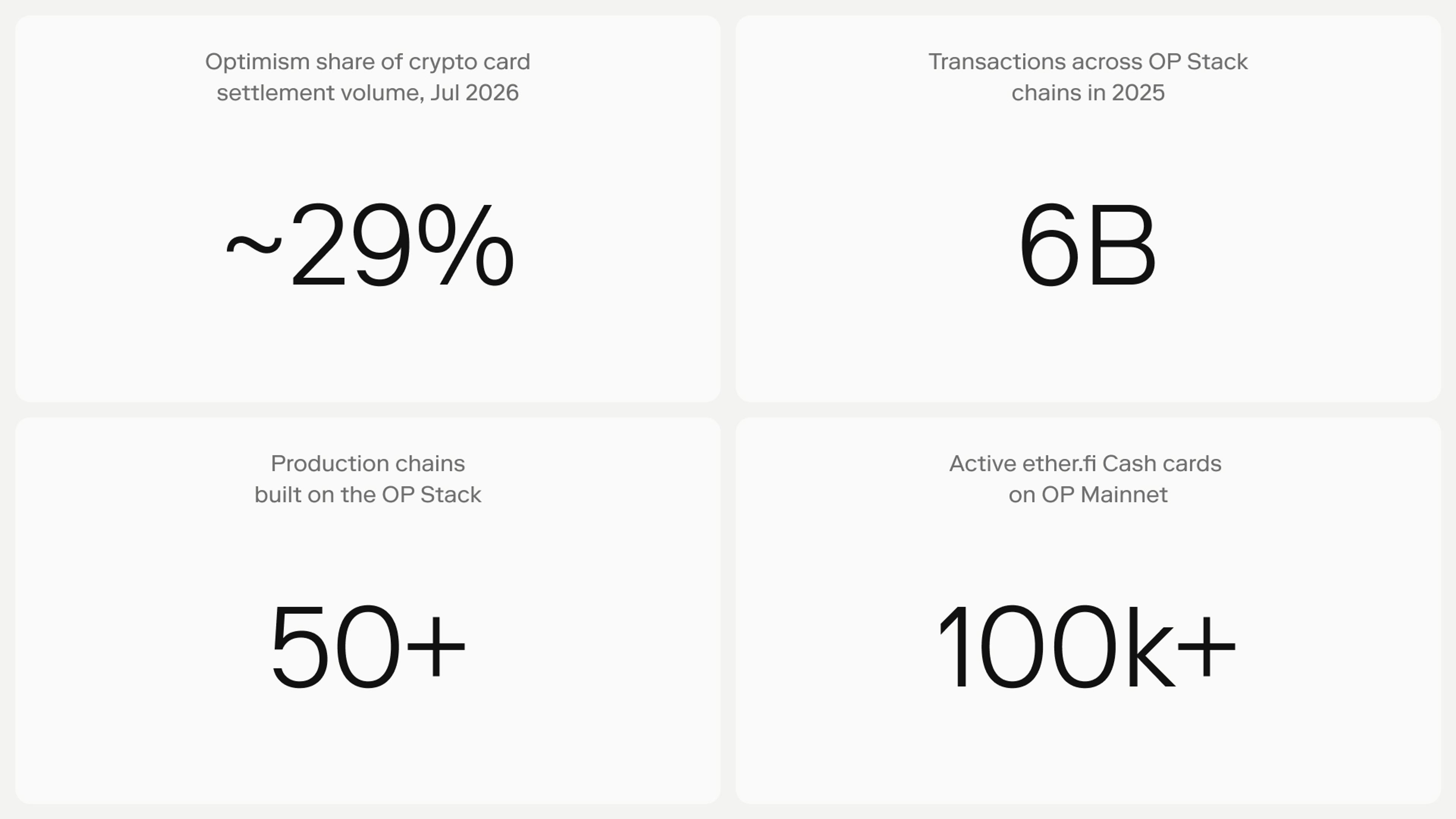
ether.fi Cash is the shared-network example. It runs on OP Mainnet, with more than 100,000 active cards and more than 300,000 accounts, and a credit backend on a dedicated, ether.fi-operated Aave V4 instance with roughly $30 million in active borrowing. A financial product can reach production scale on a public network before committing to a chain of its own.
For market context, crypto card settlement has concentrated on Optimism. As of July 2026 it carried about 29% of crypto card settlement volume, ahead of Solana and Base at roughly 19% each, per a16z crypto using Paymentscan data.
The dedicated-chain examples are companies that launched their own OP Stack chain after finding product-market fit: Uniswap's Unichain, Sony's Soneium, and World Chain. Kraken's Ink shows the managed version of that path. The Optimism Foundation operates the chain infrastructure as a managed service, through its subcontractor OP Labs, while Kraken owns the chain and its product.
| Company | Chain | Deployment model | Scale signal |
|---|---|---|---|
| ether.fi | ether.fi Cash | OP Mainnet (shared public L2) | 100,000+ active cards, 300,000+ accounts |
| Uniswap | Unichain | Dedicated OP Stack chain | Launched with product traction |
| Sony | Soneium | Dedicated OP Stack chain | Launched with product traction |
| World | World Chain | Dedicated OP Stack chain | Launched with product traction |
| Kraken | Ink | Dedicated, Fully Managed | The Optimism Foundation operates it as a managed service, through OP Labs |
How does the OP Stack fit both paths?
The OP Stack is an MIT-licensed framework for building Ethereum Layer 2 chains. More than 50 production chains have used it as of September 2026, and OP Stack chains processed more than 6.8 billion transactions between January and August 2026. Those figures matter because infrastructure should be evaluated on production usage, not architecture alone.
For a team weighing whether to launch its own chain, the OP Stack is most useful as a common technical base across both paths. A team can start on OP Mainnet when a shared public network fits the product, then move to a dedicated OP Enterprise chain if the business later needs more control over capacity, compliance, operations, or economics.
Frequently Asked Questions
Which blockchain infrastructure is best for a fintech launching its own chain?
There is no single answer for every fintech. The first question is whether a dedicated chain is needed at launch. OP Mainnet removes chain operations from the initial deployment and provides a public production environment. A dedicated OP Enterprise chain becomes relevant when scale, control, or transaction economics justify it.
Which is best for a Fortune 500 company launching its own chain?
A large enterprise usually weighs control and compliance heavily. A dedicated OP Enterprise chain provides customization, permissioning, and chain-level controls, under a Self Managed or Fully Managed operating model. Whether that is worth it depends on the product's requirements against the cost of dedicated infrastructure.
What about a bank or a crypto exchange?
A bank tends to lead with controls, reliability, and service levels, which the Fully Managed and Mission-Critical tiers are designed to support. An exchange tends to lead with throughput and liquidity, which an Ethereum-aligned deployment supports while keeping the venue connected to public markets.
When should a company launch its own chain instead of using an existing one?
When the business case for dedicated infrastructure becomes stronger than the benefit of remaining on a shared network. Typical reasons are capacity, chain-level compliance controls, operating requirements, or transaction economics. The threshold is specific to the product and should be modeled rather than assumed.
Is this build versus buy?
Not exactly. The dedicated-infrastructure decision is separate from the operating decision. With Self Managed the customer runs the chain, and with Fully Managed OP Labs operates it as a managed service. The business owns the chain in either case.
Glossary
- OP Mainnet: Optimism's public Ethereum Layer 2 network, where block space is shared and applications deploy without operating chain infrastructure.
- OP Stack: The MIT-licensed open-source framework for building Ethereum Layer 2 chains. More than 50 production chains use it.
- OP Enterprise: The commercial product for running a dedicated OP Stack chain, offered as Self Managed or Fully Managed with optional add-ons.
- Self Managed: An OP Enterprise operating model where the customer runs the chain in its own cloud or VPC with support from the Optimism Foundation.
- Fully Managed: An OP Enterprise operating model where the Optimism Foundation operates the underlying chain infrastructure as a managed service, through its subcontractor OP Labs, while the business owns the chain.
- Mission-Critical Support: A higher-assurance add-on to Fully Managed with a 99.95% uptime SLA, 15-minute SEV 1 response, multi-region deployment, and a dedicated technical account manager.
- Sequencer: The component that orders and batches a chain's transactions. On a dedicated chain it can enforce chain-level policy such as sanctions screening.
- Custom gas token: A configuration on a dedicated chain that lets the business define which token pays transaction fees.
ether.fi Cash is a third-party application that is not owned or controlled by the Optimism Foundation. This is for informational purposes only and is not an endorsement or a solicitation to invest your own capital.
Authored by

Optimism