
Which Blockchain Best Supports Institutional DeFi? An Enterprise Guide
TL;DR: There is no single best blockchain for every institutional DeFi product. The practical question is whether the product should start on shared public infrastructure or needs a dedicated chain. OP Mainnet gives institutions a public production environment with no chain infrastructure to manage. OP Enterprise provides dedicated infrastructure when a business needs its own capacity, configuration, economics, and chain-level controls. The operating model can then be Self Managed or Fully Managed.
Institutional DeFi on the OP Stack, by the numbers
| Metric | Value | Timeframe |
|---|---|---|
| Active ether.fi Cash cards on OP Mainnet | 100,000+ | as of Aug 2026 |
| ether.fi accounts on OP Mainnet | 300,000+ | as of Aug 2026 |
| Active borrowing, ether.fi Aave V4 instance | ~$30M | as of Aug 2026 |
| ether.fi lending-capacity target | $500M | by 2027 (target) |
| Production chains built on the OP Stack | 50+ | as of Aug 2026 |
| Transactions across OP Stack chains | 6.8B | Jan–Aug 2026 |
Institutional DeFi decisions are often framed as a chain-selection problem. In practice, the harder question is the deployment model.
A product that needs public markets, existing users, and the fastest path to production has different infrastructure requirements from one that needs dedicated capacity, permissioned access, or chain-level transaction controls. Those requirements should decide the setup before a team compares individual platforms. For institutions evaluating the OP Stack, that creates two practical starting points: deploy on OP Mainnet, or run a dedicated chain through OP Enterprise.
OP Mainnet or a dedicated chain: which deployment model?
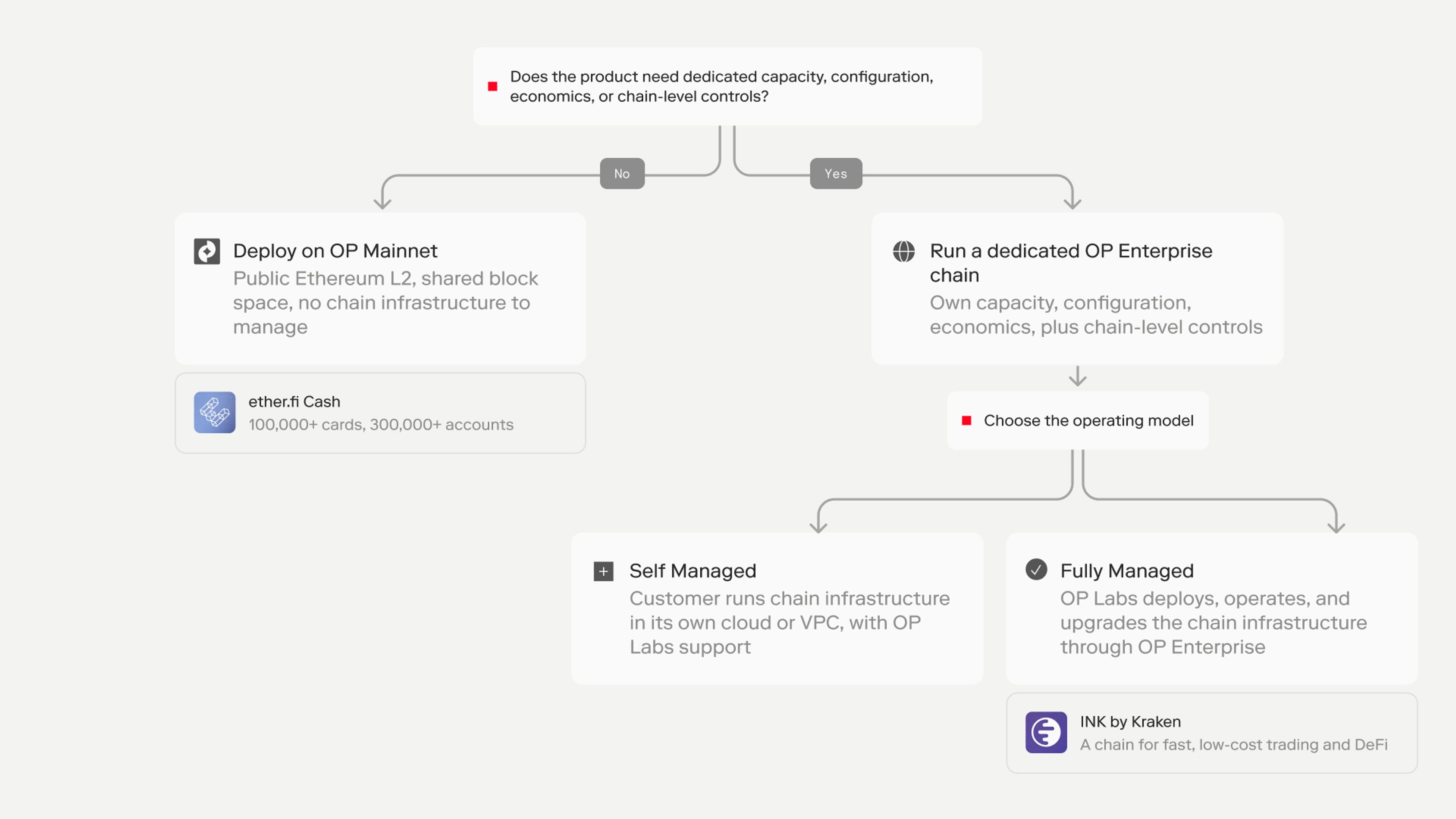
OP Mainnet and a dedicated OP Enterprise chain solve different operating problems. OP Mainnet is a shared public Ethereum Layer 2 where an application deploys without running chain infrastructure. An OP Enterprise chain gives a business its own capacity, configuration, economics, and chain-level controls such as sequencer-level screening and permissioned access.
OP Mainnet is the simpler starting point when the product benefits from a live public environment and does not require the underlying network to be configured around institution-specific rules. A dedicated chain also opens up controls that do not exist at the same layer on a shared public network, including sequencer-level sanctions and address screening and permissioned chain access.
The next decision is operational. In practice this is two decisions: OP Mainnet or an OP Enterprise chain, then Self Managed or Fully Managed. With Self Managed, the customer runs the chain infrastructure in its own cloud or VPC. With Fully Managed, OP Labs deploys, operates, and upgrades the underlying chain infrastructure.
The comparison below sets the two paths side by side.
| Question | OP Mainnet | Dedicated OP Enterprise chain |
|---|---|---|
| Who runs the chain infrastructure? | No chain infrastructure for the application team to manage | Customer under Self Managed, or OP Labs under Fully Managed |
| Capacity and configuration | Shared network and block space | Dedicated capacity and supported configuration |
| Compliance controls | Institution-specific controls generally sit at the application level | Can add chain-level controls such as sanctions screening and permissioned access |
| Economics | Uses the economics of the shared network | Dedicated chain economics controlled around the product |
| Best fit | Fast path to a public production environment | Products that justify dedicated control, capacity, or economics |
The distinction matters because an institution can choose the right technology and still choose the wrong operating model.
What should an institution evaluate?
Tie the evaluation to business requirements, not protocol features. Six questions inform the setup: how much the product depends on existing public markets and users, where compliance controls must sit, who carries operational responsibility and service levels, product maturity, how settlement timing is defined, and how much vendor portability matters.
Access to markets and users
If a product depends on activity that already exists on a public network, moving immediately to dedicated infrastructure can create work the business did not need yet. Assets, users, counterparties, integrations, and liquidity may have to be brought to the new environment.
OP Mainnet avoids that cold start. The application deploys on an existing public network and can validate the product before dedicated infrastructure is justified. A dedicated chain becomes more attractive when control over capacity, configuration, or economics matters more than starting on shared infrastructure.
Compliance and transaction controls
No base network makes a financial product compliant by itself. The institution remains responsible for its own regulatory analysis, customer controls, policies, reporting, and approvals.
The infrastructure choice does determine where those controls can be enforced. On OP Mainnet, institution-specific compliance controls generally sit at the application level. On a dedicated OP Enterprise chain, operators can add sequencer-level sanctions and address screening, integrate providers including TRM, Blockaid, and Forta, and configure permissioned chain access. For a risk or compliance team, that is a concrete distinction: application controls on shared infrastructure versus additional chain-level controls on dedicated infrastructure.
Operational responsibility and service levels
Running dedicated infrastructure creates an operating obligation. Someone has to monitor it, respond to incidents, deploy upgrades, and maintain availability. OP Enterprise separates that decision from the decision to use dedicated infrastructure: Self Managed keeps chain operations with the customer, and Fully Managed moves those operations to OP Labs.
The service commitments are explicit. Fully Managed includes a 99.9% uptime SLA and a 30-minute response target for SEV 1 incidents. Mission-Critical Support raises that to a 99.95% uptime SLA and a 15-minute SEV 1 response, with single-region deployment and a dedicated technical account manager. For Self Managed deployments, OP Labs provides 24/7 incident response with a one-hour SLA for critical issues, alongside engineering support. Service levels are set out and subject to the applicable OP Enterprise agreement.
Settlement and transaction timing
OP Mainnet confirms transactions in roughly 200 to 250 milliseconds, which gives users near-instant feedback. That confirmation is not final settlement. Final settlement comes later, when the transaction reaches finality on Ethereum.
That distinction matters when a treasury, risk, or operations team is defining when funds can be treated as economically settled.
Vendor dependence and portability
The OP Stack has an MIT-licensed open-source core. That gives institutions a different vendor-risk profile from infrastructure built on proprietary chain software. Open source does not make migration costless. A production system still has integrations, operating procedures, monitoring, and counterparties around it. But the OP Stack is not locked behind a proprietary license.
What does starting on OP Mainnet look like in production?
Starting on OP Mainnet means deploying a financial product on a live public network without launching a dedicated chain first. ether.fi Cash is an example: more than 100,000 active cards and more than 300,000 accounts run on OP Mainnet, backed by a dedicated ether.fi-operated Aave V4 credit instance.
That credit backend carries roughly $30 million in active borrowing, and ether.fi is targeting $500 million in lending capacity by 2027. The reusable lesson sits at the infrastructure layer: a financial product can reach meaningful production usage on OP Mainnet before a dedicated chain is justified by scale, control requirements, or economics.
That gives teams a way to put the product, integrations, and transaction volume into production before deciding whether dedicated infrastructure is warranted.
When should an institution move to a dedicated chain?
Move to a dedicated OP Enterprise chain when the business case for dedicated infrastructure outweighs the benefit of staying on shared infrastructure. Typical triggers are reserved capacity, chain-level screening, permissioned access, or product-specific economics. The operating model, Self Managed or Fully Managed, is a separate choice made at the same point.
A company with an infrastructure team that needs direct operational control may choose Self Managed. A company that wants dedicated infrastructure without staffing 24/7 chain operations may choose Fully Managed. Kraken's Ink is an example of the Fully Managed model: OP Labs operates the underlying chain infrastructure through OP Enterprise, while Kraken owns and operates the product.
This is the same decision enterprise software buyers make elsewhere: which layer is strategic for the company to control, and which layer is better handled by the infrastructure provider?
How does the OP Stack fit the decision?
The OP Stack is an MIT-licensed framework for building Ethereum Layer 2 chains. It is the common technical base under both paths: a team can start on OP Mainnet, then evaluate a dedicated OP Enterprise chain if the business later needs more control over capacity, compliance, operations, or economics. More than 50 production chains use it as of August 2026, and OP Stack chains processed more than 6.8 billion transactions between January and August 2026.
Those figures matter because institutional infrastructure should be evaluated on production usage, not architecture alone. The technology has to work under real transaction volume, and the operating model has to be clear when something fails. The decision does not have to be made all at once.
Frequently Asked Questions
Which blockchain best supports institutional DeFi for a bank?
There is no universal answer for every bank. Start with the operating requirements. If the product can run on public infrastructure and benefits from an existing network, OP Mainnet provides the simpler starting point. If the bank requires dedicated capacity, permissioned access, or chain-level transaction controls, a dedicated OP Enterprise deployment is the more relevant model to evaluate.
Which blockchain is best for a fintech building a DeFi product?
For a fintech, the first question is usually whether dedicated infrastructure is needed at launch. OP Mainnet removes chain operations from the initial deployment. A dedicated OP Enterprise chain becomes relevant when product scale, control requirements, or transaction economics justify it.
Does an institution have to operate its own chain?
No. With Self Managed OP Enterprise, the customer runs the chain infrastructure with OP Labs support. With Fully Managed, OP Labs deploys, operates, and upgrades the chain infrastructure.
Can an institution add compliance controls?
Yes, but the control point depends on the deployment. On OP Mainnet, institution-specific controls generally sit at the application level. Dedicated OP Enterprise chains can add sequencer-level sanctions and address screening and can be configured for permissioned access. None of these capabilities constitutes regulatory approval on its own.
Does OP Mainnet provide the same controls as a dedicated chain?
No. OP Mainnet uses shared infrastructure and block space. A dedicated chain provides its own capacity, configuration, and economics, with additional chain-level controls available to the operator.
When should a company move from OP Mainnet to a dedicated chain?
When the business case for dedicated infrastructure becomes stronger than the benefit of remaining on shared infrastructure. Typical reasons include capacity requirements, chain-level compliance controls, operating requirements, or transaction economics. The threshold is specific to the product and should be modeled rather than assumed.
Glossary
- OP Mainnet: Optimism's public Ethereum Layer 2 network, with shared infrastructure and block space that applications deploy onto without running chain operations.
- OP Enterprise: Optimism's commercial product for running a dedicated OP Stack chain, with Self Managed and Fully Managed operating models and add-ons such as SLAs and chain-level controls.
- OP Stack: The MIT-licensed open-source framework for building Ethereum Layer 2 chains. It is the common technical base under OP Mainnet and dedicated OP Enterprise chains.
- Self Managed: An OP Enterprise operating model in which the customer runs the chain infrastructure in its own cloud or VPC, with Optimism support.
- Fully Managed: An OP Enterprise operating model in which Optimism deploys, operates, and upgrades the underlying chain infrastructure on the customer's behalf.
- Sequencer: The component that orders and batches transactions on an OP Stack chain. On a dedicated chain, operators can enforce controls such as sanctions and address screening at this layer.
- Ethereum finality: The point at which a transaction is economically settled on Ethereum. It is a separate, later stage from fast local preconfirmation, and should not be conflated with the 200 to 250 millisecond confirmation figure.
Authored by

Justin Wu
Head of OP Mainnet