
How can a Fortune 500 enterprise use institutional DeFi compliantly?
There is no single setup that fits every institution, but the pattern most large enterprises land on is a chain they control rather than a shared public network where they cannot set the rules. On a dedicated OP Stack chain, the enterprise decides who can transact, how transactions are ordered, and what screening runs at the sequencer. The financial products, whether tokenized assets, treasury operations, or onchain settlement, run on top of that controlled base layer.
Compliance itself stays with the institution. No blockchain makes a product compliant on its own. The enterprise owns its regulatory analysis, its controls, and its approvals in the jurisdictions where it operates. What the chain provides is a set of technical controls the compliance team can configure to support that work. "Compliance-compatible" describes the design, not a certification or an approval.
Why compare a dedicated chain to dedicated cloud infrastructure?
The clearest analogy for a treasury or technology leader is the move from shared to dedicated cloud. A shared public L2 is multi-tenant cloud: fast to start, low overhead, and you share the environment with everyone else. A dedicated chain is closer to a virtual private cloud or a reserved instance. You get isolated capacity, your own configuration, and control over the environment, with the tradeoff that you take on more of the operating responsibility, or contract it out.
The OP Stack is the open-source codebase for building that dedicated chain. It is MIT licensed, so an enterprise can fork it and run entirely on its own, or engage OP Enterprise as a managed service.
More than 50 chains have launched on the OP Stack, including Sony's Soneium, Uniswap's Unichain, Ink, and World Chain. Base launched on the OP Stack before moving off in February 2026.
Across those chains, the OP Stack ecosystem secures roughly $17 billion in value (L2BEAT, as of August 31, 2026), ahead of Arbitrum at roughly $14 billion on the same date. OP Stack chains have processed about 6.8 billion transactions between January and August 2026.
Dedicated chain vs. shared L2 vs. permissioned chain
The three common architectures for enterprise onchain finance trade off control, openness, and operating burden differently. A dedicated OP Stack chain sits between a fully public network and a closed consortium ledger.
| Attribute | Dedicated OP Stack chain | Shared public L2 (e.g., OP Mainnet) | Permissioned / consortium chain (e.g., Canton, Hyperledger Fabric) |
|---|---|---|---|
| Closest cloud analogy | Dedicated / private cloud | Public multi-tenant cloud | On-premise private network |
| Block space | Reserved for the enterprise | Shared across all users | Reserved, closed membership |
| Chain-level controls (allowlists, pause, ordering) | Configurable by the operator | Not available to a single tenant | Configurable |
| Access to public liquidity and composability | Yes, settles to Ethereum | Yes | Limited or none |
| Transaction economics | No license or protocol fee; operator controls the economics | Pay network fees per transaction | Varies by consortium |
| Codebase | Open source (MIT) | Open source (MIT) | Open source (license varies) |
| Ethereum settlement | Yes | Yes | Typically no |
A permissioned or consortium chain gives strong control but usually gives up connection to public liquidity and Ethereum settlement. A shared public network gives full openness but no tenant-level control. The dedicated chain keeps the enterprise connected to public rails while letting it govern its own environment.
What compliance controls are available at the chain level?
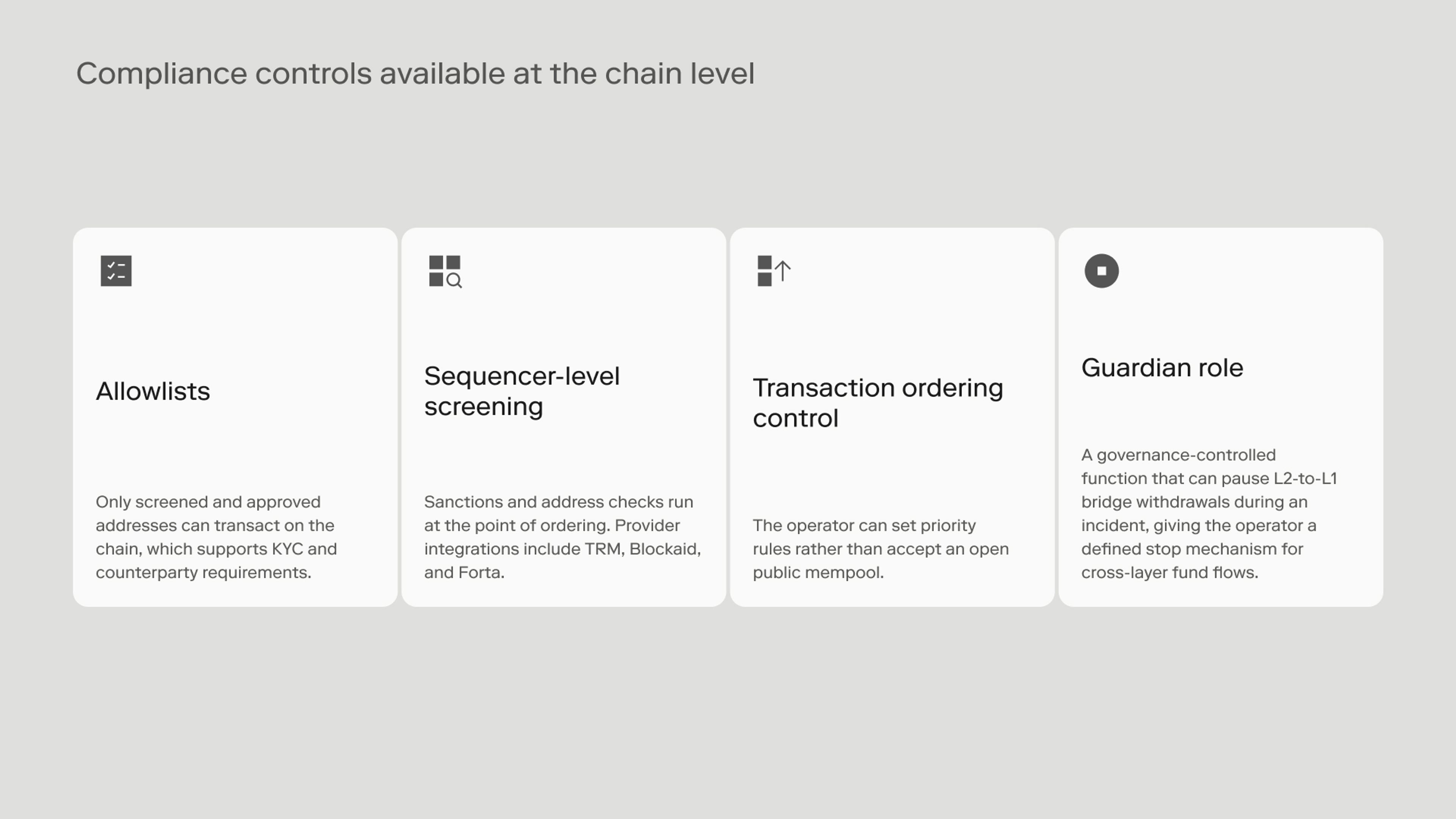
A dedicated chain lets the compliance team set controls at the base layer, before an application ever sees a transaction. The main ones an enterprise can configure include:
- Allowlists, so only screened and approved addresses can transact on the chain, which supports KYC and counterparty requirements.
- Sequencer-level screening, where sanctions and address checks run at the point of ordering. Provider integrations include TRM and Forta.
- Transaction ordering control, so the operator can set priority rules rather than accept an open public mempool.
- A Guardian role, a governance-controlled function that can pause L2-to-L1 bridge withdrawals during an incident, giving the operator a defined stop mechanism for cross-layer fund flows.
On chains that participate in Optimism Governance, the Guardian role sits within a broader upgrade structure: a 2-of-2 L1 Proxy Admin Owner (the Optimism Foundation plus the Security Council), a 75%-threshold Security Council multisig, and a 14-day delay with a Foundation veto on non-emergency upgrades (privileged roles docs, Stage 1 spec). Chains that self-manage their own keys are not bound by this structure.
These are configuration choices the operator makes, not changes to the underlying system. They give a CCO documented, technical enforcement points that map to existing controls, which is usually easier to evidence in an audit than a policy applied only at the application layer.
What do treasury operations and onchain settlement look like on a dedicated chain?
Treasury and settlement run as applications on the controlled chain, using the same public standards the rest of the ecosystem uses. Tokenized assets (cash equivalents, funds, or commodities represented onchain) can move and settle in near real time against stablecoins or other tokenized instruments, with settlement finalizing to Ethereum. Because the enterprise controls access, it can restrict these flows to approved participants while keeping the option to connect to public liquidity when it wants.
A production reference point is ether.fi Cash, which runs on OP Mainnet with more than 100,000 active cards and more than 300,000 accounts (August 2026). Its credit backend uses a dedicated, ether.fi-operated Aave V4 instance with roughly $30 million in active borrowing (as of August 31, 2026) and a stated target of $500 million in lending capacity by 2027. It shows the pattern in practice: a financial product built for institutional-grade compliance, using onchain credit and settlement rails at scale.
Who operates the chain, and what service levels apply?
An enterprise can run the chain itself or have Optimism operate it as a managed service, and the choice usually comes down to how much infrastructure the institution wants to own. OP Enterprise offers three operating tiers, and service levels scale with how critical the deployment is.
| Tier | Uptime SLA | P1 / SEV1 response | Notes |
|---|---|---|---|
| Self Managed | None (customer controls the infrastructure) | Within 1 hour | The customer runs the chain in its own cloud or VPC, with support from Optimism. |
| Fully Managed | 99.9%, contractual, with service credits | Within 30 minutes | Optimism deploys, operates, and upgrades the infrastructure as a service; the partner still owns its chain and its product. Service credits: below 99% uptime = 10% credit, below 95% = 20% credit. |
| Mission-Critical | 99.95% | Within 15 minutes | Adds multi-region deployment and a dedicated technical account manager. |
Source: OP Enterprise service-tier documentation, current as of September 2026.
What about privacy for institutional transactions?
Confidential transaction data is a common requirement for institutions, and the ecosystem approach here uses third-party tooling rather than a native chain feature. Privacy Boost is a privacy SDK built by Sunnyside Labs that combines zero-knowledge proofs and trusted execution environments (TEEs), with priority support for OP Enterprise deployments. Sunnyside Labs has reported sub-500ms proof generation and throughput above 1,800 TPS (source: Optimism blog, "Privacy Boost, a deeper look"). It is a third-party SDK, not a native OP Enterprise capability, and a TEE relies on a hardware trust assumption, so it should not be described as removing all trusted parties.
What does it cost, and who keeps the revenue?
The OP Stack is open-source and charges no license fee or protocol-level fee to use, so on a chain you run yourself the transaction economics are yours to control. That is a meaningful difference from a shared network, where per-transaction fees flow to the network rather than to the enterprise, and it changes the economics for any product that expects real transaction volume. For a CFO, a chain the enterprise runs itself becomes an asset that can generate transaction revenue rather than a pure cost line.
The base codebase is free and open under the MIT license. The commercial cost sits in the OP Enterprise service tier the enterprise chooses, which is where operating support, SLAs, and add-ons are priced.
What's next
Enterprises evaluating this path typically move through a few concrete steps:
- Scope the chain configuration with compliance and engineering (access model, screening providers, ordering rules).
- Choose an operating model (self-managed or fully managed) and a service tier.
- Run a pilot deployment for one product, such as tokenized treasury settlement, before scaling.
Cross-chain interoperability between OP Stack chains is in development and is not live today. The first implementation is planned between OP Mainnet and Unichain.
Frequently Asked Questions
Does Optimism issue, custody, or offer returns on the assets?
No. The OP Stack and OP Mainnet are execution-layer infrastructure. The enterprise and its partners issue and operate any financial products, hold any funds, and are responsible for the product. Optimism provides the technology and, in the managed model, operates the chain infrastructure as a service.
Is a dedicated chain "regulated" or automatically compliant?
No. No base network makes a product compliant by itself. The chain provides configurable technical controls, and the institution owns its regulatory analysis, its controls, and its approvals in the relevant jurisdictions.
How is this different from a permissioned chain like Hyperledger Fabric or Canton?
A permissioned or consortium chain gives strong access control but usually gives up connection to public liquidity and Ethereum settlement. A dedicated OP Stack chain lets the enterprise set access and screening controls while still settling to Ethereum and reaching public liquidity when it chooses.
Who keeps the transaction revenue on a dedicated chain?
The OP Stack charges no license fee or protocol-level fee to use, so on a chain the enterprise runs itself, the transaction economics are the operator's to control. On a shared public network, per-transaction fees go to the network instead.
Can we restrict who transacts on the chain?
Yes. Allowlists and sequencer-level screening let the operator limit transactions to approved, screened addresses, which supports KYC and counterparty controls.
Is cross-chain interoperability available today?
No. Interoperability between OP Stack chains is in development, with the first implementation planned between OP Mainnet and Unichain. It should not be relied on as a current capability.
What service levels come with OP Enterprise?
OP Enterprise ties service levels to the operating model. Self Managed carries no OP-side uptime SLA, since the customer runs the infrastructure, but Optimism commits to a one-hour response for critical incidents. Fully Managed adds a 99.9% uptime SLA with service credits and a 30-minute critical-incident response. Mission-Critical raises that to 99.95% uptime, a 15-minute response, and a dedicated technical account manager.
Glossary
OP Stack — The open-source, MIT-licensed codebase used to build a chain. The technology layer.
OP Enterprise — The commercial product for running a dedicated chain, including self-managed and fully managed operating models and service tiers. The product layer.
Sequencer — The component that orders and processes transactions on the chain. On a chain the enterprise runs itself, the operator runs the sequencer and controls the transaction economics it generates.
Sequencer revenue — Transaction fees the chain collects through the sequencer.
Total value secured (TVS) — The value held in and secured by a chain or ecosystem at a point in time.
Allowlist — A configured list of approved addresses permitted to transact on the chain.
Tokenized asset — A real-world asset (cash equivalent, fund, or commodity) represented as a token onchain.
Onchain settlement — Finalizing a transaction or transfer of value directly on the blockchain.
TEE (trusted execution environment) — A hardware-isolated processing environment. It carries a hardware trust assumption.
Zero-knowledge proof — A method of proving a statement is true without revealing the underlying data.
Guardian role — A governance-controlled function on chains that participate in Optimism Governance. It can pause L2-to-L1 bridge withdrawals during an incident; it cannot alter finalized transaction history or halt the sequencer directly.
Authored by

Optimism