
CEXs decided to integrate onchain experiences and value into their product. They had a choice:
- Route the users and assets that they have spent years and millions attracting and retaining to another product and ecosystem
- Expand their product suite to include a chain, and retain these users and assets.
Five major exchanges made the same call. All five chose OP Stack.
Why major exchanges are building OP Stack chains
Major centralized exchanges are building OP Stack chains to own the infrastructure their users transact on instead of routing those users, assets, fees, and applications to someone else's ecosystem.
The operational advantage is control: the exchange owns its sequencer policies, upgrade decisions, infrastructure configuration, and product roadmap. The compliance advantage is enforcement in the block-building layer, including optional address, asset, chain, and bridge controls. The revenue advantage is that the exchange captures the economics generated by applications and transactions built on top of its chain.
| Advantage | What the exchange gains |
|---|---|
| Operations | A dedicated chain, full sequencer control, independent upgrade decisions, and managed infrastructure options |
| Compliance | Transaction screening before block inclusion, address freezes, asset-level halts, incident buffers, and bridge controls |
| Revenue | Sequencer economics, application revenue, deeper asset retention, and ownership of the infrastructure supporting new products |
| Distribution | A direct route from the exchange's existing users into DeFi, payments, perps, tokenized assets, and other onchain products |
| Ecosystem | Access to protocols already audited and deployed across 50+ OP Stack chains |
Exchange Products Built on OP Stack
Coinbase → Base
After launching on Base, Morpho went from $354M to over $2B in under a year. Base is now Morpho's #2 chain globally—generating 13x more fees than Arbitrum, and more than every other non-Ethereum chain combined.
At the time of publication, DefiLlama reported approximately $4.5B in DeFi TVL on Base, roughly 51% of all L2 DeFi. Base is also the infrastructure behind Coinbase's AI agent strategy and its expansion of USDC payments.
The result is what owning distribution looks like. Coinbase users can move into lending, payments, and other onchain products without Coinbase sending that activity to another operator's chain.
Kraken → Ink
Kraken built Ink as a vertically integrated revenue stack. They licensed Aave V3 for Tydro, a white-label lending deployment that pulled $124M in deposits in its first 24 hours. Tydro crossed $500M TVL in 90 days. Aave V3 on Base took 627.
They acquired Vertex and launched Nado as native perps. By January 2026, it had reached $17B in monthly volume. At the time of publication, the chain carried more than $480M in TVL, up more than 3,800% since launch.
Every dollar of that activity runs on Kraken's infrastructure. 99% of Ink's one million users had no prior Kraken onchain history. The chain didn't recycle an existing user base. It built a new one.
OKX → X Layer
In 2025, OKX moved X Layer from a competing infrastructure stack to OP Stack.
In 2026, Intercontinental Exchange, the parent company of the NYSE, invested $200M in OKX at a $25B valuation. The partnership stated plans to bring NYSE-listed tokenized equities to OKX users in H2 2026.
Upbit → GIWA
Upbit is building GIWA for Korean and Southeast Asian exchange-native use cases. Its launch target includes a programmable sequencer policy engine from day one.
“Choosing the OP Stack for GIWA allowed us to leverage Ethereum's robust security while achieving the scalability needed for a global exchange. It serves as a seamless gateway, connecting Upbit's users directly to the broader Web3 ecosystem.”
Bitpanda → Vision Chain
Bitpandaannounced Vision Chain in March 2026 as the first fully managed OP Enterprise client and described it as the first MiCA-compliant exchange chain in Europe. MiCA is now live across the European Union.
The chain is the first exchange chain to use a euro-pegged stablecoin as gas. No FX friction for institutional users. White-label partnerships with major European financial institutions are in development, which will extend distribution beyond Bitpanda's own user base.
“Our ambition with Vision Chain is to become the foundation for Europe's DeFi economy: built for the European regulatory landscape, designed for regulated financial institutions, and open to Web3 builders. To deliver that, we needed infrastructure proven at scale. Optimism's OP Stack gives us battle-tested technology and compatibility with the wider Ethereum economy. With OP Enterprise, we have the right partner to build and operate Vision Chain at the standard this market demands.”
Revenue Products and Chain Economics
On a shared chain, the operator captures the fees. Chain owners capture everything built on top.
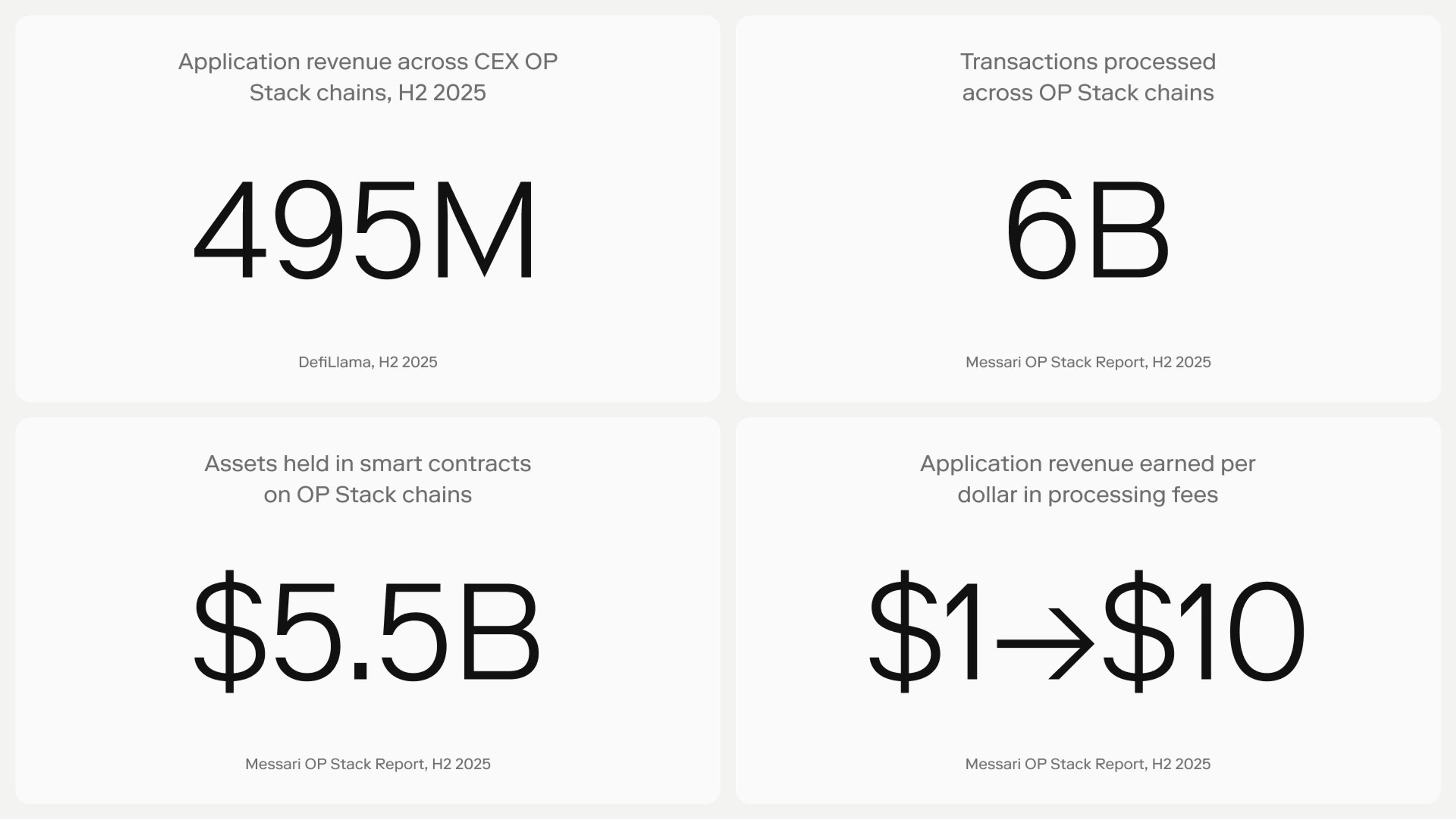
The difference is bigger than transaction fees. Coinbase built a distribution layer for DeFi and payments. Kraken built lending and perps. Bitpanda is building regulated financial infrastructure with euro-denominated gas. The chain owner keeps those products, users, assets, and economics inside its own product suite.
Operational Infrastructure and Product Control
All five built completely different products. Coinbase built a DeFi platform. Kraken built a perps exchange. Bitpanda built a regulated European chain with euro gas. None of them worried about whether the infrastructure would hold, because it already had.
The exchange owns the chain. It decides which products launch, which sequencer policies apply, when upgrades happen, and how the chain connects to the rest of the Ethereum economy.
Sequencer Sovereignty and Incident Controls
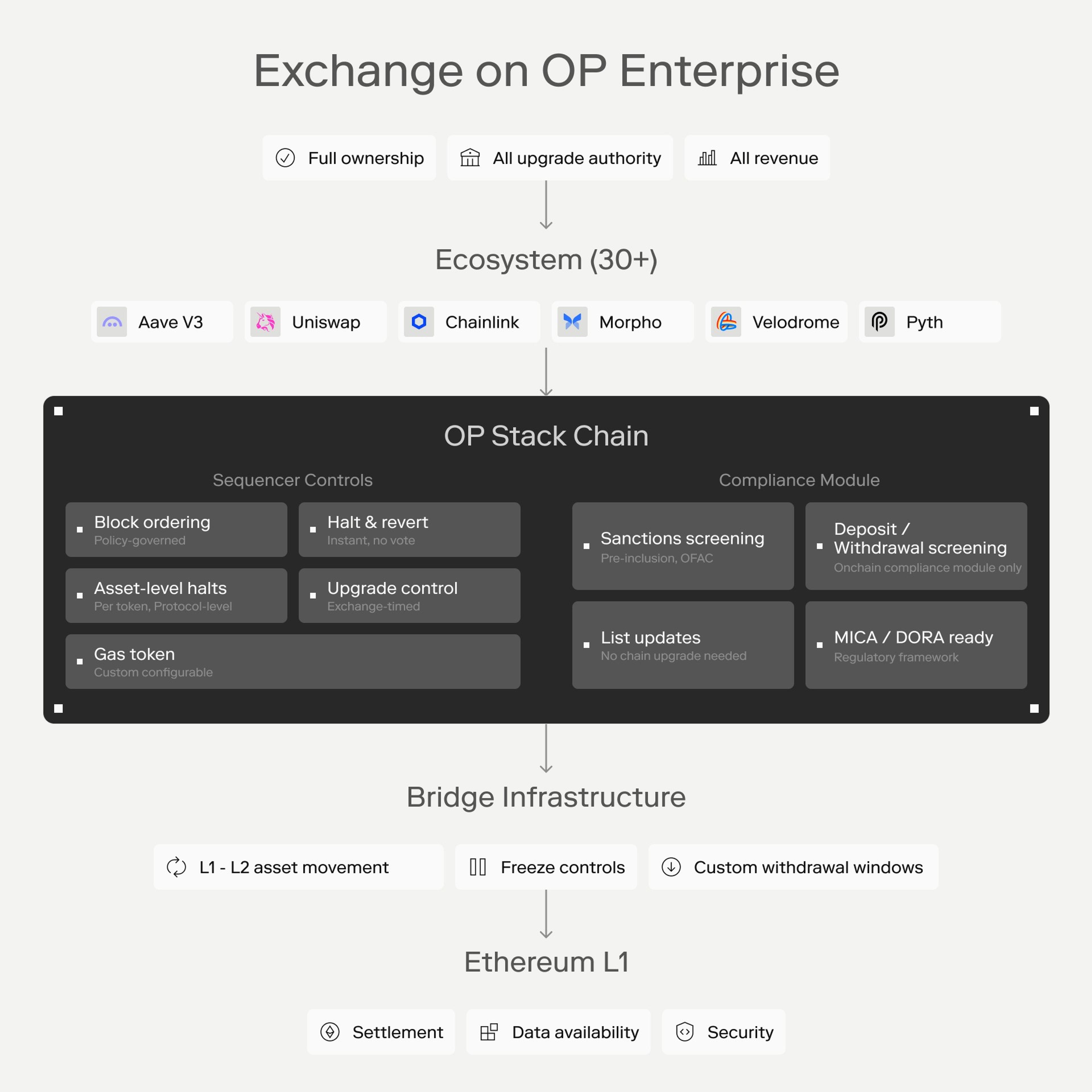
Your OP Stack chain runs its own sequencer: the computer that decides which transactions enter each block before anything commits to Ethereum. You control it unilaterally, without a governance vote or an L1 contract upgrade. Your L1 contracts can still carry a Security Council separately if you want stage 1 decentralization alongside full sequencer sovereignty. Flip a sequencer rule and it takes effect on the next block.
Bridge halt and onchain compliance screening are opt-in. Enabling them carries real decentralization tradeoffs. Chains prioritizing maximum decentralization would opt out. Exchanges running regulated infrastructure see it differently. If a DPRK-linked actor is draining funds, whoever runs the sequencer decides whether to act. On a shared chain, that's not your call. On your own chain, with the tools you've opted into, it is.
Five optional control scopes
| Control | What it does | Scope |
|---|---|---|
| Chain Halt | Stop the entire chain. Sequencer goes quiet. No new L2 blocks are produced. | Full chain |
| Asset-level Halt | Block every transaction touching a specific tokenized asset without affecting anything else. | Per asset |
| Address Freeze | Freeze a flagged address at the sequencer level. No waiting for app developers to cooperate. | Per address |
| Incident Buffer | Time-delay L1 withdrawals during an active incident, buying time before governance convenes. | Security |
| Bridge Halt | Pause all L1 withdrawals while each L2 keeps running. One activation covers every OP Enterprise chain at once. | Collective |
All scopes are optional at the request of the chain operator, and their implementation is subject to the review and approval of the chain operator.
Compliance Products in the Block-Building Layer
That same sequencer is where compliance enforcement happens. Every transaction is screened before it enters a block. Compliance enforced downstream only catches what already got through.
You bring your own compliance partner: TRM Labs, Chainalysis, or any provider with an API integrates directly into the sequencer. Your existing compliance infrastructure makes the calls, and they apply uniformly across every protocol on your chain before anything is committed.
One additional control: if you tokenize a regulated equity then you can halt trading on that specific asset at the sequencer level without touching anything else running on the chain.
Bitpanda built Vision Chain on this architecture. Bitpanda described it at launch as the first MiCA-compliant exchange chain in Europe.
Protocol and Liquidity Products on Day One
Launching your own chain doesn't mean building an ecosystem from scratch.
Aave, Chainlink, Velodrome, Uniswap, Pyth, and the broader suite of protocols are already audited and deployed across 50+ OP Stack chains.
That changes the partnership conversation. When Ink launched, Velodrome committed as a day-one liquidity partner because the infrastructure was already proven. When Tydro went live ten months later, $124M in deposits arrived in the first 24 hours because Aave V3 was already deployed and trusted. You don't spend 12 months proving your stack before protocols will talk to you. You start from credibility.
OP Enterprise Deployment Products
Running a centralized exchange means managing a list of decisions that never gets shorter, and infrastructure shouldn't be one of them. Compliance requirements change quarterly, competitors launch products you weren't planning for, and token listings, custody, and regulatory filings across multiple markets all compete for the same team's attention.
We built OP Enterprise because the exchanges we work with asked for more than a codebase: a partner behind it, a team that ships new capabilities every week, integrates what we learn from customers back into the product, and is on call when something needs to move fast. We offer three ways to work with us, depending on how much of the infrastructure your team wants to run directly.
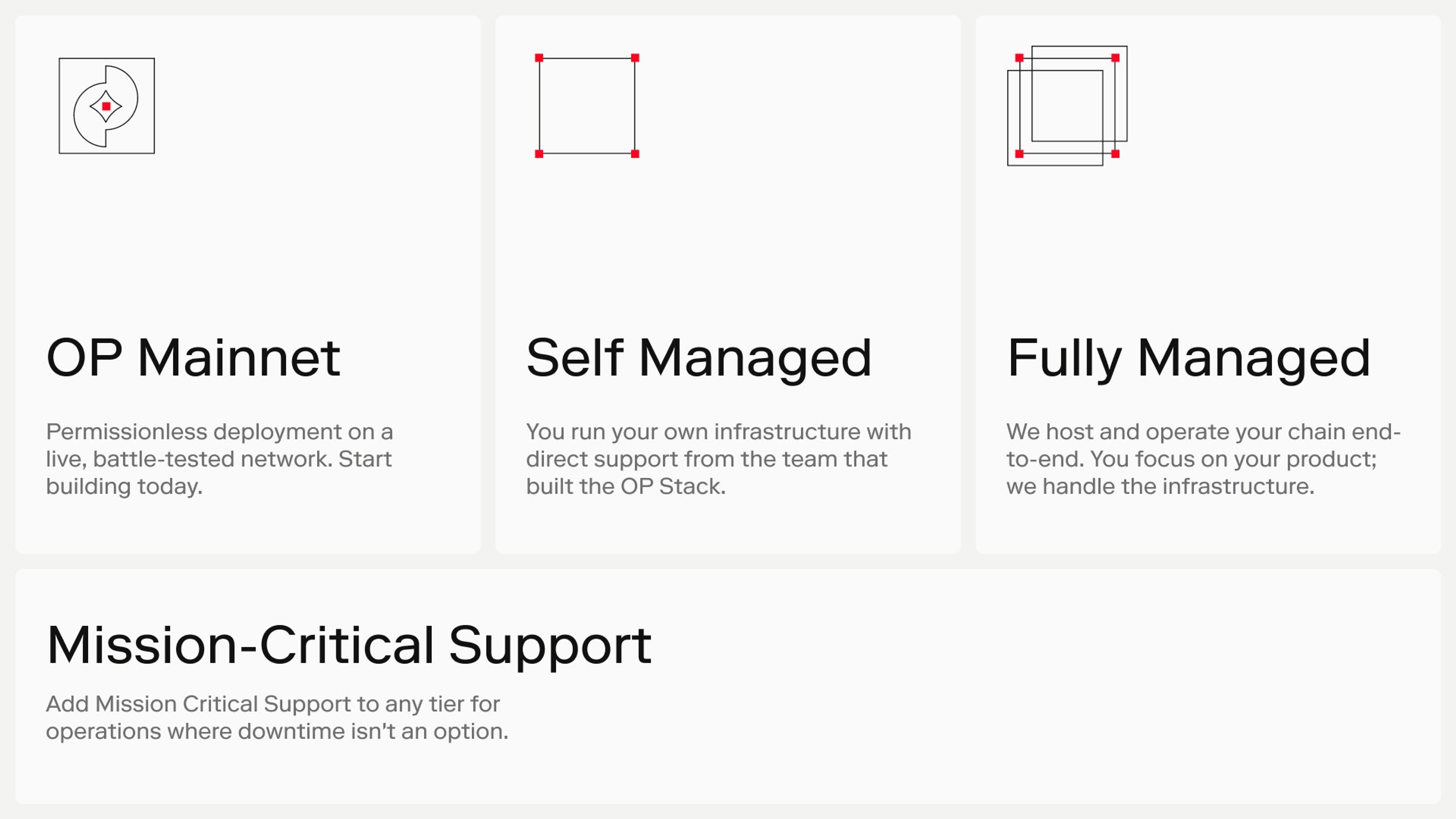
Deploy on OP Mainnet for immediate ecosystem access without dedicated infrastructure. Self Managed gives your team a dedicated chain and full sequencer control, and OP Enterprise handles the tooling. Fully Managed gives you the same dedicated chain and sequencer control without the infrastructure overhead. We run it end to end, and every decision on top of it is yours.
The chain you build is yours, including every upgrade decision, every sequencer policy, and every compliance rule. OP Enterprise provides the team and the infrastructure underneath it.
The Operational and Revenue Decision
MiCA is live. The US position on digital commodities and tokenized securities is changing. Institutional custody is no longer the blocker it was before 2025. Exchanges building their own chains in 2026 will be positioned when that volume arrives. The ones that wait will be running on someone else's infrastructure when it does.
Partners can go from signed contract to live chain in 8 to 12 weeks. Exchanges that build in-house typically spend 12 to 18 months before shipping a single user-facing product, plus $750K to $4.5M per year in ongoing costs and the dedicated team required to keep the stack running.
Exchanges keep choosing OP Stack over the fork-it-yourself path for the same reason: they don't want infrastructure to be the thing that fails them. What they want is to own the chain, controlling every sequencer policy, every compliance rule, and every upgrade decision, while the infrastructure stays someone else's problem to run.
At the time of publication, Base held approximately $4.5B in DeFi TVL. Ink crossed $480M inside its first year. That activity was going to happen somewhere. For Coinbase and Kraken, it happens on their chains. The question for every other exchange is where theirs goes.
Owning the chain means capturing it. That's what every exchange that becomes an OP Enterprise client decides, and more are making the same call every day.
Frequently Asked Questions
Why are centralized exchanges building OP Stack chains?
Centralized exchanges are building OP Stack chains to keep users, assets, applications, and revenue inside infrastructure they control. Instead of routing activity to another chain operator, they can add DeFi, payments, perps, tokenized assets, and other onchain products directly to their own product suite.
What operational advantages does an OP Stack chain give an exchange?
An OP Stack chain gives the exchange control over its sequencer policies, upgrades, infrastructure configuration, and product roadmap. OP Enterprise also offers self-managed and fully managed deployment models, so the exchange can retain chain control without taking on every infrastructure task.
How can an exchange enforce compliance on an OP Stack chain?
Optional compliance controls can screen transactions before they enter a block. An exchange can integrate an API-based compliance provider and apply address freezes, asset-level halts, incident buffers, chain halts, or bridge halts according to the controls it has chosen to enable.
How does owning a chain create revenue for an exchange?
Owning the chain lets the exchange capture sequencer economics and the revenue created by applications built on top. It also keeps users and assets inside the exchange's own ecosystem instead of sending that activity to another chain operator.
Does sequencer sovereignty involve decentralization tradeoffs?
Yes. Controls such as transaction screening, address freezes, and bridge halts are optional, and enabling them carries decentralization tradeoffs. Chains prioritizing maximum decentralization can opt out. Exchanges running regulated infrastructure may choose to enable them.
What is the difference between Self Managed and Fully Managed OP Enterprise?
Both products provide a dedicated chain and full sequencer control. With Self Managed, the exchange runs the chain while OP Enterprise handles the tooling. With Fully Managed, OP Enterprise operates the infrastructure end to end while the exchange retains the decisions made on top of it.
Authored by

Optimism