
- x402 turns the HTTP 402 status code into a payment request that software can answer without an account or API key.
- Fee size relative to payment size decides which chains make sense for small, frequent agent payments.
- Several chains can settle x402 payments, and support depends on the facilitator, so confirm current documentation.
Legal and regulatory requirements vary by jurisdiction and structure. This guide is informational. Consult your own legal and regulatory advisors.
What is an agentic payment?
An agentic payment is a payment that software makes on a person's or business's behalf, without a human approving each transaction. Agents pay for data, compute and APIs, usually in small amounts and at high frequency. Our research on agentic commerce has shown that roughly 71% of stablecoin transfer volume is driven by automated systems.
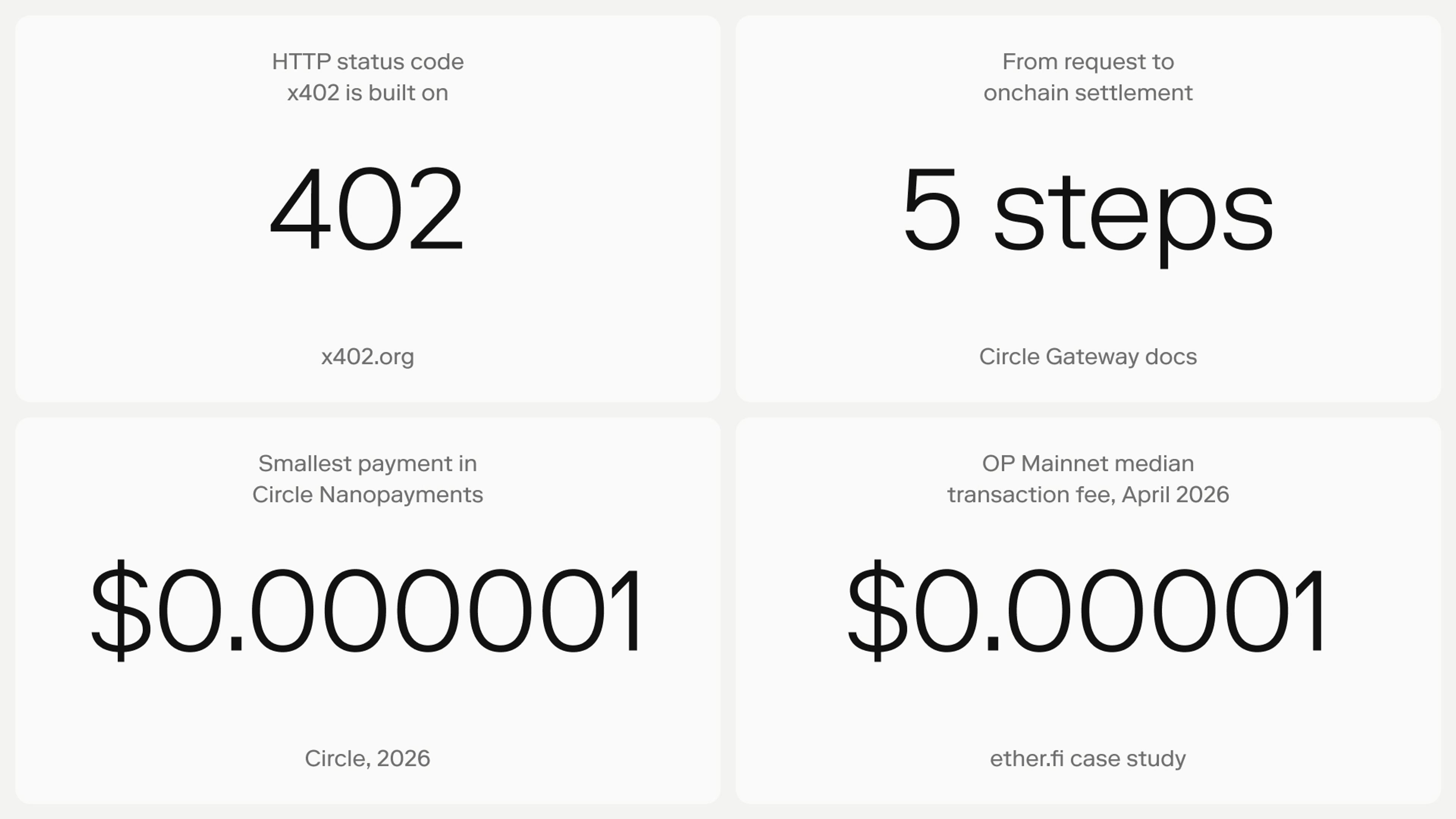
In words: x402 builds on HTTP status 402, a payment takes five steps, Circle supports payments as small as $0.000001, and ether.fi reported a median fee of $0.00001 on OP Mainnet in April 2026.
How does an AI agent pay with x402?
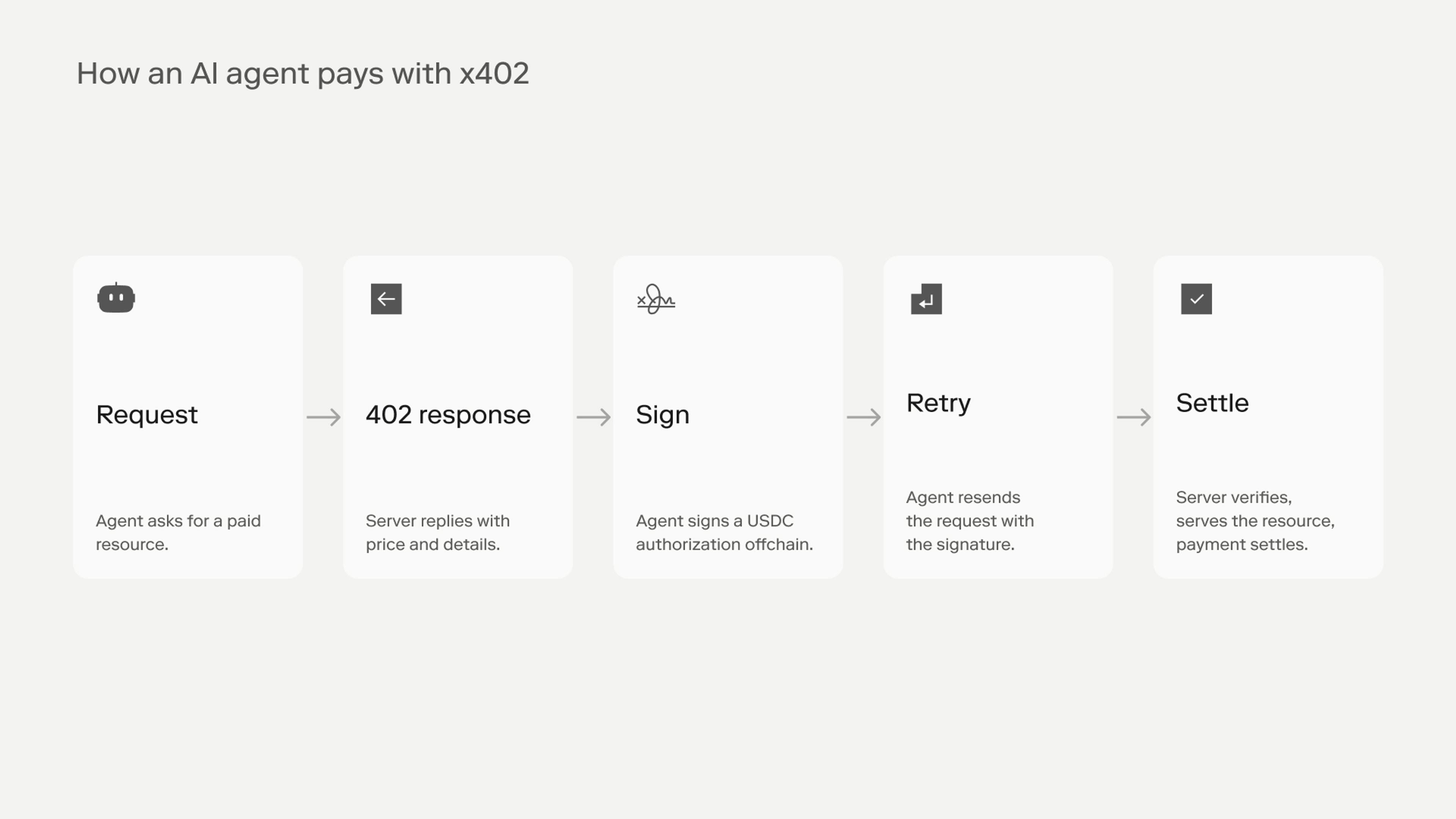
An agent pays with x402 in five steps. It requests a paid resource, the server replies with HTTP 402 and a price, the agent signs a USDC authorization offchain, it retries with that signature, and the server verifies it, returns the resource and settles the payment onchain. Sources: x402.org and the Circle Gateway Nanopayments documentation.
What does one payment look like end to end?
Take an illustrative $0.001 weather forecast. The agent deposits USDC once into a Gateway Wallet, asks for the forecast, receives a 402 with the price, signs an EIP-3009 authorization offchain, and retries. The seller verifies the signature and returns the forecast. Circle batches many authorizations and settles net positions onchain. The price and API here are examples.
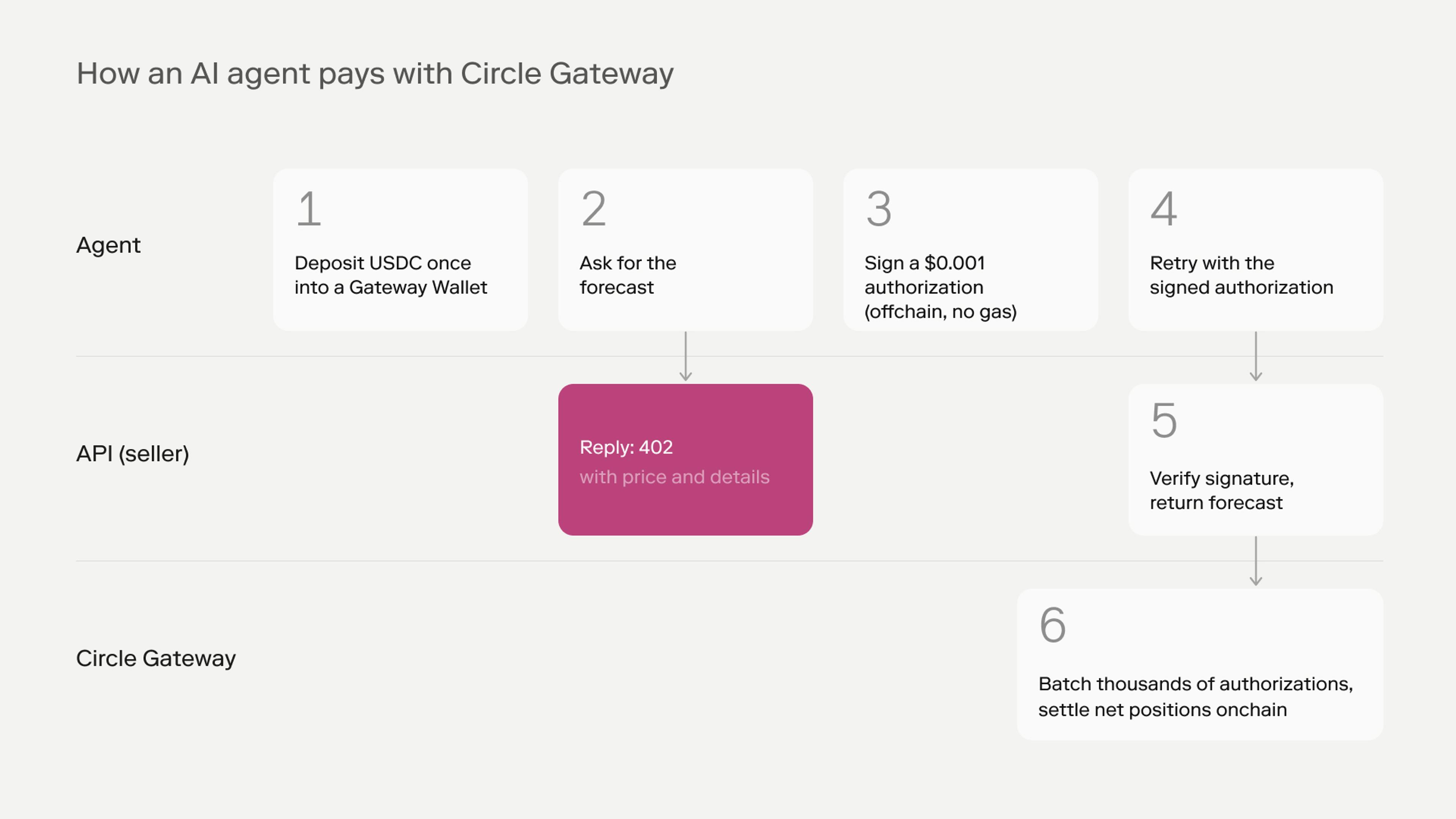
The agent pays no gas for each signature, because only the batched settlement touches the chain.
How is x402 different from API keys and subscriptions?
API keys and subscriptions require an account and a prior relationship. x402 puts the price in the response and lets the agent pay per request with a signed authorization. Olas described this shift for its Pearl agents on November 7, 2025.
| API keys and subscriptions | x402 payments | |
|---|---|---|
| Account | Sign up before first use | No account needed |
| Access | API key issued and managed | Signed payment with each request |
| Pricing | Plan or subscription tier | Price returned in the 402 response |
| Approval | Manual or contract based | Agent signs within its own limits |
| First use | Needs a prior relationship | Can try a service for one call |
Why does the chain matter for agent payments?
Settlement cost sets the floor on payment size. A fee that is larger than the payment makes small payments pointless, so agent payments favor chains with very low fees. Circle Nanopayments batches authorizations to support amounts down to $0.000001. ether.fi reported a median transaction fee of $0.00001 on OP Mainnet in April 2026 (case study). OP Mainnet streams Subblocks about every 200ms, which can give agents a preconfirmation. Every few minutes, that data is posted to Ethereum, after which the sequencer can no longer change or reorder it.
Which chains can settle x402 payments?
Several chains can settle x402 payments, and support depends on the facilitator or protocol in use. Other chains, including Base, also support x402 according to the open-source x402 repository on GitHub. Confirm current support in each project's documentation.
| Chain | How it relates to x402 | Source to confirm |
|---|---|---|
| OP Mainnet | Settles through facilitators such as Dexter, and through Circle Nanopayments | x402.dexter.cash, Circle documentation |
| World Chain | Supported by Circle Nanopayments and Dexter | Circle documentation |
| X Layer | OKX runs its own agent payments protocol (APP) here | OKX OnchainOS documentation |
| Celo | Stablecoin gas on its OP Stack network | Celo documentation |
| Other chains, such as Base | Support x402 | github.com/coinbase/x402 |
How do OKX and Celo run agent payments?
OKX built OnchainOS and its agent payments protocol on X Layer, and Celo lets users pay fees in stablecoins on its OP Stack network. Both are examples of a chain operator choosing which assets pay for gas and how blockspace is reserved.
A team that operates its own chain may consider sequencer policies and reserved blockspace for agent traffic. These are design options, and each one has trade-offs for cost and fairness.
What may you consider when choosing a chain?
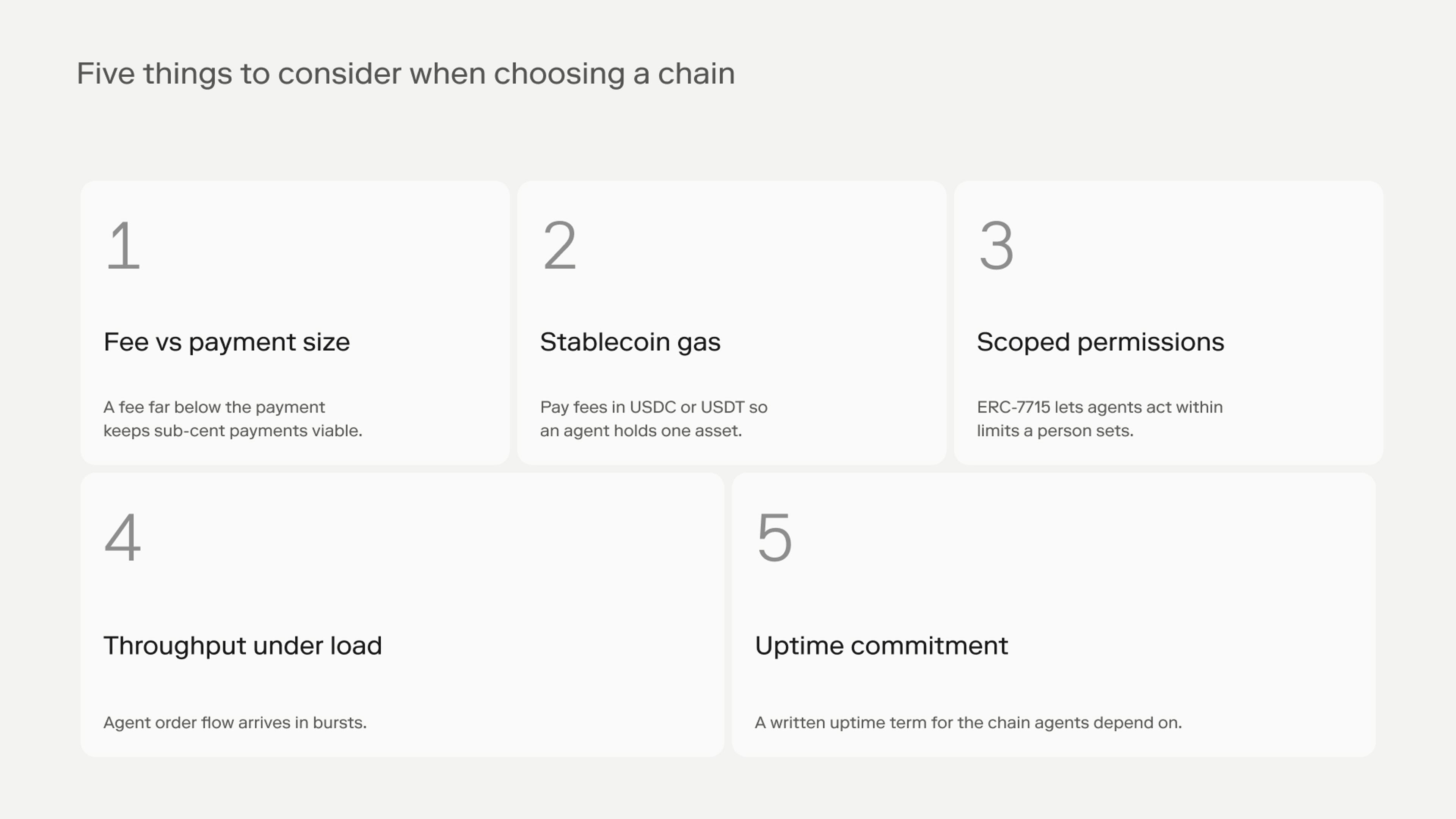
Teams often consider five things: how a chain's fee compares with the smallest payment, whether fees can be paid in a stablecoin, whether agent permissions can be scoped, how the chain handles bursts of agent traffic, and what uptime commitment applies. For OP Enterprise, the Fully Managed plan includes a 99.9% uptime SLA, and Self Managed includes 24/7 incident response with a one-hour SLA for critical issues (OP Enterprise SLA terms).
Frequently Asked Questions
What is x402?
x402 is an open standard that uses the HTTP 402 status code so a server can ask for payment before returning a resource. A client signs a stablecoin payment authorization, resends the request, and the payment settles onchain. It lets software pay for APIs and data without accounts or API keys.
Do AI agents need a crypto wallet?
In most x402 designs, yes. To sign a payment authorization, an agent needs a wallet or key it controls, usually holding USDC. Some designs deposit funds once into a managed balance, such as a Circle Gateway Wallet, so each later payment is a signature rather than a separate transaction.
Which chains can settle x402 payments?
Several. Facilitators such as Dexter support OP Mainnet, Circle Nanopayments supports OP Mainnet and World Chain, OKX runs its own agent payments protocol on X Layer, and other chains such as Base also support x402. Support depends on the facilitator, so confirm it against current documentation.
Why do fees matter for agent payments?
Settlement cost sets the floor on payment size. When a fee exceeds the payment, small payments stop making sense. ether.fi reported a median fee of $0.00001 on OP Mainnet in April 2026, and Circle Nanopayments supports payments as small as $0.000001 by batching authorizations.
Can a business run agent payments on its own chain?
Yes. A business can launch its own chain on the OP Stack through OP Enterprise, offered Self Managed or Fully Managed, and own that chain. Sequencer policies and reserved blockspace are among the controls a chain operator may consider. Whether that fits depends on volume and requirements.
Glossary
- x402: An open standard that uses the HTTP 402 status code to request payment for a resource.
- Agentic payment: A payment made by software acting on behalf of a person or business, without a human approving each transaction.
- Facilitator: A service that verifies a signed payment and settles it onchain for the seller. Dexter is an example.
- Payment authorization: A signed approval for a specific amount, created offchain and submitted with a request.
- EIP-3009: An Ethereum standard for transferring tokens with a signed authorization, so the sender signs and another party submits the transaction.
- Nanopayment: A payment of a fraction of a cent. Circle Nanopayments supports amounts down to $0.000001.
- Scoped agent permissions (ERC-7715): An Ethereum proposal that lets a person grant an agent limited, revocable permissions to act from their account.
- Stablecoin gas: Paying network fees in a stablecoin such as USDC instead of the chain's native token.
- OP Stack: Open-source software for building Ethereum Layer 2 chains.
- OP Mainnet: An Ethereum Layer 2 network built on the OP Stack.
- OP Enterprise: The Optimism Foundation's offering for businesses that want their own OP Stack chain, available Self Managed or Fully Managed.
- World Chain: An Ethereum Layer 2 network built on the OP Stack, supported by Circle Nanopayments.
- X Layer: OKX's Layer 2 network, where OKX runs its agent payments protocol.
- The Optimism Foundation and OP Labs: The Optimism Foundation is a steward for the Ethereum Layer 2 network, OP Mainnet, while OP Labs is the Foundation's primary subcontractor. OP Labs also provides the Foundation with business development and deal structuring support for its Layer 2 commercial offerings.
Related reading
- x402.org
- Circle Gateway Nanopayments documentation
- Optimism agentic commerce post
- ether.fi case study
- Olas, Pearl and x402 (November 7, 2025)
- Dexter x402 facilitator
- Optimism Docs: Subblocks
- ether.fi on Dune and Paymentscan
- github.com/coinbase/x402
This article is informational and is not legal, financial or investment advice. Third-party products and companies named here, including Circle, Olas, OKX, Celo, Dexter and ether.fi, are named for reference only, and their inclusion is not an endorsement.
Authored by

Optimism