
Best Rollup Frameworks for Launching an Ethereum L2
TL;DR: OP Stack, Arbitrum Orbit, Polygon CDK, and ZK Stack are the four frameworks handling most new Ethereum L2 launches in 2026. OP Stack leads production adoption, running 50+ chains and over 50% of L2 transaction volume.
Launching a dedicated Ethereum L2 means choosing a framework. That framework defines your security model, your data availability architecture, your smart contract environment, your sequencer economics, and your interoperability options. Getting it wrong is expensive to fix later.
Four frameworks handle the majority of new production chain deployments. This piece covers what each one does, where each is strong, and what the decision looks like for teams at different stages.
What Does a Rollup Framework Do?
A rollup framework is the software that handles everything below your application: ordering transactions, compressing batches, posting data to Ethereum, committing state, generating proofs, and running bridge contracts. It determines your proof type, settlement path, supported languages, sequencer economics, and available partner integrations.
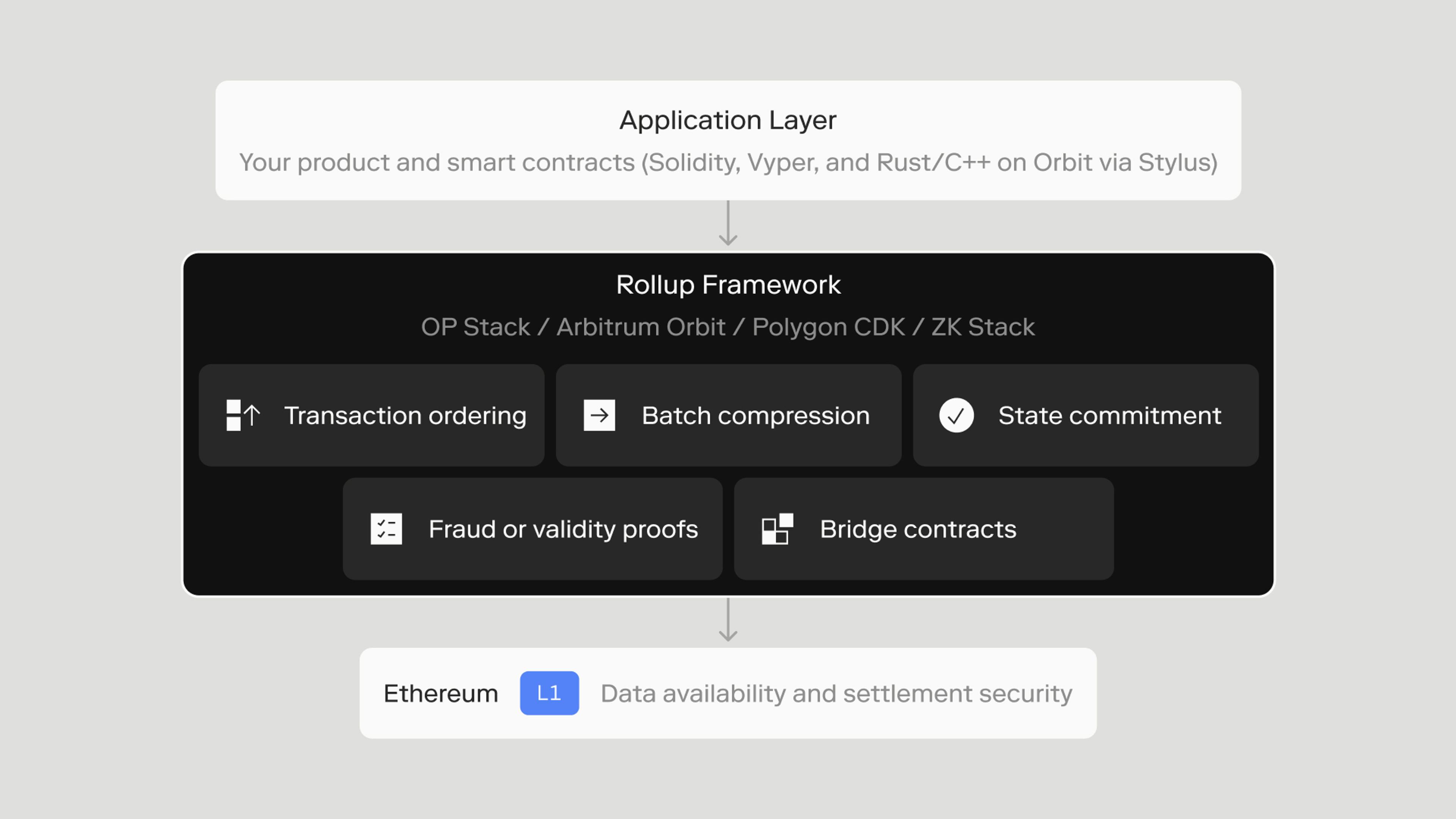
The framework decides:
- Whether the chain uses optimistic or ZK proofs
- Whether it settles directly to Ethereum or to another L2
- Which smart contract languages developers can use
- What the sequencer economics look like, and who captures the fees
Changing frameworks after launch is technically possible but operationally complex. Most teams treat the decision as permanent.
The Main Frameworks
OP Stack
OP Stack is the open-source framework built by OP Labs. It powers OP Mainnet, Base, Unichain, Sony Soneium, Kraken Ink, OKX X Layer, World, and more than 50 other production chains.
OP Stack uses optimistic rollups. Transactions are assumed valid by default, and anyone can challenge an incorrect state during a defined window through the permissionless fault proof system.
OP Stack chains have full EVM equivalence. Smart contracts written for Ethereum deploy without modification. The code is MIT-licensed with no fees to OP Labs.
More than 50 chains are in production on the OP Stack, together securing $16 billion in assets and processing 6 billion transactions in 2025.
OP Enterprise gives teams first-party managed operations:
- SLA-backed sequencer uptime
- Security monitoring
- Compliance tooling for regulated entities
- Access to Optimism's partner network of stablecoin issuers, oracles, bridges, and wallets
Partner integrations that typically take months compress to weeks through that network.
Arbitrum Orbit
Arbitrum Orbit is the chain deployment framework built on Arbitrum's Nitro stack. Orbit chains can settle to Ethereum mainnet, to Arbitrum One, or to Arbitrum Nova. The settlement target determines the cost structure and security guarantees: chains settling directly to Ethereum L1 pay no fees to Arbitrum, while chains settling to Arbitrum One or Nova pay a portion of fees to the Arbitrum DAO under governance-set terms.
Orbit chains support full EVM equivalence. They also support Stylus, which allows smart contracts written in Rust or C++ to run natively alongside Solidity and Vyper. Orbit includes an AnyTrust option that reduces posting costs by storing data with a trusted committee rather than posting all data to Ethereum directly, trading a more direct security path for lower operational costs.
Dozens of Orbit chains are in production. The framework's strongest deployment cluster is in gaming: Xai and Treasure Chain both launched on Orbit, and that ecosystem has meaningful network effects for teams building in that vertical. There is no first-party managed infrastructure equivalent to OP Enterprise. Teams that want managed operations work with third-party operators in the Arbitrum ecosystem.
Polygon CDK
Polygon Chain Development Kit is the ZK-based framework for launching chains with validity proofs. CDK chains generate a cryptographic proof of transaction validity with every batch, enabling near-instant finality and eliminating the 7-day challenge window of optimistic rollups.
CDK chains can settle to Ethereum directly or use Polygon's AggLayer, which aggregates validity proofs from multiple chains before posting to Ethereum. AggLayer settlement trades a more direct security path for lower data availability costs. EVM compatibility on CDK is close but not fully equivalent: some edge cases remain where Ethereum contracts require adjustments before deploying.
CDK powers Astar zkEVM and several other production chains. There is no first-party managed chain offering from Polygon.
ZK Stack
ZK Stack is zkSync's open-source framework for launching ZK-based chains. Like CDK, it uses validity proofs for near-instant finality. ZK Stack chains form a network that shares proof generation infrastructure, which reduces the individual cost of generating proofs at scale.
ZK Stack uses a custom EVM-compatible execution environment. Full Ethereum contract compatibility is close but not complete, with some edge cases where behavior differs from standard EVM. Production deployments are limited as of 2026. The codebase is active and the framework is production-capable, but adoption is earlier-stage than OP Stack or Arbitrum Orbit. There is no first-party managed chain offering from zkSync.
Framework Comparison
| OP Stack | Arbitrum Orbit | Polygon CDK | ZK Stack | |
|---|---|---|---|---|
| Proof type | Optimistic (fault proofs) | Optimistic or AnyTrust | ZK validity proofs | ZK validity proofs |
| Settlement | Ethereum L1 | Ethereum L1, Arbitrum One, or Nova | Ethereum L1 or AggLayer | Ethereum L1 |
| EVM compatibility | Full equivalence | Full equivalence + Stylus | Near-full; edge cases remain | Near-full; edge cases remain |
| Smart contract languages | Solidity, Vyper | Solidity, Vyper, Rust, C++ | Solidity, Vyper | Solidity, Vyper |
| Finality | 20-30 min after submission to Ethereum block | 7-day challenge window | Near-instant | Near-instant |
| Framework fees | None | None (L1); DAO fees for Arbitrum One/Nova | None | None |
| Production deployments | 50+ | Dozens | Several | Limited |
| L2 volume share | 55%+ | Smaller share | Small share | Early-stage |
| Managed infrastructure | OP Enterprise (first-party) | Third-party operators | None | None |
| Interoperability roadmap | Native interop in development | Cross-chain via Arbitrum bridge | AggLayer proof aggregation | Shared proving network |
What the Production Data Shows
Transaction volume is the clearest signal the market has produced. OP Stack chains handled more than 70% of all L2 activity in 2025. Arbitrum Orbit, Polygon CDK, and ZK Stack together account for most of the rest, with Orbit the largest among them. ZK Stack is earlier-stage.
Production scale matters for a specific reason: framework problems surface at volume. Sequencer edge cases, batcher cost optimization, fault proof behavior under real transaction loads, and partner integration gaps all appear in live production environments that test deployments cannot replicate. A framework running 50+ chains and 6 billion transactions has a different error surface than one with a handful of deployments.
This is not a knock on ZK frameworks as a category. Arbitrum One, zkSync Era, and Starknet are all live, high-volume networks. The frameworks for deploying new chains on those architectures - Orbit, Polygon CDK, ZK Stack - vary significantly in how much track record they carry from chain deployments specifically.
Which Rollup Framework Should You Choose?
For most teams, OP Stack is the practical default. The production proof is the clearest in the market, first-party managed infrastructure is available from the team that built the framework, and the interoperability roadmap has no equivalent among the alternatives.
Glossary
| Term | Definition |
|---|---|
| Optimistic rollup | A rollup that assumes transactions are valid by default and allows a challenge period for anyone to dispute an incorrect state. |
| ZK (validity) rollup | A rollup that generates a cryptographic proof of transaction validity with every batch, removing the need for a challenge period. |
| Fault proof | The mechanism an optimistic rollup uses to let anyone challenge and correct an invalid state during the challenge window. |
| Sequencer | The component that orders and batches transactions before they're posted to the settlement layer. |
| Batcher | The component that compresses and posts batched transaction data to Ethereum. |
| Data availability (DA) | Where transaction data is stored so anyone can verify or reconstruct chain state. |
| Challenge window | The period during which a fault proof can be submitted to dispute an optimistic rollup's state (commonly 7 days). |
| EVM equivalence | Full compatibility with Ethereum's execution environment, so existing smart contracts deploy without modification. |
| AggLayer | Polygon's proof-aggregation layer that combines validity proofs from multiple CDK chains before posting to Ethereum. |
| Stylus | Arbitrum Orbit's execution environment extension that lets Rust and C++ smart contracts run alongside Solidity and Vyper. |
| AnyTrust | An Arbitrum Orbit data availability option that stores data with a trusted committee instead of posting it all to Ethereum, lowering cost. |
Frequently Asked Questions
Can I migrate from one framework to another after launch?
Migration is technically possible but complex. OP Stack and Arbitrum Orbit both use full EVM equivalence, so smart contract code ports without modification. The complexity sits at the infrastructure layer: data availability configuration, sequencer architecture, and bridge contracts all require changes. Most teams that launch on a framework stay on it.
Does the choice of framework affect which tokens I can use on my chain?
Not directly. Standard ERC-20 tokens work on any EVM-compatible chain. Native stablecoin integrations, like Circle CCTP for USDC, require separate agreements with issuers and apply equally across frameworks. The difference is speed: OP Enterprise includes access to Optimism's existing partner relationships, which shortens the integration timeline compared to negotiating independently.
Does using OP Stack mean being part of the Optimism ecosystem?
The OP Stack is MIT-licensed and operates independently of Optimism's governance or ecosystem programs. Using the framework doesn't require participation in any Optimism governance structure.
What is OP Enterprise?
OP Enterprise is Optimism’s managed chain service for organizations that want to run on the OP Stack without owning the full infrastructure operations. Three tiers cover a range of operating models, from fully managed SaaS to self-operated with OP Labs support.
Authored by

Optimism